Showing posts with label free rider problem. Show all posts

Sunday, October 23

Spotify: Either Upgrade, Or Cheat Artists?

Image result for spotify user


I love music and I love free things (who doesn’t?), so, naturally, I was thrilled when I discovered how to stream music online.  I always had a sinking suspicion, though, that artists aren’t getting paid enough for their work, so I did a bit of investigation into the ways companies like Spotify, Pandora, YouTube, Apple Music, Tidal, Deezer, and Amazon Prime Music work – and, disappointingly, it turns out that my enthusiasm for free streaming is indeed not shared by the artists who get me through Public Choice readings and workouts at the gym.  As a specific example, Spotify calculates their pro-rata payments to artists this way:

Monthly per-stream rate =  

So it follows that as the number of streams increases, while gross revenue remains relatively constant, artists are getting paid less and less for their work the more that people – even good, Premium-paying people – click on those “Your Favorite Coffeeshop” and “Weekend Feels” playlists, leading to disparities between revenue and per-stream royalties as shown in this graph:    

overall_streaming_comparison

It is a classic Free Rider Problem: I value accessible music as a good that bestows group benefits, but as long as everyone else pays for it so that I can keep streaming cost-free, I’m going to do just that.  46% of respondents to the 2015 Nielson Music 360 Report said that their reason for not subscribing to a streaming platform is because it was too expensive, and 42% stated that they could simply find ways to stream for free elsewhere.  How to solve this issue?  Perhaps Tiebout could contribute through a little preference revelation.

Digital Music News suggests  that the homogeneity of the freemium model – in which you can easily stream music for free, but hopefully will become addicted enough to pay for music without ads –accounts for a lot of loss in terms of revenue for both these companies and for the artists.  The current crisis in music streaming – artists getting paid a measly fraction of the pro-rata monthly rate per stream, thus being severely underpaid for their work – could perhaps be solved by an exercise in preference revelation.  What if, instead of these being your choices:

  1. Be a free rider and listen to any music you want with occasional ads.
  2. Cough up $9.99/month for full, unlimited Premium access without ads or offline data usage (when I say “Premium-like access” later on, these are the qualities I mean to reference.  I know there is a student rate, but since most of us won't be students for much longer, I left this option out).

These were your choices? 

  1. Be a free rider and listen to any music you want with occasional ads, but with lesser sound quality.
  2. Pay $0.99/month for music with better sound quality and occasional ads.  
  3. Pay $1.99/month for Premium-like access to only one genre of music.
  4. Pay $1.99/month for Premium-like access to only 10 artists.
  5. Pay $3.99/month for Premium-like access to 3 genres of music.
  6. Pay 3.99/month for Premium-like access to 40 artists.
  7. Pay $5.99/month for Premium-like access to 100 artists. 
  8. Pay $9.99/month for full Premium access.

These are just examples I hazarded guesses at, but it’s clear that consumers of music, when offered these choices, could more easily subscribe to whatever subscription tier (AKA “community revenue-expenditure pattern,” to quote Tiebout) best suits their personal preferences.  Revenue would increase through a surge in low-level subscribers, (theoretically) enabling the companies to dole out more money to the artists themselves.  I know I personally would choose option F above, because while I listen all the time and am willing to pay for ad-free music, I only listen to about 30 artists consistently – so this plan would be the perfect solution.  It’s not by any means an end-all, fix-all, but it could certainly be a good start to ridding the music industry of nasty, selfish, rational free riders like myself. 

Sunday, October 16

Wikipedia: Every Student's Free Friend


No one likes a free rider. We think of free riders as these lazy people who will do anything to avoid contributing to group benefits, like that one guy you had in a group project in high school that just happened to be “sick” the night before it was due but promised he would contribute by looking over the rest of the group’s work to make sure it looked good. Gruber says that if "an investment has a personal cost but a common benefit, individuals will underinvest", meaning there are too many free riders for these situations. But is it always the case there are too many?

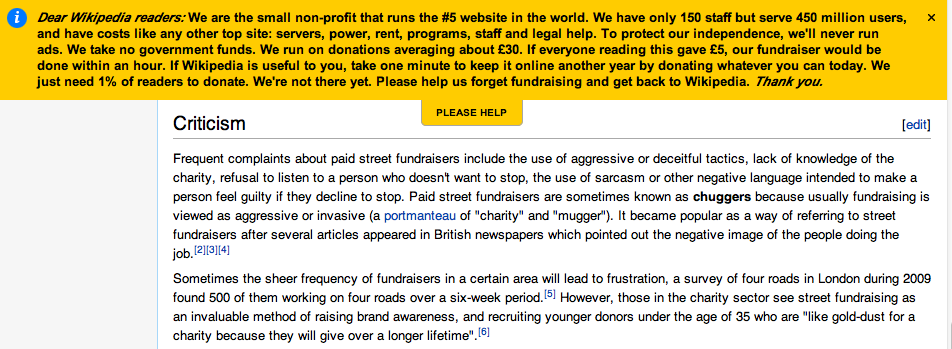
 I thought long and hard if I would ever sink to that level, and then I realized, I do it every week and most of us do too! How? We use Wikipedia.  Every year, while we’re doing research for papers for our classes or looking up a definition for a word, we see that big yellow banner like caution tape cover the top half of our screen, asking for donations in order to survive. 


Without advertising for revenue, it makes sense to plead with everyone that they will shut down if we don’t donate, right? Wrong. As it turns out, last year Wikipedia was hoping for $25 million in donations to survive, but ended up receiving $75 million, 1.5x the site’s annual expenses. They are raking it in, more and more each year. The craziest part about this is that Wikipedia page views have gone down by 5.4 billion (18.3 to 12.9 billion) from 2013-2015 and yet had an increase in the number of donations by almost double (2.5 to 4.9 million donations). Clearly, as poor college students, it is rational to take advantage of the kindness of others and continue to not pay for great Wikipedia resources on our future projects and papers.  To me, this can be viewed as one of the few times that there aren’t enough free riders for a good that gives non-rivalrous group benefits, even if they only need 1% of readers to donate. 

Your Free Ride Just Tilted

A tilt for my IM Soccer team (Blood Bath & Beyond)

In class, we discussed the free rider problem as being a limitation to the Coase Theorem. People are reluctant to contribute to the payment for goods that bestow group benefits. I started thinking about this last week when my intramural soccer team (Blood Bath & Beyond) used Tilt to pay the registration fee for the fall season. Crowdfunding sites, such as Tilt, reduce the free rider problem by making it feasible to charge all of the members of a group no matter how large it is. The crowdfunding service acts as an umpire, requiring a critical mass to contribute before the good is provided and before any money changes hands.

Online crowdfunding platforms make it easier for the private market to lead to an allocatively efficient distribution of resources. For a group to eliminate the free rider problem altogether, just make the minimum number of payers equal to the size of the group- that way everybody shares the cost, and you minimize the cost per person. 

The catch here is that it requires unanimity. If one person in the community doesn’t want to pay for the good, then the good will not be provided. This could potentially lead to high decision-making costs. The time it takes for everyone to make their contribution and for the event to Tilt will tend to increase with the size of the group, just as we saw in Buchanan & Tullock chapter 6, "A Generalized Theory of Constitutions."


Sunday, November 16

Benefactor problem in grocery shopping

Being the only person with a car in a 4-people apartment can be a problem--especially if your primary reason for getting that car is to go grocery shopping. Before you know it, you've become the "parent" of the household, providing shared food and supplies for everybody at the cost of your own time (and maybe even gas money, if it's not factored into the share). Sooner or later, you've become the person who knows best of everybody's preferences of cheese, fruits and veggies, and that gives all the more reason for you to be doing the groceries and not anyone else. What's worse, the free-riders (aka all your "kids" in the house) always devour the foods before you know it, leaving you with about 1/8 the consumption but paying more than 1/4 of the cost.
In this case, it doesn't seem all that "voluntary" for the benefactor to be the benefactor, because the one person who owns a car is compelled by various circumstantial reasons to provide the public goods. The others don't have easy access to the goods, and thus it would be at higher private cost for them to provide it. Plus, they have plenty of incentives to be rationally ignorant about it--they don't want to know what to get according to everybody's preferences, because they don't want to be the one doing the runs. It's not rational for the driver to take all of them with him/her to the groceries either, because that would just result in extra cost of time for everybody. Therefore, although Olsen argues that for a small group to work there often is a voluntary benefactor, in the case of grocery shopping it works because the benefactor was forced.

Saturday, October 11

Because You Know I'm All About That Bass


   “We all use this room and could benefit from a sweet set of speakers and if we all just pitched in we can make it happen by this weekend!” Donation requested of each brother: $10. Number of brothers: 64. Cost of speakers: $450. The economic rationale as to why many of us didn’t pay: priceless.

   The brothers argued that everyone should help pay for speakers for their upstairs room by defining them as a public good, as people could benefit from 500 Watt  sound in a non-rival and non-excludable way. Despite many flaws and assumptions in this opinion, such as the fact that we all couldn’t fit in the room to enjoy the music and we have different music preferences, our main problem became reluctance to pay – we were all free riders at heart.

   I thought to myself, “Why would I pay $10 for speakers that, even if they were non-rival and non-excludable, if enough other brothers covered the cost, I could enjoy the music for free?” Essentially, many of us were reluctant to incur a private cost for a public benefit that really was not all that public. But the eager brother did not back down. He used creative and humorous tactics such as email threads displaying names of donors and how much they had paid (perhaps it would have been more effective to display who had not paid), and, perhaps the most effective tactic, the hilarious in person encounter and demand for action on the spot. Many brothers conceded, either to see their name on the “good list” over email or to not be “the cheap guy who didn’t pay just ten bucks.”


   But we knew that he wanted the speakers badly enough to raise money some way or another, and some of us are now benefiting from the brand new speakers free of charge.  However, I think I am currently more than paying my fair share for them by way of their negative consumption externality – the speakers rest right above my room and on nearly any given night the speakers shake my room until 2 AM.

Sunday, September 21

Yelp Me- I Have Free Riders!


Internet property rights can be tricky. In a recent article  published by the Wall Street Journal, small business owners took Yelp, an online review site, to court for "economic extortion." The business owners claimed that Yelp was removing any positive reviews from their website if said business-owners did not pay for the Yelp service. In the business owners' view, the Yelp reviews pertain to their businesses and therefore they should have the rights to what people say about them on Yelp. Here is a classic case where the non-exclusive nature of public goods can pose problems.


The judge ruled that firstly the business owners could not prove that Yelp was extorting them; Yelp denies that accusation and that's another issue. Secondly but more importantly, Judge Berzon ruled that Yelp has the right to "seek payment for the service offered." Technically these small businesses are free riders if indeed Yelp's reviews hinge on payments. They are not able to be excluded from seeing Yelp's website, yet they are not paying for the benefits it may bestow. The judge said:
“By withholding the benefit of these positive reviews... Yelp is withholding a benefit that Yelp makes possible and maintains. It has no obligation to do so, however.” Harnessing the logic of Ronald Coase, it would not matter who was liable for the damages; as long as property rights are defined, bargaining can take place and the efficient market allocation would lead to the party valuing the good the most gaining possession of it through the transaction. In this case, therefore, small businesses will pay Yelp (if they believe postings are based on payments) if their benefit of positive reviews is greater than or equal to the subscription fee. Yelp is just doing their part to clean out the free riders.


Saturday, September 20

3 AM Economics


You know you are starting to think like an economist when your annoying neighbor wakes you up at 3 AM on a Wednesday and you immediately think: EXTERNALITIES! My neighbor from the floor below mine has this very particular loud laugh that he loves to show off at very early morning hours. He definitely does not take into consideration the external costs it has to the rest of the people in our building who are trying to get some quality sleep.

So on the third day that I was woken up by this individual, I asked myself: What would Ronald Coase do? He would argue that I do not really need to talk to the building office to make this guy stop because it does not even matter who is the liable party in this situation, the guy and the rest of us could still get the allocative efficient output of his laugh by reaching a mutual agreement. All the neighbors could get together, go to his apartment, and reach a solution.  

However, there are some problems with Ronald's proposition. For example, not all the tenants bear damage in equal amounts, maybe some of use are light sleepers while others sleep more profoundly; my roommate has been woken up more times than I have and she has less tolerance than I do, so she is being more affected. Also, if we all agree to take the time and go to his apartment, some people might free-ride and benefit from our talk without paying the cost of time foregone and probably being hated by the guy.

By weighing my costs and benefits, I decided that there is so many people affected by this negative externality that in the near future, there will be someone so annoyed by his laugh that he or she will do something, so I will be a free-rider and wait for someone else (probably my roommate) to take action.   

Friday, September 19

Duck Weed: Scourge of the Neighborhood

My family home is nestled on a lake with 19 other homes. The lake was like a perfect little Eden, with limpid, beautiful water. Then one day, the duckweed hit. The nasty, green goop covered absolutely everything in the lake, and the classic free rider problem reared its ugly head. Because the twenty households that live on the lake cannot exclude one another, and one household's utility derived from viewing a clean lake certainly cannot diminish any other household's utility from viewing the same thing, the view of a clean lake can be considered a public good among the households.

Not a putting green, but a duckweed-ravaged lake.

There are several ways to get rid of, or at least control, duckweed, but they all involve some sort of cost to implement. One neighbor got an assessment and reported that putting in fountains to break up the duckweed would have cost about $44,000. There would be four fountains, and each would cost $11,000. Each one would get rid of some duckweed, but all four would get rid of all of it. The remedy would require one household to make a personal investment to bestow a common benefit, leading to the classic free-rider problem. If one of the neighbors really hated the goo and decided to install any or all of the fountains, it would be entirely infeasible to exclude the other 19 households from looking at the beautiful, clear, green-sludge free lake.

The clear lake would bring about a positive consumption externality because one household's consumption of the clearer or totally clear lake (through its own provision of the fountain(s) ), would benefit all of the other households that did not contribute any money for the cost. However, no household has yet to install any fountain because the tendency is for underproduction of positive consumption externalities. For simplicity's sake, assume each household derived about the same private marginal benefit from the good provided by each fountain installation (around $1,000 for the private marginal benefit of cleared lake from each fountain). Collectively, then, a totally clear lake (all four fountains were installed) would be worth $80,000 ($4,000 x 20 households), meaning the social benefit exceeds the total cost. However, in all cases the private marginal benefit ($1,000) remains under the private marginal cost ($11,000), leading to "underproduction," or in fact no production, of the clear lake. Furthermore, our neighborhood suffers from a Hatfield and McCoy-like feud (an interesting, but unrelated story), increasing transaction costs and rendering a Coasian solution impossible.

So where does that leave me? Staring at a green lake, cursing the dismal science for its logic.

Group Meals and the Free Rider Problem

Some of my fondest memories growing up involve time spent sharing food with friends and family, whether it be poolside cookouts with neighbors and friends or potluck dinners to celebrate achievements as a Boy Scout troop or Athletic team.  I really enjoy making various different potluck recipes with my family to bring to these occasions.  Until recently, I could never quite put my finger on what it was that made some of these "group meals" better than others.  By considering the economic arguments made by Buchanan about public goods we can shed some light on this discrepancy between the "good" and the "great" in terms of a potluck dinner.

 At such an event, the food is the public good being consumed.  As we defined in class, a public good must be both non-excludable and non-rivalrous in consumption.  For example, in the case of an end of season potluck dinner for my high school cross country team, the food is non-excludable to those athletes and their immediate families who are part of the team.  No one invited to the potluck will be denied access to the food.  Next, I need to enlist the help of Buchanan in order to explain how the food at a potluck dinner is non-rivalrous. Normally food is considered a private good because, for example, my consumption of a pie prevents anyone else from eating it.  However, Buchanan argues that few goods are purely public or purely private because essentially everything has a degree of "publicness" to it (i.e. the pie can be divided and shared.)  Therefore everyone invited to the potluck gets to share in the consumption of the public good.

Like any public good, potluck dinners exhibit the Free Rider Problem where someone benefits from the consumption without paying the costs of that benefit.  A rational individual planning on attending this dinner would  have an incentive not to bring anything because they would still be able to enjoy a "free" meal.  There's always that one guy who brings a bag of Tostitos for the group to share and then helps himself to everyone else's more substantial contributions.  Because a group is coming together to bear the costs of a public good there is a diffusion of responsibility to equally contribute, thereby causing incentives to free ride.

Wednesday, September 10

Throwing Things At The Trashcan: The Economics of Fraternity Cleanin


I was seeking to give advice to a friend with roommate issues and came across some helpful tips (especially #8-9) that reminded me of a problem my fraternity is currently facing. This is our story.

            Our house is filthy and our guests say we should clean it, but economics says we shouldn’t. Without a formal cleaning system in place, the individual rooms reflect the lifestyles of their inhabitants while the hallways and common spaces are just gross. We clean our own rooms because we reap all the benefits of the efforts we put into it. But why wipe down the bathroom sink or mop the floor when it’s not just your mess and someone who didn’t clean at all will enjoy the benefit as well?
            We can attribute our filth to free riders because the brothers rarely clean spaces that are used by everyone. Essentially, we underinvest when we face a private cost (time and effort cleaning) for a commonly shared benefit (a cleaner house). It is easy to do because there are no penalties in place for not cleaning. It is also hard to tell who is and isn’t cleaning, and we don’t bother searching for those skipping out because the time it would take to find them and get them to work would outweigh their output anyway.
            It was different last year in my apartment with just 4 roommates because when ¾ of us cleaned, it put more pressure on the lazy person to step up and clean, plus it was easy to see when he wasn’t working. It also made cleaning dramatically faster when the fourth person chipped in, by 33% in fact assuming equal cleaning productivity. However, in a larger fraternity house with 25 residents, it is much harder to tell who isn’t cleaning and individual output is so small relative to that of the rest of the house that it seems like skipping out doesn’t really make a difference. In other words, the lazy member’s non-contribution has a smaller effect and is harder to detect when the number of roommates is larger.
          Our president has tried to offer incentives for cleaning, such as demerit reduction for those in bad standing, but this strategy actually backfires on brothers who don’t have any demerits at all and therefore don’t receive the benefits from the incentives whatsoever. We need to either seek more individualized rewards or sanctions and implement formal cleaning assignments, have a group incentive so each brother feels responsible to the others, or raise dues to hire a cleaning service. Until then, we will be jumping over pizza boxes on the way to the shower and throwing things in the general direction of the trashcan.

Sunday, September 29

Celebrity Tax Evasion

Although many regular citizens evade taxes every year, it's much more interesting when celebrities do it. In "10 Celebrity Tax Evaders", Garth Sundem explains the cases of well-know people ignoring their taxes, or just plain refusing to pay them (the Leona Helmsley part is particularly amusing). Tax evasion is a form of the free rider problem that Gruber describes as a problem with the Coasian solution. He states that "when an investment has a personal cost but a common benefit, individuals will underinvest", leaving the externality or externalities unresolved (Gruber 127). These taxes represent a cost to these celebrities. Even though they have millions of dollars, they do not pay their share because the common benefit (roads, highways, national defense, etc) is available to everyone.

This also ties in with the role of the government as a policing agency. It strives to ensure everyone follows the laws it sets forth. The IRS is the agency that pursues and convicts tax evaders. Typically, evaders have to pay the full amount of their taxes owed, plus an addendum, and serve jail time. Due to the enforcement of these laws, there is a high cost to evading taxes which deters many from this crime, but not everyone (I guess their marginal benefit is greater than their marginal cost in this situation - maybe they like the attention from the media or their cozy jail cells).

Monday, November 5

Pirates and the FRP


For the first time in years, there's good news from the Horn of Africa. Pirate attacks in the "treacherous waters" near Somalia are down from 222 last year to just 46 this year - a nearly 80% drop. The U.S. Navy attributes the decrease in part to "aggressive patrolling by international forces," specifically an international counterpiracy team called Combined Task Force 151 (CTF 151).

Security in the waters surrounding the Horn is a public good; the area is an important shipping route for dozens of nations. And since most attacks occur in international waters, no one nation is liable for the security of the region. The nations with shipping interests in the area thus form an interest group that must overcome the Free Rider Problem to achieve success.

"Blast...they've overcome the F 'arrr' P!"
Olson arrrgues in “A Theory of Groups and Organizations” that groups of unequal “size” provide public goods more effectively, because the “large” member’s interest in the good often outweighs their reluctance to incur costs for group benefits (the FRP). CTF 151 is such a group; though command of the multinational force rotates, the U.S. Navy provides most of its military resources. The group has been successful because the U.S. (still by farrr the largest national economy) has a sizeable interest in protecting this vital shipping route. 

Saturday, October 30

NATO, the United States, and Underprovision

This Time Magazine article of 1956 discusses one of the most powerful groups of the twentieth century: NATO. As Olson notes, a defining characteristic of a group is the shared interest of its members. In the case of NATO, all member nations shared in common a desire for protection against the threat of a Soviet invasion of Western Europe. However, defense against the Communist threat was a public good, so member nations had an incentive to free ride.

Olson discusses how, even in the absence of organization, a public good will often be provided if there is a dominant group member. Being the most powerful nation of the group in military, political and economic terms, the United States stood to lose perhaps the most in the event of a Communist dominated Western Europe. The loss of military bases, allies, and trading partners in Western Europe would strike a huge blow to American power and wealth. In the case of NATO, the U.S. may be considered the dominant group member; the value to the U.S. is a high proportion of the total group. Additionally, NATO membership consisted entirely of sovereign nations, making it very difficult to enforce contributions. Assuming the U.S. was the dominant member of the group, Olson’s model predicts that the U.S. would incur a great amount of the costs of the public good of defense, while other group members largely free ride. This is largely what we see in the provision of NATO.

Furthermore, the U.S. general heading NATO makes a compelling case that the level of NATO defense provision is below the optimal level for its members, and this is exactly what Olson’s model predicts.

Friday, October 22

Tea Party Political Action

The subtitle of this article gets to the heart of the biggest question facing the Tea Party: "Can a decentralized social movement be organized enough to get out the vote?" At first glance, this seems like a sure challenge. Olson argues that large groups won’t be able to organize as well as small groups, and the Tea Party certainly contains a large number of people across the country. In order to have success, a large number of people sharing in the Tea Party’s beliefs must volunteer time, money, and effort to supporting candidates and policies. With such a large group spread throughout the country, why would any members find it worthwhile to put forth this effort?

Ben Adler’s article on the Tea Party’s grassroots social networking movement shows some unique qualities of this group that point to the answer to this question. The Tea Party started with a number of “outraged conservative activists” who weren’t capable of having much of an individual impact who came together with one another as like-minded individuals. As Olson explains, most groups struggle to organize people with one common interest to accomplish a common goal when that goal may run contrary to their individual interests. However, it seems that in this particular case, being a member of the group (e.g. having the Tea Party’s interests) involves an inherent interest in being politically active – so while most groups struggle to get members to contribute to political activity, this very activity itself is what brings Tea Partiers together in a way that makes them more effective but also brings personal benefits. For example, the article states that “the social experience of political activism remains central for many Tea Partiers.” Certainly this is unique – I doubt most union members would say they are in it for the social experience of paying membership dues.

The Tea Party’s goal isn’t a specific piece of legislation or candidate’s election (with the national group not even supporting particular candidates); it is extreme conservative political action in and of itself. Since each member feels a powerful urge to contribute for their own gain, it appears that the free rider problem, normally such a powerful barrier to success for large groups, doesn’t really exist here.

Sunday, October 17

The McRib Rent Seeking Problem

'Bona Fide Fans Chase Rib-Free Rib Sandwich' is a The Wall Street Journal article that talks about big McDonalds fans that drive around the country chasing the McRib. This sandwich made its debut in 1981 but soon after was taken off the menu. Nowadays, the sandwich will randomly be offered in different places but customers go far ways to seek the benefits of this sandwich.

"The McRib actually has nothing to do with ribs. It's a boneless pork patty molded into the shape of a rib slab and adorned with pickles, onions and barbecue sauce on a bun. The sandwich made its debut in 1981. But McRibs are almost never available at all McDonald's restaurants at the same time. Instead, the Oak Brook, Ill., company offers them in different cities at different times, rarely for longer than a few weeks."

In class we talked about how rent seeking is concerned about the reallocation of resources. This article is a perfect example of such reallocation by customers. McDonald's fans are willing to "drive up to 10 hours after hearing that a McDonalds there was selling the sandwich". People waste their valuable time (just think of opportunity costs), put themselves at risk (probability of getting in a car accident), incur unnecessary costs (money for gas), and also cause more harm to the environment than otherwise (global warming). Too bad that this simple sandwich, the McRib, can change people's behavior in such a way that resources are reallocated (inefficiently).

Climate Change... Not Much Change

One of the hottest topics in politics, both in the United States and globally, has been the topic of global warming. This older article was written just before the nations of the world went to Copenhagen, Denmark to discuss what must be done about climate change. The author of the article also mentioned his believe that the Denmark conference wouldn’t have much more of an impact on the issue of climate change as that of an earlier conference in Kyoto, which was set up a few years earlier to discuss the same problem. In the article he says,

“Copenhagen will be no more successful than was Kyoto. The reason: China. Last year China surpassed the U.S. in producing carbon dioxide, even though China's overall economy is still about one-third the size of ours. By 2020 China's emissions will be twice those of the U.S. Beijing is not about to stop its headlong economic growth in the name of fighting global warming.”

The reason China will not stop its “headlong economic growth” is because it has not incentive to do so due to the free rider problem. In this case, the global environment and climate is the public good, because it is a non-excludable good that is non-rivalrous in consumption.
To reduce global warming, the large number of countries liable for the damages to Earth that causes global warming would have to agree to reduce their production of pollution. However, since there is a large number of those liable for global warming there is an incentive to free ride on the problem; thus like the author says the problem is China, because they are free riding on the rest of the world’s agreement to reduce their pollution, while China continues to pollute at a greater rate. In this instance, China will reap the benefits of the other countries’ agreement to reduce pollution, which they hope will reduce global warming and allow everyone, including China, to live in a cleaner/safer world, all while bearing none of the economic burden that other countries are incurring from reducing their emissions of pollution.

The big question isn't who is to blame but what needs to happen for China to get on board with the rest of the world in their efforts to reduce climate change?