No one likes a free rider. We think of free riders as these
lazy people who will do anything to avoid contributing to group benefits, like
that one guy you had in a group project in high school that just happened to be
“sick” the night before it was due but promised he would contribute by looking
over the rest of the group’s work to make sure it looked good. Gruber says that if "an investment has a personal cost but a common benefit, individuals will underinvest", meaning there are too many free riders for these situations. But is it always the case there are too many?
I thought long
and hard if I would ever sink to that level, and then I realized, I do it every
week and most of us do too! How? We use Wikipedia. Every year, while we’re doing research for
papers for our classes or looking up a definition for a word, we see that big
yellow banner like caution tape cover the top half of our screen, asking for
donations in order to survive.
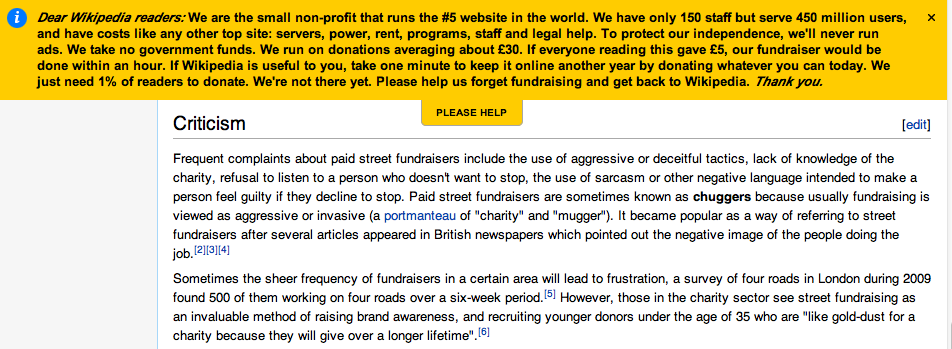
Without advertising for revenue, it makes sense
to plead with everyone that they will shut down if we don’t donate, right?
Wrong. As it turns out, last year Wikipedia was hoping for $25 million in
donations to survive, but ended up receiving $75 million, 1.5x the site’s
annual expenses. They are raking it in, more and more each year. The craziest
part about this is that Wikipedia page views have gone down by 5.4 billion (18.3 to 12.9 billion) from 2013-2015 and yet had an increase in the number of
donations by almost double (2.5 to 4.9 million donations). Clearly, as poor
college students, it is rational to take advantage of the kindness of others
and continue to not pay for great Wikipedia resources on our future projects
and papers. To me, this can be viewed as
one of the few times that there aren’t enough free riders for a good that gives
non-rivalrous group benefits, even if they only need 1% of readers to donate.

