Wednesday, November 9

Rent Seeking in the Presidential Election?

If you look at the time stamp on this post, you will see that I wrote it out during the conclusion to the Presidential election. My thought process was what better way to take my mind of an incredibly contentious and heated election season than talking about rent seeking! Or specifically, can we view presidential runs as rent seeking? CBS estimated that the mudslinging contest between Trump and Clinton cost roughly 2.65 BILLION dollars. That amount is actually a little smaller than the all-time high of 2.76 BILLLION in the 2012 race between Romney and Obama. So was all of this campaign money really just a form of rent dissipation, or is it something entirely different?

In a simple sense, perhaps this can be viewed as rent seeking behavior. We can see Donald Trump and Hillary Clinton both competing for a government contract. That contract is the title of President, and it does come with a small salary (roughly 400,000 dollars a year or 109,000 dollars less than President Sullivan’s salary). But the position seems to be more then just the money. Since only one of the candidates can win, the winner would get to act in a sort of monopolistic role exercising all the powers that the President is allotted. They use their rent seeking resources to essentially lobby the American people into choosing them. The market they operate within could potentially be a simple demand and supply market with the demand is the policies desired by the population and the supply is the policies set by whomever the President is (with their monopolistic power giving them the ability to better set their own agenda then if in a different political position).

However, this potential model can be complicated by the fact that we really only associate rent seeking with private firms, and rent isn’t usually the ability to set a policy window, but rather the ability to generate economic profit. Additionally, the rent seeking behavior firms exhibit tend to be geared towards using their own resources instead of the resources a candidate generally borrows/takes from others (as one does in a campaign). Perhaps this would require us to then integrate some of the ideas toward collective action that we see in Olson’s theory as to determine when someone would contribute.

As such, while political campaigns are definitely their own animal with their own nuances, there does appear to be some similarities to the rent seeking behavior we see in private firms and collective action. Perhaps there is the potential to expand these models in a way that will bring presidential campaigns into the fold as their own form of rent seeking.    
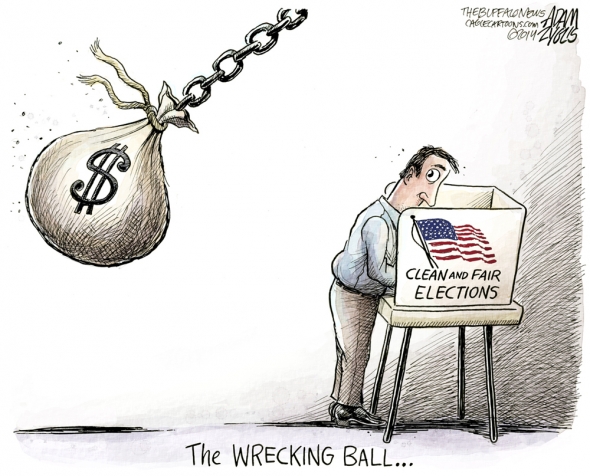

Image result for money in politics

Monday, November 7

Will You Be Rational Tomorrow?

In NPR’s article, “Social Science Says: Go Vote!,” psychology professor Tania Lombrozo explains how voting can actually be rational, unlike the claims made by Johnson in the excerpt titled “Voting, Rational Abstention and Rational Ignorance.”

Lombrozo acknowledges the costs associated with voting and the small probability of making a difference to the outcome (p), however she introduces a proposed clarification to the value of “p” in the marginal benefit calculation. Lombrozo claims that although the probability of deciding a vote is small, the outcome of the election could “have non-trivial consequences for a very, very large number of people.” Therefore the expected value of the vote should be calculated in terms of the small probability of deciding the vote AND the large consequences that deciding the election could involve.

Along with also acknowledging the variable we termed “D” as the expressive value that constitutes the “experience of voting – the sticker, the comradery, the civic engagement, the personal involvement as the vote counts come in,” Lombrozo also mentions the regret that will accompany not voting, as we discussed in class regarding the minimax regret matrix. Additionally, she adds the psychological analysis that “people also tend to regret missed experiences more than missed opportunities” which would account for why voting can be perceived as rational, to choose actions today to minimize regret in the future. This must be the reason for the below Facebook post and as to why this particular individual values the expected benefit of voting as equivalent value to a “black barbour jacket,” a license, a debit card and “some cash in the pockets.”


For Ted Cruz, Virtue Does Command So High a Price

I get it, most of you probably aren’t the biggest Ted Cruz fans. But humor me for two minutes (or however long it takes you to read this blog post) as I try to convince you that Cruz showed some Stiglerian “virtue” during this presidential election cycle.

In class last week, we discussed Stigler’s idea of a market for legislation in which industries can “buy” regulation. A transaction in this market involves an industry receiving “a grant of power from the state” (Stigler 10) in exchange for the votes and resources of that industry. Stigler argues, however, that the costs to society resulting from such a transaction outweigh the benefits received by the industry. Why, then, does this transaction occur? According to Stigler, it comes down to the chief motivation of elected representatives: winning re-election. Representatives generally don’t vote against regulatory policies that injure the society because if they do, they face fierce opposition to their re-election bids from the industries that benefit from such policies. Stigler puts it best: “If the representative denies ten large industries their special subsidies of money or governmental power, they will dedicate themselves to the election of a more complaisant successor: the stakes are that important” (Stigler 11).  In Stigler’s view, opposing “Big Industry” is political suicide for the representative, even if it is the right thing to do.


When we discussed this theory in class, I immediately thought of a National Review article that discussed Ted Cruz’s opposition to ethanol subsidies in the lead-up to the Iowa Caucuses. Indeed, the parallels to Stigler are abundant. Because Iowa is a heavy-corn state and has a large ethanol industry, presidential candidates from both parties have always balked at taking a stand against ethanol subsidies as they campaigned in the state. However, Cruz (and Rand Paul, for that matter) did just that. Specifically, Cruz supported a phased repeal of the Renewable Fuel Standard (RFS), which “mandates that all gas sold in the U.S. include a certain percentage of biofuels such as ethanol.” (We talked about this some in class.) According to the article, the federal mandate has cost consumers at least $10 billion since 2007, which supports Stigler’s argument regarding regulations that damage society. Moreover, as Stigler’s theory predicts, Cruz’s opposition to the RFS provoked the ire of Iowa’s ethanol industry. For example, the industry-funded America’s Renewable Future, run in Iowa by Governor Terry Branstad’s son, paid 17 staffers to run anti-Cruz ads and generally “trash” Cruz in the state.

What makes all of this particularly interesting is that Cruz ended up winning the Iowa Caucus, despite the heavy opposition from the ethanol industry. In the National Review article, Club for Growth head David McIntosh said something of a then-potential Cruz victory in Iowa that seemed to offer a counterexample to Stigler’s theory: “Our politics will be cleaner and less pandering once people can see the subsidies can be opposed and that opposing them isn’t politically fatal [emphasis added].” Certainly, the Cruz/Iowa counterexample has its flaws, but the fact remains that Cruz took on “King Corn” and ethanol in Iowa – which most political observers thought was political suicide – and won. Given Stigler’s rather bleak depiction of elected representatives and industry regulation, I think this little story provides some reason to be optimistic, even if you dislike Ted Cruz.

Sunday, November 6

Efficacy of Agricultural Regulation in the EU

Over the past several weeks, we have learned about rent seeking, i.e. how a company or organization can seek additional economic gain without actually providing value in return to consumers/society in general. We also discussed regulatory actions taken by the government can drive up the prices they can charge, while creating deadweight losses. To better understand this concept, I found a topical example of rent seeking.

A study conducted by the Institute of Economic Affairs, a European policy think tank, claims that the EU's many agricultural regulations are burdensome to farmers and consumers alike. They claim that the EU made a mistake in allowing lobbyists from non-farming interest groups to pressure them into instituting higher agricutral standards in regards to the environment and animal welfare. The report cites the "regulatory capture" by the aforementioned as a significant problem for the EU's Common Agricultural Policy, as their influence has increased costs while only marginally increasing safety benefits to consumers, if at all. For example, the report discusses how requiring farmers to grow all foods organically would increase the cost of growing wheat by 70% while lowering yields to half of what they were before. Yields of potato crops would decrease by 44% and prices would go up 200%. Of course, if eating organic food was significantly better for you than consuming traditionally grown crops, then there may not be deadweight loss to society from this requirement, as as such safety regulations would increase social marginal benefit overall. However, research has shown that organic produce has not been yet linked to being more nutritionally beneficial or less receptive to contamination from bacteria such as E-coli. Therefore, despite my dedication to Whole Foods and millennial views towards buying organic, I admit that this report raised good points and certainly reinforced the lessons of regulation we learned recently in class.


Save Echo Farms and Stop Overdevelopment!

During a recent phone conversation, my grandmother was describing an issue that has arisen over the last few months where she lives in Wilmington, North Carolina. Wilmington is a small coastal city in southeastern North Carolina with a population of 112,000. However, the serene and scenic beach town has an expected population growth rate of 56% over the next 25 years, but only about 13% of space is available for development.

One specific example of this growth in development is a plan to build 675 new homes in the community of Echo Farms within Wilmington, where my grandmother plays tennis. The residential community that already includes thousands of homes sits on a golf course, with private yards directly adjacent to the shared greenspace. The developers are proposing to eliminate the golf course, taking away the greenspace that is a common good for all residents, while also adding major construction that will lead to noise, pollution, and safety concerns for years.
When I heard about this, I immediately thought of the Tiebout reading from back in September. According to Tiebout, the residents chose to live in this particular neighborhood because of its revenue-expenditure pattern including the greenspace, golf course, serene neighborhood, and low-density population. All of this will be lost with the new development. For this analysis, I am assuming that residents must remain in Wilmington due to job constraints, thus there should be an equilibrium within the communities in Wilmington.

Although Tiebout theory says the current residents will then just move to another community with their ideal revenue-expenditure pattern, the assumption that residents are perfectly mobile (even within Wilmington) does not hold in this case due to the nature of the problem. Even disregarding the costs of moving, the property values of the current homes will plummet since the demand to live in this formerly tranquil neighborhood has decreased with the announcement of the new development. The people buying the new houses will have a different ideal bundle of public goods that equates to the new development, but the current residents are essentially stuck. 


Further, even if they were able to sell their homes to people who preferred less greenspace and construction, there are few areas within Wilmington that aren’t being developed and would be an affordable “haven”. If the Echo Farms Golf Course is developed, the Echo Farms community will be no different than many other developed subdivisions within Wilmington. Thus, the overall increased development of Wilmington limits residents’ ability to choose their residential community based on revenue-expenditure patterns and keeps Wilmington from attaining equilibrium in Tiebout’s theory.

SaveSave

PLEASE Regulate Me

As Stigler taught us, it is rational for some firms to seek government regulation as a resource to be acquired because regulation will allow them to capture additional rents that would have been foregone without regulation.  We discussed an example in class of a railroad oligopoly that argued if the regulated price were lowered that it would force them to cut costs and the public would suffer.  This argument by the railroad firms is that it is in the "public interest" for the price regulation to remain high.  Whether or not this would benefit the public, we all know those firms are just trying to make more money, not just act for the interests of the public.

In an article about chemical manufacturing companies, another example of incentive to seek government regulation is displayed.  These chemical manufacturing companies are pushing the EPA and Congress for more regulations on certain chemicals in order to attain more rents.  Some large department stores like Macy's and even Target have stopped selling certain products because of health and environment risk claims made by activist groups.  These chemical manufacturing firms have concluded that additional regulations will result in more testing and more clarity on the true extent of any danger to certain chemicals.  They claim that under normal exposure there us no risks for these things.  It is assumed that with stricter regulations, department stores like Macy's and Target will sell products with some of the chemicals in them because the vetting process for chemicals will be much stricter and they can feel safer selling these products.  In the eyes of the chemical manufacturing firms there are rents to be collected here! Because of these rents, the firms have been lobbying congress for these regulations on their chemicals and for the vetting to be done.