Showing posts with label Gruber. Show all posts

Sunday, October 16

Wikipedia: Every Student's Free Friend


No one likes a free rider. We think of free riders as these lazy people who will do anything to avoid contributing to group benefits, like that one guy you had in a group project in high school that just happened to be “sick” the night before it was due but promised he would contribute by looking over the rest of the group’s work to make sure it looked good. Gruber says that if "an investment has a personal cost but a common benefit, individuals will underinvest", meaning there are too many free riders for these situations. But is it always the case there are too many?

 I thought long and hard if I would ever sink to that level, and then I realized, I do it every week and most of us do too! How? We use Wikipedia.  Every year, while we’re doing research for papers for our classes or looking up a definition for a word, we see that big yellow banner like caution tape cover the top half of our screen, asking for donations in order to survive. 
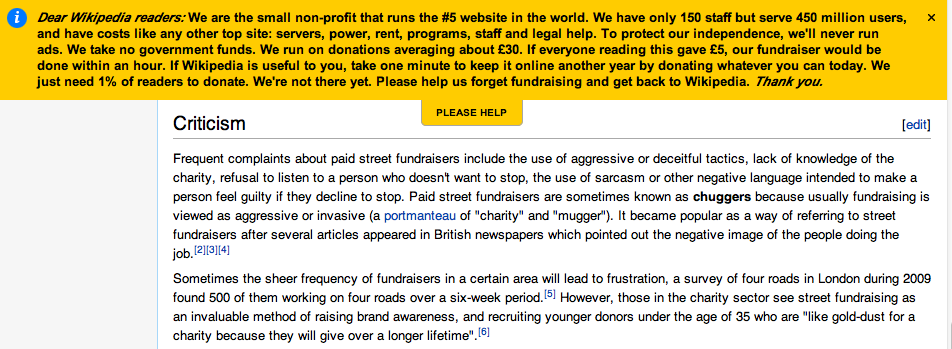

Without advertising for revenue, it makes sense to plead with everyone that they will shut down if we don’t donate, right? Wrong. As it turns out, last year Wikipedia was hoping for $25 million in donations to survive, but ended up receiving $75 million, 1.5x the site’s annual expenses. They are raking it in, more and more each year. The craziest part about this is that Wikipedia page views have gone down by 5.4 billion (18.3 to 12.9 billion) from 2013-2015 and yet had an increase in the number of donations by almost double (2.5 to 4.9 million donations). Clearly, as poor college students, it is rational to take advantage of the kindness of others and continue to not pay for great Wikipedia resources on our future projects and papers.  To me, this can be viewed as one of the few times that there aren’t enough free riders for a good that gives non-rivalrous group benefits, even if they only need 1% of readers to donate. 

Saturday, September 27

The Negative Externalities of Running a Red Light

Saudi Arabian roads are some of the most dangerous in the world. One study reported that an average of 19 road fatalities occur daily in the country.  The government of Jeddah, the second largest city in the nation, recently increased the penalties of running a red light to help solve the problem. Those caught running a red light must pay a fine and spend 24 hours in jail. In the past, offenders only had to pay a fine.

One can use the externalities framework presented in Gruber Chapter 5 to explain the motivation behind this new policy. There are negative externalities associated with running a red light. For those who run a red light, the private marginal benefit of getting to the destination quickly exceeds the marginal cost of exposing his or herself to additional risk. One could argue that this externality leads the market to under provide drivers who adhere to stoplights in Jeddah. The local government views this as a reason to intervene. The policy makers increased the marginal cost of running a red light with the new mandatory jail sentence. In economic terms,  the new law makes the private marginal cost of running a red light more accurately reflect the social marginal cost of running a red light. The aim of this intervention is to decrease the number of drivers who run red lights.


Sunday, September 29

Celebrity Tax Evasion

Although many regular citizens evade taxes every year, it's much more interesting when celebrities do it. In "10 Celebrity Tax Evaders", Garth Sundem explains the cases of well-know people ignoring their taxes, or just plain refusing to pay them (the Leona Helmsley part is particularly amusing). Tax evasion is a form of the free rider problem that Gruber describes as a problem with the Coasian solution. He states that "when an investment has a personal cost but a common benefit, individuals will underinvest", leaving the externality or externalities unresolved (Gruber 127). These taxes represent a cost to these celebrities. Even though they have millions of dollars, they do not pay their share because the common benefit (roads, highways, national defense, etc) is available to everyone.

This also ties in with the role of the government as a policing agency. It strives to ensure everyone follows the laws it sets forth. The IRS is the agency that pursues and convicts tax evaders. Typically, evaders have to pay the full amount of their taxes owed, plus an addendum, and serve jail time. Due to the enforcement of these laws, there is a high cost to evading taxes which deters many from this crime, but not everyone (I guess their marginal benefit is greater than their marginal cost in this situation - maybe they like the attention from the media or their cozy jail cells).