 |
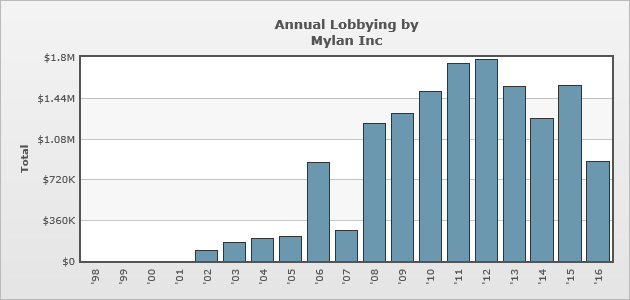
Source: https://www.opensecrets.org/lobby
Among many other several successful lobbying efforts, Mylan lobbied lawmakers to make epinephrine autoinjectors a necessity in schools. These efforts were supposedly to provide quick solutions to allergic reactions in general, agnostic of what the solution may be. However, further lobbying by Mylan included seeking federal legislation that provided subsidies to schools for the purchase of EpiPens, given that these schools do not buy epinephrine autoinjectors from any other vendors. Due to Mylan's years of lobbying and lavish PR/marketing, they had established themselves as the only player in the market, inevitably making them the only vendor in schools.
With the help of the FDA, Mylan also lobbied to recommend the best treatment as 2 dosages instead of one, so now EpiPens are only sold in twin-packs. The monopolization of the epinephrine autoinjectors would not have been possible without the alliance between Mylan and governmental agencies. Also, can we examine the millions of dollars wasted to attain this rent?
|
Sunday, October 29
What rings a bell - epinephrine autoinjectors or EpiPen?
Pharmaceutical manufacturer, Mylan, has quite notably generated a monopoly around epinephrine autoinjectors, which releases epinephrine to stop a severe allergic reaction. Mylan's product, the EpiPen, has risen from less than $100 in 2007 to over $600 in 2017 (an over 400% price hike!) How is the company able to continue increasing its price without losing customers and market share? It's because of Mylan's lobbying efforts and close relationship with government mandates, fueling extremely high entry barriers, price and dosage changes, and restrictions on generic/brand name products.


Monday, October 23
Amazon HQ 2
Amazon has begun plans on establishing a
second headquarters equal to their Seattle Headquarters, in some city, in the
US. Amazon says it will invest $5 billion in the construction of their HQ 2 and
house 50,000 Amazon employees in the future. They have already received 238proposals, including bids from 7 cities in Canada and 3 in Mexico. Amazon has created a desirable prize for cities across the country and internationally that are looking to
benefit from the influx in economic growth that this will certainly bring.

All of these cities are rent seeking this
prize, using resources to incentivize Amazon to pick their city and in turn
diverting those resources that could be used to provide for their respective
communities. The company has even stated “Incentives offered by the
state/province and local communities to offset initial capital outlay and
ongoing operational costs will be significant factors in the decision-making
process.” The problem arises when the cities that don’t get the prize will have
lost all of the resources expended on the incentives for Amazon.
Sunday, October 22
Uber's Attempts to Ride the Gravy Train
The taxi market has always been engaged in the practice of rent-seeking, as groups lobby city commission boards for a medallion - which equates to access to the rent in the monopolistic market created due to these government licensing restrictions. Not only does lack of competition hurt consumers, who would pay higher than competitive market fares, but the expenditure on attempting to obtain a license - the bribes - are an allocatively inefficient use of resources. They are the costs associated with rent-seeking. When Uber arrived on the scene, it seemed to be to the benefit of the consumer. It provided a welcome alternative to taxis, undercutting the monopoly. Of course its entry brought about an increase in rent-seeking or "rent-protecting" behavior by taxi cabs who were threatened by the competition. But Uber, was spending its opposing lobbying money in ways that would seem to be socially positive: helping consumers by increasing competition. (One might argue that lobbying is in itself an inefficient use of resources, but the blame would be on the government for providing the barriers that Uber is being forced to lobby against.) It was decreasing the rent available, and increasing consumer surplus.
In the first half of 2017 Uber is the top lobbying spender in New York, attempting to decrease market regulations in upstate New York. Open markets seem to be a socially positive outcome such that it would be hard to call Uber's actions rent-seeking. However, reports also state that once Uber has planted itself into a locality, it has tried lobbying for regulations that hurt present & future competitors (Lyft etc.). While the money spent here would be considered rent-seeking, what about previous lobbying efforts? If Uber were to establish the monopoly they seek, this would be at a detriment to consumers. If the loss of consumer surplus was equal/higher than when taxis ruled, would all of the lobbying done by Uber up to this point be considered rent-seeking? In the short-term, early lobbying would seem to have led to socially positive outcomes, but what happens if in the long-run the outcome becomes negative? If Uber's goal was always to open up competition only to decrease it and establish their own monopoly, effectively all of their actions would be for the purposes of securing a transfer of rent from taxis. Most seem to think that Uber will fail to secure a monopoly, meaning this question is moot. But in a hypothetical world with a more socially negative outcome, how much of Uber's lobbying efforts would constitute rent-seeking?
In the first half of 2017 Uber is the top lobbying spender in New York, attempting to decrease market regulations in upstate New York. Open markets seem to be a socially positive outcome such that it would be hard to call Uber's actions rent-seeking. However, reports also state that once Uber has planted itself into a locality, it has tried lobbying for regulations that hurt present & future competitors (Lyft etc.). While the money spent here would be considered rent-seeking, what about previous lobbying efforts? If Uber were to establish the monopoly they seek, this would be at a detriment to consumers. If the loss of consumer surplus was equal/higher than when taxis ruled, would all of the lobbying done by Uber up to this point be considered rent-seeking? In the short-term, early lobbying would seem to have led to socially positive outcomes, but what happens if in the long-run the outcome becomes negative? If Uber's goal was always to open up competition only to decrease it and establish their own monopoly, effectively all of their actions would be for the purposes of securing a transfer of rent from taxis. Most seem to think that Uber will fail to secure a monopoly, meaning this question is moot. But in a hypothetical world with a more socially negative outcome, how much of Uber's lobbying efforts would constitute rent-seeking?
D factor
We know for a fact that it is irrational for people to vote on any kind of election since the expected benefit from
voting is really small compared to the cost that will be incurred. Yet, there
are still people who decide to vote instead. The more people who abstain from
elections, the greater the effect an individual vote can have and hence the
greater the incentive to vote. But this decrease cannot possibly account for a
significant increase in the expected benefit that will exceed the cost. So, the
D factor is put into play where D represents social pressure people are getting
for not voting. The new equation is now E[B]+D>MC in order for people to
vote.
College Football: Hoos ranked? Not us.
“In any ranking system, perfection or consensus is not
possible”
However, there are a host of polls that try their best to
get as close to “perfect” as possible. The
AP (Associated Press) Poll, which is released weekly during football season,
names the Top 25 teams in the nation and is a good indicator of potential
post-season matchups. It is created by a
panel of 60 sports reporters who cast votes using a Borda Count method. They vote on which teams they believe are the
best in the nation and rank them accordingly.
For every first place vote a team receives, the earn 25 points. For every second place vote, 24 points, and
so on—a classic Borda count voting procedure in action. The Coaches’ Poll works in the same way,
except the panel is made up of head football coaches from FBS schools.
Before Saturday’s game against Boston College gave all of us
a reality check, there was this tiny grain of hope in me that maybe this year
we could break into the Top 25 of the College Football AP Poll. Last week, UVA received 10 points in the AP
Poll (29th in the nation) and 42 points in the Coaches’ Poll (28th
in the nation). But, following our 41-10
loss on Saturday, we would have been lucky to see even one this week.

This picture was under the headline "BC Hands UVA a Beatdown" #ouch #hoosrising
Wednesday, October 18
Bills, Pills, and Lobbying
The United States of America is in the midst of a massive opioid crisis that continues to gain momentum annually. Last year however, Congress passed a law that lessened the Drug Enforcement Administration's power in regards to controlling the opioid problem, a seemingly odd move considering the seriousness of the issue. Investigations recently found that representatives who supported the laws had a strong incentive to do so, even though it does not align with the country's best interests: drug distributors contributed more than $1.5 million dollars to the sponsors of the bill's campaigns. The Washington Post disclosed "the drug industry spend $102 million lobbying Congress on the bill" according to lobbying reports. This is a very clear example of rent seeking behavior performed by the pharmaceutical companies, because resources ($102 million) were spent in order to obtain rents (more profit from opioids) which derive from some activity that has negative social value.

Additionally, this situation contains another public choice principal we learned this semester. A look at the breakdown of lobbying reports by organization reveals multiple free riders. The massive contributions of the top two organizations, which total $73.3 million, were a major factor in the bill passing, and therefore benefitted all of the subsequent parties in the drug and pharmaceutical industry, regardless of how much the other companies spent on lobbying.

Additionally, this situation contains another public choice principal we learned this semester. A look at the breakdown of lobbying reports by organization reveals multiple free riders. The massive contributions of the top two organizations, which total $73.3 million, were a major factor in the bill passing, and therefore benefitted all of the subsequent parties in the drug and pharmaceutical industry, regardless of how much the other companies spent on lobbying.
Tuesday, October 17
Occupational licensing and rents
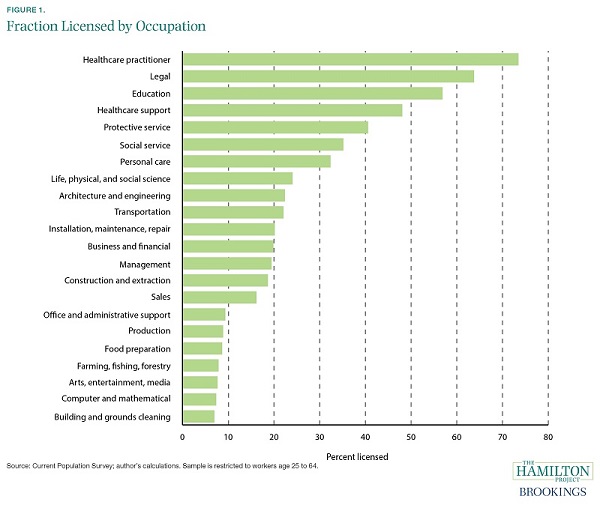
Occupational licensing -- government regulations requiring an individual to obtain a license, and often undergo training and pay a fee, before taking up an occupation -- have existed in the US for decades. This affects occupations including but not limited to barbers, cosmetologists, doctors, lawyers, and florists. Ilona Holland provides a great example of its impact: After deciding that she wanted to start a massage therapy business in Nebraska, she discovered she'd need to accumulate 1,000 hours of training to meet the state's licensing requirements. Here, occupational licensing's impacts are apparent: it creates an artificial entry barrier which limits the field of workers in an industry, thus reducing competition and potentially increasing salaries of workers already in the industry.
This directly ties in to the topic of rents: the raised barrier of entry created by occupational licensing creates rents for the protected workers. With these rents comes a great incentive to rent-seek. If workers in an industry can come together and lobby the government to pass a law requiring all future workers in that industry to pay a fee and get a license first, that will limit the number of people who enter and most likely raise the wages of those workers already in the industry. Perhaps this explains why so many industries require a license (see graph) or somehow increase barriers to entry in that industry. It's not that training is bad; the problem is that it is government-mandated, which nearly guarantees an artificially smaller pool of workers in a given industry, which creates the rents.
This directly ties in to the topic of rents: the raised barrier of entry created by occupational licensing creates rents for the protected workers. With these rents comes a great incentive to rent-seek. If workers in an industry can come together and lobby the government to pass a law requiring all future workers in that industry to pay a fee and get a license first, that will limit the number of people who enter and most likely raise the wages of those workers already in the industry. Perhaps this explains why so many industries require a license (see graph) or somehow increase barriers to entry in that industry. It's not that training is bad; the problem is that it is government-mandated, which nearly guarantees an artificially smaller pool of workers in a given industry, which creates the rents.
Subscribe to:
Posts (Atom)