Sunday, October 22

College Football: Hoos ranked? Not us.

“In any ranking system, perfection or consensus is not possible”

However, there are a host of polls that try their best to get as close to “perfect” as possible.  The AP (Associated Press) Poll, which is released weekly during football season, names the Top 25 teams in the nation and is a good indicator of potential post-season matchups.  It is created by a panel of 60 sports reporters who cast votes using a Borda Count method.  They vote on which teams they believe are the best in the nation and rank them accordingly.  For every first place vote a team receives, the earn 25 points.  For every second place vote, 24 points, and so on—a classic Borda count voting procedure in action.  The Coaches’ Poll works in the same way, except the panel is made up of head football coaches from FBS schools.  These polls are taken as fairly accurate evaluations, and given the Borda Count is relatively Condorcet Efficient (especially when compared with simple pluralities or elimination/run-offs), this might not be too far off from naming the best team in the nation (or the Condorcet winner, should there be one).


Before Saturday’s game against Boston College gave all of us a reality check, there was this tiny grain of hope in me that maybe this year we could break into the Top 25 of the College Football AP Poll.  Last week, UVA received 10 points in the AP Poll (29th in the nation) and 42 points in the Coaches’ Poll (28th in the nation).  But, following our 41-10 loss on Saturday, we would have been lucky to see even one this week.

This picture was under the headline "BC Hands UVA a Beatdown" #ouch #hoosrising

Wednesday, October 18

Bills, Pills, and Lobbying

The United States of America is in the midst of a massive opioid crisis that continues to gain momentum annually. Last year however, Congress passed a law that lessened the Drug Enforcement Administration's power in regards to controlling the opioid problem, a seemingly odd move considering the seriousness of the issue. Investigations recently found that representatives who supported the laws had a strong incentive to do so, even though it does not align with the country's best interests: drug distributors contributed more than $1.5 million dollars to the sponsors of the bill's campaigns. The Washington Post disclosed "the drug industry spend $102 million lobbying Congress on the bill" according to lobbying reports. This is a very clear example of rent seeking behavior performed by the pharmaceutical companies, because resources ($102 million) were spent in order to obtain rents (more profit from opioids) which derive from some activity that has negative social value.


Additionally, this situation contains another public choice principal we learned this semester. A look at the breakdown of lobbying reports by organization reveals multiple free riders. The massive contributions of the top two organizations, which total $73.3 million, were a major factor in the bill passing, and therefore benefitted all of the subsequent parties in the drug and pharmaceutical industry, regardless of how much the other companies spent on lobbying.

Tuesday, October 17

Occupational licensing and rents

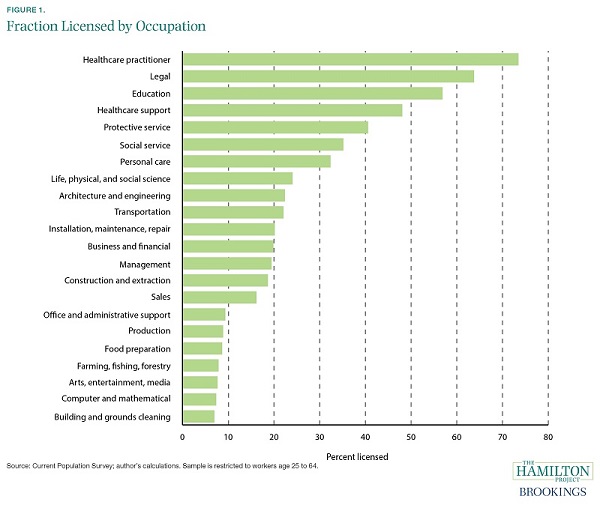
Occupational licensing -- government regulations requiring an individual to obtain a license, and often undergo training and pay a fee, before taking up an occupation -- have existed in the US for decades. This affects occupations including but not limited to barbers, cosmetologists, doctors, lawyers, and florists. Ilona Holland provides a great example of its impact: After deciding that she wanted to start a massage therapy business in Nebraska, she discovered she'd need to accumulate 1,000 hours of training to meet the state's licensing requirements. Here, occupational licensing's impacts are apparent: it creates an artificial entry barrier which limits the field of workers in an industry, thus reducing competition and potentially increasing salaries of workers already in the industry.

This directly ties in to the topic of rents: the raised barrier of entry created by occupational licensing creates rents for the protected workers. With these rents comes a great incentive to rent-seek. If workers in an industry can come together and lobby the government to pass a law requiring all future workers in that industry to pay a fee and get a license first, that will limit the number of people who enter and most likely raise the wages of those workers already in the industry. Perhaps this explains why so many industries require a license (see graph) or somehow increase barriers to entry in that industry. It's not that training is bad; the problem is that it is government-mandated, which nearly guarantees an artificially smaller pool of workers in a given industry, which creates the rents.

1_fraction_licensed_by_occupation

Friday, October 13

Ballon D' Or Borda Count


El Ballon D’ Or is the most coveted individual price in the world of the beautiful game. It is given to the best football player of the year, each year, with many legends of the game winning the individual prize. The individual award is now picked by FranceFootball Magazine who picks the most respected Football Journalists from across Europe to participate in the voting. Previously, international team managers and captains would be the voters, obviously giving way for bias.


The way the winner is chosen is exactly like the Borda count-voting rules discussed in class. The 30 top players are chosen by the magazine and are voted on by the journalists. They only vote for their top 3 choices with 1st choice getting 5 points, 2nd choice getting 3 points and 3rd place getting 1 point. This voting system has been in place for a while and it seems to do quiet well in picking the best player every year since the 2 current best players in the world have won it an unprecedented 4 and 5 times, respectively, over the past 9 years.  

Sunday, October 8

Is it worth the risk ?

A country's constitution is considered to be the most important piece of legislation which sets the foundations for a whole nation upon which it will develop and prosper. One can easily understand that making any changes to it, more than just a simple majority will be required as these changes will affect the actions of the whole society since the constitution itself applies to every man living in the country. An example of a country in which the process of changing theconstitution is particularly hard is Greece. In particular, 60% of the congressmen consisting the Greek Parliament need to vote in favor of starting the process of actually changing it while each law that is being proposed for change has to be voted upon, having to receive either 60% or 50% plus one vote in order for the constitution to be updated. . In general, the Greek constitution has been revised only three times after its "final" form had been settled in 1975.

 Through public choice, we can easily explain why changing the constitution can be a hard process. Any changes to it are reasons that can cause the external-cost curve to shift outwards. In other words, if the process was easy, people would expect higher external costs as the government in power would have relatively small boundaries in what it can or cannot do. The shift of Nα from simple majority to an extensive majority ensures that power is divided appropriately. Everything has its price though. If we consider a constitution that contains many week or unfair policies, someone can argue that ,since changing it can be a difficult task, the constitution itself can prevent the country itself from prosperity. In addition, factors such as logrolling and corruption are further shifting the Nα point even further. Such cases are really difficult to solve and they require people to lower their expected external-cost in favor of risky but potentially beneficial update of the laws consisting the rules of this game.

Wednesday, October 4

Innovation: Is the Juice Worth the Squeeze?

In recent decades we are facing diminished economic growth, leading some to believe that "there simply are not many breakthroughs left to be uncovered."  Four Stanford students conducted four case studies comparing research inputs (money spent on labor and equipment) and outputs.  Their findings relate to our discussion of externalities and welfare.

The blue line represents total-factor productivity (SMB) of research while the red line shows the effective number (SMC) of researches since 1930.  For almost 50 years, the cost of research is rising while its productivity remains the same  Mueller states that "an externality occurs when the consumption or production activity of one individual or firm has an unintended impact on the utility or production function of another individual or firm."  By over-researching, individuals and firms have created a negative consumption externality on innovation.  As a result, our output and price of ideas are higher than the social optimum, and we have lower utility as a society.

A Pigouvian solution to this problem is appropriate.  If the government subsidizes the workers' education and training, the number of workers that can actually use new ideas would increase, moving society towards an efficient allocation of resources.

Tuesday, October 3

Is p really almost zero?

Warning: this post delves somewhat into the metaphysics of causation. While it's conclusions are very relevant to the economics of voting, the issues directly discussed are somewhat more philosophical in nature.

In our discussion of voting, we discounted a vote's instrumental utility by the probability of that vote having a causal effect. We accepted causation as a concept reasoned from the counter-factual ("but for" causation). That is, act A caused outcome O if  outcome O would not have occurred but for act A. However, this definition of causation may be far too narrow. Take the example of a firing squad. If anyone one of the squad had refrained from firing, their target would still be equally dead, thus failing the "but for" condition of causation. Does it then make sense to suggest that causal responsibility cannot be assigned to any member of the firing squad? Clearly not. Suppose, however, that the convict to be put to death has some superhuman traits and can only be killed by four or more bullets. Given a four person firing squad, to whom do we assign causal responsibility? Each has an equal claim to be the "but for" factor in the outcome (i.e., the "deciding vote"). However, none has an individual claim. Each actor was pivotal, but not uniquely so. The firing squad's action were collectively pivotal. What about a firing squad of five? None has any claim to have been the "but for" causal actor, but would any of us deny that they have caused his death? This scenario is like a landslide election: an outcome was clearly caused, but it seems difficult to assign causal responsibility.

Eliezer S. Poupko proposes (see section III), and I agree, that we should assign causal responsibility to those actions which were necessary for an outcome, not simply to a single action which we may mark as decisive by reasoning from the counterfactual. Thus, in the five-person firing squad example, 4 of the 5 bullets were necessary (thus, causal), while the fifth bullet was redundant. How does this apply to voting theory? Suppose a population of 99 and a simple majority rule. Candidate A gets 60 votes; candidate B gets the remaining 39 votes. Thus, 50 of the 60 voters for candidate A are causally responsible for the outcome. Leading up to this election, if this margin of victory was confidently predicted by polling, then citizens intending to vote for candidate A should have considered their votes as having a 50 in 60 chance (0.833) of being causally effective, despite having a (near) zero chance of being the decisive vote. The value of p under this theory is not the probability that a vote is decisive, but instead the probability that the vote is part of the efficacious set.

Under this more rational theory of causation, p is not almost zero. Rather, it can very nearly approach one. Then, a voter could be rational in voting purely for instrumental, rather than expressive, reasons. This seems to be more theoretically satisfying and to have more predictive value than simply explaining people's decision to vote through expressive/intrinsic motivations.


Notting Hill Private Gardens: Proving Friedman Wrong?

 In The Role of Government in a Free Society, Milton Freedman provides city parks as an example for acceptable government intervention.  He goes on to explain "If there is a park in the middle of the city the houses on all sides get the benefit of the open space, and people who walk through it or by it also benefit. To maintain toll collectors at the gates or to impose annual charges per window overlooking the park would be very expensive and difficult.".
Immediately I thought of Notting Hill, an area of London where I recently traveled to see family. Notting Hill, made famous by the Hugh Grant and Julia Roberts movie Notting Hill, is known for great restaurants, beautiful townhouses, and a massive private garden. This luscious private garden, which spans an entire block in the heart of the neighborhood, is housed in by tall black fences which are lined with trees and bushes, completely blocking the view of the park to an outside pedestrian. To become a member of the garden, and therefore receive entry access, an individual must pay a large sum of money and live in the square of houses directly surrounding the garden.
Upon first contemplation, I thought the private gardens of Notting Hill proved Friedman (at least partially) wrong on his argument that the benefit could not be accurately assigned and therefore paid for. In this city park: the users of the city park are taxed, non-paying pedestrians cannot walk through, play in, or admire the park views, and the townhouses are built high enough so that only those directly around the park can see it (therefore houses beyond the perimeter not eligible for membership do not benefit). All of the externalities seem accounted for. Yet there is one scenario for externalities: people who live in townhouses directly around the square who do not opt to become members. Although they are not granted access to use the park itself, they are positively benefitted by the view of the park and the lack of extra neighbors who could live in area of the park if it didn't exist (more neighbors would increase noise and decrease parking among other issues). Perhaps because of the potential for externalities, the Notting Hill private gardens should be run by the British government as a public park instead.

Identity Politics + Rational Ignorance = Trump

Identity Politics:  Over the last decade specifically, there has been a sharp increase in commonality of citizens here in the United States voting more because of how they identify with the left or the right based on a few defining characteristics: race or education.  Using race, which most strongly highlights this idea, based on exit polls in both the 2012 and 2016 presidential election, white voters preferred Republican candidates at a 20 point advantage and black voters preferred the democratic candidates/incumbents at a minimum of an 80 point advantage.  (Follow the hyperlink to see more stats that support the presence of Identity Politics) In addition to the large disparity purely based on race according to Pew Research Center's exit polls, Trump also had a 39 point advantage over Clinton in the population of white citizens who did not attain a college degree.  To support these proportions, the voter turnout forwhites was 65.3% and for blacks was 59.6%.  That difference grew marginally comparing 2012 and 2016 which shows that in general the identity politics argument holds since the white population “came out to the polls” and Trump captured the uneducated white vote you can correlate that to his victory

Rational Ignorance:  Up until the 2016 campaign there was a level of rational ignorance that the majority of Americans became accustomed to and were never punished for it.  During the Bush and Obama elections, while the structure of identity politics was being laid, citizens were able to vote on a handful of issues that they felt most affected them directly.  After becoming informed on those issues, they stopped researching and finding solutions to other public issues.  The reason why the cost of looking for further solutions that do not affect the voter is irrational is simply because the marginal benefit from becoming educated on a topic that will not affect them could not out-weigh the time and effort it took to become well-versed with the subject.  The reason why President Trump's election was such a surprise for so many, on both the left and right, was the ridiculousness of his behavior no one expected a buffoon to be elected... which you could talk about until the cows come home.  However, Trump exploited the rational ignorance of the average American in a way that they neglected his behavior and outlandish statements as long as some of his platform aligned with their own.  
                                 

Trump:  The election of Mr. Donald J Trump can be attributed to many reasons, but the most significant are the combination of identity politics and rational ignorance and how these two aspects of our political landscape strong-armed the median voter in the US to go for the man who claimed he would "Make America Great Again".