Sunday, November 13

Ridesharing Regulation


In class, we have been discussing how firms divert resources away from productive endeavors in order to secure a monopoly or gain some rent. This idea explains the behavior of Uber in Lyft, two companies who spent $9 million campaigning to rewrite the local rules around ridesharing in the city of Austin, Texas. In a USA Today article, David Mack, a Lyft spokesperson said, “since this process began, we’ve participated in hundreds of hours of meetings, hearings, and phone calls.”

Both companies began operating in Austin in 2014 and operated outside of the regulations applied to taxi drivers, including fingerprint background checks; however, in December, Austin City Council passed an ordinance requiring ride-hailing drivers to submit fingerprint-based background checks. In response, the ride-hailing companies sponsored Proposition 1, a ballot measure to change the regulations. Officials with both companies have said fingerprinting requirements are burdensome and unnecessary, since they already do their own name-based background checks for every driver. City officials believe that fingerprinting adds another layer of security that will protect riders.

Despite threats from Uber and Lyft that they would leave the city if Proposition 1 failed, voters rejected the proposed change in regulation. The companies said how disappointed they were to hear the outcome of the vote, but that they would still be leaving the city of Austin. A spokesperson for Uber said in a statement, “we hope the city council will reconsider their ordinance so we can work together to make the streets of Austin a safer place for everyone.” Uber and Lyft claimed they’ll return if the rules are changed in their favor.

The battle over regulation hurts riders and drivers much more than it hurts the companies. Ridesharing services help allocate resources more effectively and help reduce heavy traffic and drunk driving. Additionally, a combined 10,000 Uber and Lyft drivers are out of work in Austin following the vote, and people have fewer ways to get around.


Uber and Lyft led this campaign in an effort to stop regulations such as these from spreading, diverting valuable resources away from productive activity and creating a deadweight loss. This negative-sum-game result is just as those we saw in the Stigler paper.

The Future of the Median

This past week, the election came up at least one time with each one of my friends or family members. I was talking to one of my friends who shared this article with me. The article has the image below showing what the electoral college map would look like if only millennials voted in this past election. After looking at the image, my friend turns to me and says, "do you realize in the future, there will be liberals and then extreme liberals." This made me laugh and then think about what the median vote will be in the future. In class, we discussed voter distribution with liberals all the way on the left and conservatives all the way on the right. According to this image it seems like that distribution will mostly be made up of liberals with the future "conservatives" really just being today's moderate liberals. Although, I don't believe it will be that simple as social psychology teaches us that as people age they become a little more conservative.

Here's what the Electoral College map would look like if only millennials voted

Even though most millennials did vote for the Democratic candidate, they did not lean left in the extent that they have in 2012. More young adults in 2016 than in 2012 "supported a third party candidate, did not vote for a presidential candidate, or specifically chose not to answer" the exit poll question. If it is the case that these voters simply did not vote for Clinton even though they are Democrats and have voted for the Democratic nominee in the last few elections then they probably felt alienated and abstained from voting for her considering how many millennials supported Senator Bernie Sanders.  In the primaries more young people voted for Sanders than Trump and Clinton combined. Voter i vote if and only if there exists some number (di in this case) where the inequality 
 [Ui(Pi*) – Ui(Pj)] < di is true. The di represents a number that is larger if a voter is willing to still vote for that candidate even if s/he is far from his/her standard or preferences. The left side of that inequality represents the difference between the utility of voter i from the platform of candidate j and the utility of voter i from his/her optimal platform. For some millennials who abstained from voing for the Democratic nominee, the inequality did not hold.


The Trump Presidency and the Sleeping Giant on the Other Side

As everyone reading this post knows by now, Donald Trump was elected last week as the next President of the United States. Reactions to his shocking victory have run the gamut - while many praise his election has a historic victory in the fight against corruption in Washington, D.C, many others are upset and angry at the results of last Tuesday. Among those who have reacted angrily are members and proponents of the ACLU, i.e. the American Civil Liberties Union. The ACLU is a non-profit organization that exists to protect the constitutional rights of all Americans, with a mission statement that highlights their commitment to fighting for for religious freedom, gay marriage, the protection of reproductive rights, and lowering rates of incarceration.

The ACLU's reaction to Donald Trump's victory was swift - they immediately posted a picture of Trump on their homepage (pictured below) with the threatening line directed at Trump "See you in court" and a request to donate from supporters of their causes. No doubt they are referring to some of Donald Trump's statements during his campaign regarding women's reproductive rights, curbing the immigration rights of Muslims into this country, and several other controversial positions he has taken.

The organization's marketing efforts appeared to have paid off. The day after the election, a spokesperson for the ACLU reported that they had received almost 1 million dollars in donations since it became clear that Trump had clinched the presidency, which is most certainly a record breaking amount of donations for one day. This gave me a thought - everyone has been talking about the silent majority as supporters of Donald Trump, but it seems to me that reactions such as these show that there is also a sleeping giant on the other side of the political spectrum. This giant was rudely shaken awake by Trump's unexpected victory, explaining the ACLU's record levels of support. I would go as far as to say that the people now working against Trump, before he has even taken office, are members of Olson's "latent" group. The ACLU may have had difficult organization costs before because no one could be excluded from the benefits of their fighting for Americans' civil rights, but there are valid reasons to believe that Trump's presidency may threaten those some of those rights. Previous free riders (such as myself) are now stepping up to help mitigate those costs and donating to help the ACLU in droves.  

The Sleeping Giant - White Working-Class Voters

Donald Trump, pulled off one of the greatest upsets in political history by beating Hilary Clinton on November 8th to be the newly elected president of the United States. Prior to the election, polls said that Clinton's chances of winning the election if she wins a given swing state average 92 percent whereas Trump averaged only 60 percent which brings us to the main question - what caused the upset? This could be caused because of abstentions from the Democratic party, due to alienation from the Bernie Sanders supporters because they might've thought that Hilary was too far off from Bernie.

However, a lot of analysts are saying that the main reason Donald Trump won was because there "silent majority" - which was referred to the white working class voters. In class we read, Olson's "A theory of successful groups" and learned about the taxanomy of groups and how their T* (Optimal amount of tariff) differ. The white working class voters could be referred to as the Latent Group  - which is the group in which any member of this group could withhold his contribution to the public good without causing a noticeable reduction in its supply. In this situation, the contribution would be their votes and the supply would be their selected benefits from the elected candidate. Trump did a very good job of acquiring the votes from this particular group by constantly advertising the selected benefits that the group would enjoy given Trump is elected for example raising the top income tax rate to 33 percent, providing more jobs, bettering trade deals.

Hilary on the other hand ignored these group of people contrary to what her husband Bill Clinton advised her to do because she underestimated the amount of voters that there really are. There are two sources that provide evidence for a whiter, less-educated and older electorate - Firstly, the Current Population Survey which pointed towards an underestimation of the population compared to other surveys and secondly, a so-called voter file which is a compilation of local records on every American who has registered to vote, including address, age and whether the person voted in a given election. Both of these data sets were deemed to be more accurate and unbiased in comparison to public voting records. Therefore, according to Olson's theory it was not rational for members in this group to vote previously because both candidates in previous years were from similar backgrounds. However, during this election there was a huge difference between the two candidates leading to the awakening of this sleeping-giant.


Ranked Choice Voting and Condorcet Winners

On that hallowed Tuesday, November 9th, 2016, after many elections where Governors had an approval rating below 40% before they even entered office, Maine voted to change to the ranked choice voting system. As this video describes, Maine has faced forty years of three or more candidates for Governor and went into some of the difficulties in getting the referendum on the ballot (if anyone wants to do a post trying to explain why a group would organize to put a different type of voting system in place, be my guest).

My fundamental question in comparing ranked choice voting and single ballot voting is: can the voting system change the Condorcet winner due to changes in campaign strategy? The main (heh heh) argument from the video is that elections utilizing ranked choice voting tend to focus on positive, rather than negative, campaigning. This is due to the candidates' fear of alienating voters because even if candidates know they can't convince voters to rank them as number one on the ballot, they might be able to persuade voters to rank them as their second choice.

The video's criticism of single ballot voting is a nod to the power the media has in portraying elections. As Trump's victory began to sink in I realized I didn't know of any policies he hopes to implement as leader (other than much-talked-about ridiculous proposals like the Mexican wall). Of course, this could be due to what my friends call political apathy (though I prefer the term 'rational ignorance'), but the media focused little on what policies either candidate hoped to implement if elected. The media primarily focused on scandals that made both candidates look horrible. If, instead of the media focusing on scandals, they focused on policy initiatives, could the dominant discourse of the election change from "I really don't want either candidate" to "the benefits I get from candidate A are, most assuredly, higher than I would receive from candidate B." Because I honestly didn't even know what the 'B' is in my P(B) + D > C equation. How am I supposed to make a rational decision if I don't know one of three variables necessary to determine whether marginal benefit is greater than marginal cost?

Let's assume Trump is a Condorcet winner since no third party candidate came close to winning all electoral votes from a state and he won in what was essentially a pair-wise election with the strongest candidate, Clinton. If we saw ranked choice voting in the presidential election from the start and third parties were more likely to enter the race, and the two primary candidates might have been more incentivized to run a positive campaign (where they focus more on the issues and less bashing the other candidate), would the Condorcet winner change?

On the other hand, if candidates ran positive campaigns the Internet would be less entertaining. 
(The photoshopped image is from Reddit after the President-elect Trump met with President Obama and made uncomfortable poses while the press took photos)

Revisiting the MVT: The hidden dimension of political preferences

As we discussed in class, one of the key assumptions to Downs’ Median Voter Theorem states that participants must have political preferences that can be represented by a one-dimensional spectrum. This “left-right” continuum is something we have all become familiar with, and there is substantial reason to believe political ideologies can be represented in this way from the liberal left to the conservative right. But what this assumption presumes is that voters care entirely about technical policy positions and are willing and able to study the positions of each candidate to identify which one most closely matches their views.

In the wake of the 2016 election, I think there are ample reasons to abandon this assumption. It’s quite evident that voters also have preferences for non-technical qualities in candidates that perhaps outweigh preferences for complex policy stances. I believe exploring this year’s electoral map and the counties that flipped from President Obama in ’08 and ’12 to President-Elect Trump offers strong support for the emphasis voters place on alternative qualities. Secretary Clinton obviously occupied a place much closer to President Obama on the traditional left-right spectrum, so if Downs’ assumptions were to hold, we would not expect to see substantial amounts of voters flip from Obama to Trump. The fact that we did see this indicates that the left-right spectrum is an inadequate measure for political preferences.


The obvious explanation is that voters simply have other preferences that are not expressed by the traditional political spectrum. Identifying these preferences may be difficult, but theories of political behavior that we’ve explored in class may offer some help in understanding why voters care less about hard policy positions than pundits generally assume. As we’ve discussed, it is costly to consume political information and become fully informed on complex political issues. Even for voters who obsessively follow politics, there are many extremely complicated topics that are difficult to determine where one falls on the political spectrum. For voters with high opportunity costs, voting based on underdeveloped preferences for technical policy isn’t rational. It makes more sense to vote based on perceptions of strength, temperament, confidence, or any number of other factors that are not expressed on the one-dimensional continuum assumed by Downs.

Fine, I'll Become a Member

This summer I was invited to join Team USA for the U23 NACAC Championship in El Salvador. It was an honor to be invited to join this team, but before I could get on the plane to leave I had a checklist of things to complete. Tasks like getting a passport, sending my sizing info for gear and to my surprise, paying to become a member of USATF. For context, USATF is the national governing body for all of track and field in the United States. This organization sanctions events, promotes races and strives to make track and field an overall more popular sport in the United States.


So the question now is, why would I ever agree to pay for a membership that will benefit me regardless of whether or not I join? Well, the answer lies with the selective incentives that USATF provides for its members. Sure there is a discount for the USATF online store and insurance benefits, but I personally couldn't care less about these offers. The real incentive that wakes up the "sleeping giant" of track runners is the fact that you can not compete at a number of USATF sanctioned events or be a part of Team USA unless you are a member. Without these selective benefits, rational individuals would choose to be free riders and still receive the benefits from the political pressure USATF puts on TV stations for more coverage in order to increase the popularity of track and field.

By providing these selective benefits, the latent group now has a reason to come together and pay for a membership to USATF. By reducing this groups incentive to free ride, USATF is now able to reaching the optimal quantity of the collective good T*, which is the increased popularity for the sport of track and field.


Wednesday, November 9

Rent Seeking in the Presidential Election?

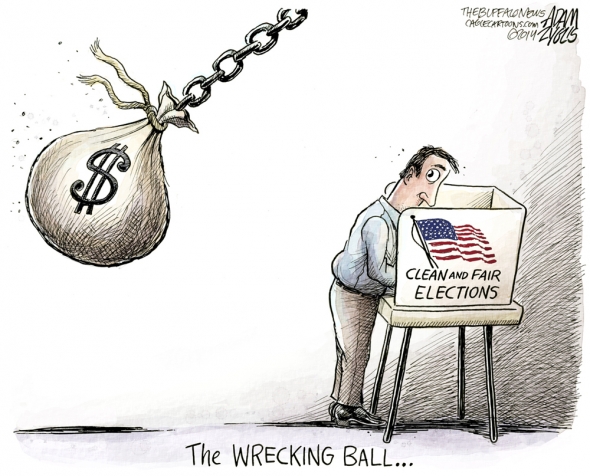
If you look at the time stamp on this post, you will see that I wrote it out during the conclusion to the Presidential election. My thought process was what better way to take my mind of an incredibly contentious and heated election season than talking about rent seeking! Or specifically, can we view presidential runs as rent seeking? CBS estimated that the mudslinging contest between Trump and Clinton cost roughly 2.65 BILLION dollars. That amount is actually a little smaller than the all-time high of 2.76 BILLLION in the 2012 race between Romney and Obama. So was all of this campaign money really just a form of rent dissipation, or is it something entirely different?

In a simple sense, perhaps this can be viewed as rent seeking behavior. We can see Donald Trump and Hillary Clinton both competing for a government contract. That contract is the title of President, and it does come with a small salary (roughly 400,000 dollars a year or 109,000 dollars less than President Sullivan’s salary). But the position seems to be more then just the money. Since only one of the candidates can win, the winner would get to act in a sort of monopolistic role exercising all the powers that the President is allotted. They use their rent seeking resources to essentially lobby the American people into choosing them. The market they operate within could potentially be a simple demand and supply market with the demand is the policies desired by the population and the supply is the policies set by whomever the President is (with their monopolistic power giving them the ability to better set their own agenda then if in a different political position).

However, this potential model can be complicated by the fact that we really only associate rent seeking with private firms, and rent isn’t usually the ability to set a policy window, but rather the ability to generate economic profit. Additionally, the rent seeking behavior firms exhibit tend to be geared towards using their own resources instead of the resources a candidate generally borrows/takes from others (as one does in a campaign). Perhaps this would require us to then integrate some of the ideas toward collective action that we see in Olson’s theory as to determine when someone would contribute.

As such, while political campaigns are definitely their own animal with their own nuances, there does appear to be some similarities to the rent seeking behavior we see in private firms and collective action. Perhaps there is the potential to expand these models in a way that will bring presidential campaigns into the fold as their own form of rent seeking.    


Image result for money in politics

Monday, November 7

Will You Be Rational Tomorrow?

In NPR’s article, “Social Science Says: Go Vote!,” psychology professor Tania Lombrozo explains how voting can actually be rational, unlike the claims made by Johnson in the excerpt titled “Voting, Rational Abstention and Rational Ignorance.”

Lombrozo acknowledges the costs associated with voting and the small probability of making a difference to the outcome (p), however she introduces a proposed clarification to the value of “p” in the marginal benefit calculation. Lombrozo claims that although the probability of deciding a vote is small, the outcome of the election could “have non-trivial consequences for a very, very large number of people.” Therefore the expected value of the vote should be calculated in terms of the small probability of deciding the vote AND the large consequences that deciding the election could involve.

Along with also acknowledging the variable we termed “D” as the expressive value that constitutes the “experience of voting – the sticker, the comradery, the civic engagement, the personal involvement as the vote counts come in,” Lombrozo also mentions the regret that will accompany not voting, as we discussed in class regarding the minimax regret matrix. Additionally, she adds the psychological analysis that “people also tend to regret missed experiences more than missed opportunities” which would account for why voting can be perceived as rational, to choose actions today to minimize regret in the future. This must be the reason for the below Facebook post and as to why this particular individual values the expected benefit of voting as equivalent value to a “black barbour jacket,” a license, a debit card and “some cash in the pockets.”


For Ted Cruz, Virtue Does Command So High a Price

I get it, most of you probably aren’t the biggest Ted Cruz fans. But humor me for two minutes (or however long it takes you to read this blog post) as I try to convince you that Cruz showed some Stiglerian “virtue” during this presidential election cycle.

In class last week, we discussed Stigler’s idea of a market for legislation in which industries can “buy” regulation. A transaction in this market involves an industry receiving “a grant of power from the state” (Stigler 10) in exchange for the votes and resources of that industry. Stigler argues, however, that the costs to society resulting from such a transaction outweigh the benefits received by the industry. Why, then, does this transaction occur? According to Stigler, it comes down to the chief motivation of elected representatives: winning re-election. Representatives generally don’t vote against regulatory policies that injure the society because if they do, they face fierce opposition to their re-election bids from the industries that benefit from such policies. Stigler puts it best: “If the representative denies ten large industries their special subsidies of money or governmental power, they will dedicate themselves to the election of a more complaisant successor: the stakes are that important” (Stigler 11).  In Stigler’s view, opposing “Big Industry” is political suicide for the representative, even if it is the right thing to do.


When we discussed this theory in class, I immediately thought of a National Review article that discussed Ted Cruz’s opposition to ethanol subsidies in the lead-up to the Iowa Caucuses. Indeed, the parallels to Stigler are abundant. Because Iowa is a heavy-corn state and has a large ethanol industry, presidential candidates from both parties have always balked at taking a stand against ethanol subsidies as they campaigned in the state. However, Cruz (and Rand Paul, for that matter) did just that. Specifically, Cruz supported a phased repeal of the Renewable Fuel Standard (RFS), which “mandates that all gas sold in the U.S. include a certain percentage of biofuels such as ethanol.” (We talked about this some in class.) According to the article, the federal mandate has cost consumers at least $10 billion since 2007, which supports Stigler’s argument regarding regulations that damage society. Moreover, as Stigler’s theory predicts, Cruz’s opposition to the RFS provoked the ire of Iowa’s ethanol industry. For example, the industry-funded America’s Renewable Future, run in Iowa by Governor Terry Branstad’s son, paid 17 staffers to run anti-Cruz ads and generally “trash” Cruz in the state.

What makes all of this particularly interesting is that Cruz ended up winning the Iowa Caucus, despite the heavy opposition from the ethanol industry. In the National Review article, Club for Growth head David McIntosh said something of a then-potential Cruz victory in Iowa that seemed to offer a counterexample to Stigler’s theory: “Our politics will be cleaner and less pandering once people can see the subsidies can be opposed and that opposing them isn’t politically fatal [emphasis added].” Certainly, the Cruz/Iowa counterexample has its flaws, but the fact remains that Cruz took on “King Corn” and ethanol in Iowa – which most political observers thought was political suicide – and won. Given Stigler’s rather bleak depiction of elected representatives and industry regulation, I think this little story provides some reason to be optimistic, even if you dislike Ted Cruz.

Sunday, November 6

Efficacy of Agricultural Regulation in the EU

Over the past several weeks, we have learned about rent seeking, i.e. how a company or organization can seek additional economic gain without actually providing value in return to consumers/society in general. We also discussed regulatory actions taken by the government can drive up the prices they can charge, while creating deadweight losses. To better understand this concept, I found a topical example of rent seeking.

A study conducted by the Institute of Economic Affairs, a European policy think tank, claims that the EU's many agricultural regulations are burdensome to farmers and consumers alike. They claim that the EU made a mistake in allowing lobbyists from non-farming interest groups to pressure them into instituting higher agricutral standards in regards to the environment and animal welfare. The report cites the "regulatory capture" by the aforementioned as a significant problem for the EU's Common Agricultural Policy, as their influence has increased costs while only marginally increasing safety benefits to consumers, if at all. For example, the report discusses how requiring farmers to grow all foods organically would increase the cost of growing wheat by 70% while lowering yields to half of what they were before. Yields of potato crops would decrease by 44% and prices would go up 200%. Of course, if eating organic food was significantly better for you than consuming traditionally grown crops, then there may not be deadweight loss to society from this requirement, as as such safety regulations would increase social marginal benefit overall. However, research has shown that organic produce has not been yet linked to being more nutritionally beneficial or less receptive to contamination from bacteria such as E-coli. Therefore, despite my dedication to Whole Foods and millennial views towards buying organic, I admit that this report raised good points and certainly reinforced the lessons of regulation we learned recently in class.


Save Echo Farms and Stop Overdevelopment!

During a recent phone conversation, my grandmother was describing an issue that has arisen over the last few months where she lives in Wilmington, North Carolina. Wilmington is a small coastal city in southeastern North Carolina with a population of 112,000. However, the serene and scenic beach town has an expected population growth rate of 56% over the next 25 years, but only about 13% of space is available for development.

One specific example of this growth in development is a plan to build 675 new homes in the community of Echo Farms within Wilmington, where my grandmother plays tennis. The residential community that already includes thousands of homes sits on a golf course, with private yards directly adjacent to the shared greenspace. The developers are proposing to eliminate the golf course, taking away the greenspace that is a common good for all residents, while also adding major construction that will lead to noise, pollution, and safety concerns for years.
When I heard about this, I immediately thought of the Tiebout reading from back in September. According to Tiebout, the residents chose to live in this particular neighborhood because of its revenue-expenditure pattern including the greenspace, golf course, serene neighborhood, and low-density population. All of this will be lost with the new development. For this analysis, I am assuming that residents must remain in Wilmington due to job constraints, thus there should be an equilibrium within the communities in Wilmington.

Although Tiebout theory says the current residents will then just move to another community with their ideal revenue-expenditure pattern, the assumption that residents are perfectly mobile (even within Wilmington) does not hold in this case due to the nature of the problem. Even disregarding the costs of moving, the property values of the current homes will plummet since the demand to live in this formerly tranquil neighborhood has decreased with the announcement of the new development. The people buying the new houses will have a different ideal bundle of public goods that equates to the new development, but the current residents are essentially stuck. 


Further, even if they were able to sell their homes to people who preferred less greenspace and construction, there are few areas within Wilmington that aren’t being developed and would be an affordable “haven”. If the Echo Farms Golf Course is developed, the Echo Farms community will be no different than many other developed subdivisions within Wilmington. Thus, the overall increased development of Wilmington limits residents’ ability to choose their residential community based on revenue-expenditure patterns and keeps Wilmington from attaining equilibrium in Tiebout’s theory.

SaveSave