I found the Downs article to be fascinating, as I think its application of a spectrum that represents the median voter’s interests can be applied to all sorts of scenarios. Downs creates a model that allows us to see a functioning dynamic between a politician seeking office and the median voter in their district. This relationship between how a politician may orient their electoral position on policy in an election along issue spectrums, depending on where voters congregate on issues, will determine where a politician will position themselves to better appeal to the median voter. This summer, I found that many politicians did this, where popular issues would arise and politicians would take advantage of a policy issues’ popularity in order to win voters in their district. More specifically, politicians narrowly focus on issues that seem irrelevant, but it actually appeals to a specific set of voters, where they congregate on a policy issue. In this press release statement, Senator Cruz supports Former President Trump proposal for 'no taxes on tips', which was introduced at a rally in Nevada and was very popular. In this scenario, Senator Cruz is appealing to the median voter by aligning himself with a popular policy issue, where the average median employee, who relies on tips, would stand. This specific set of voters is the “bump” along the spectrum. In drafting and passing policy that is extremely specified to where a certain set of voter have one preference, politicians can gain support easily. Moreover, since it is typically a group of politicians seeking elections that all might need to pass oddly specific policy that appeals to a voter spectrum to gain votes, logrolling might occur. Under the assumption of simple majority, a group of politicians create policy that appeals to their chosen spectrum of voters, this will pass in order for the politicians to be reelected.
Sunday, October 6


I voted
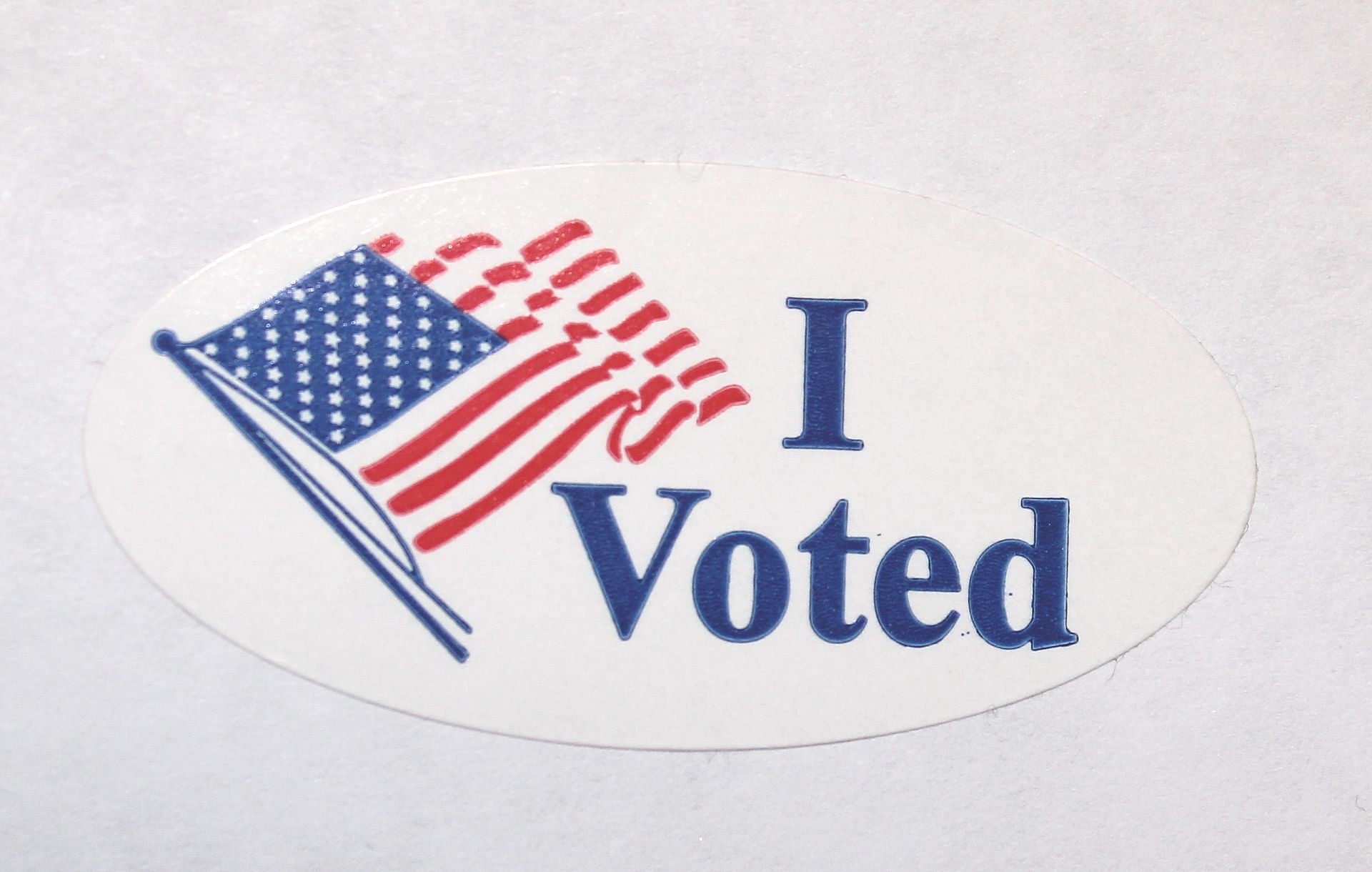 I voted today after lunch—absentee, if that wasn't clear. There's no particular reason I couldn't have voted on Election Day proper, but this was just more convenient. Indeed, I timed it, and it took 8 minutes, 34 seconds for me to vote (including walking to the nearest mailbox). That's several times faster than it would have taken me to vote in person. When I did that for this year's primary, it took about 45 minutes round-trip.
Still, I was willing to vote in both instances. This five-fold reduction in the time cost of voting wasn't decisive. Nor would we expect it to be, given how low the chances were of my vote altering the elections' outcomes in either case. I chalk it up to a taste for voting, because I always had a good time accompanying my parents to the polls when I was a wee lad. I carry that habit/taste with me into adulthood, and I value it plenty higher than even several hours of my time. It seems that most other voters do so based on a pretty strong taste, expression, or civic duty as well; after all, 2020's massive expansion of mail-in voting seems not to have had much of a causal impact on voter turnout. Those who already planned to vote voted; those who didn't, didn't.
Would Harold Hotelling go to Dunkin' or Starbucks?
Dunkin' Donuts and Starbucks have supplied America with caffeine for over half a century. Both offer a variety of specialty coffee drinks on their respective menus. I am indifferent about the two. Starbucks provides slightly better quality at a more premium price; however, with this difference, the two still provide remarkably similar products. In a study done in 2021, looking at the location of Dunkin stores, only one of the six explanatory variables studied was found to explain these locations. The number of Starbucks in each zipcode was the only statistically significant factor out of the population, number of households, income per capita, household median income, and family median income that could help predict a Dunkin' location. Harold Hotelling's model, which is related to spatial competition, could explain this observation better. In his model, with two competitors set in their respective locations, it is optimal for each store to move and operate in the exact same area. Under the assumption that people are indifferent between their products and buy from the closest location (for the purpose of the model), these moves happen because the two will play relocation cat and mouse until they end up in the exact location. This would create an equilibrium where people are indifferent about traveling to either Dunkin' or Starbucks, and it is now Pareto efficient because nobody can move without making one person worse off. When I ponder this study, what surfaced in my head are the Dunkin' and Starbucks stores that sit directly next to each other as you pull into the gates of my hometown high school, and Harold Hotelling helped me understand why. His model can be applied vastly to two-party political systems, fast-food chains, or even the bars on the Corner at UVA.
FOFR (Fear of Future Regret)
ECON 4300 - Public Choice
ARCH 1010 - Lessons of the Lawn
ECON 3720 - Econometrics
COMM 3010 - Intermediate Accounting
RELC 1220 - Early Christianity and The New Testament
This is my current schedule for the 2024 Fall semester, and as my accounting professor pointed out, it’s quite diverse. This lineup is a direct result of my aversion to future regret that drives many decisions in my life. Mueller would describe me as a minimax-regret strategist as the fear of future regret incentivizes my behavior as a rational agent.
I became conscious of this strategy at the end of first year when I finally entertained the idea of pursuing a degree in Architecture. I’ve always admired architecture and the passion that is palpable within the field, but never considered it for myself as I can barely draw a straight line. However, I recognized my opportunity to discover this field was fleeting and dreaded the idea of being discontent at a future job where I would dwell on what could have been if I’d only taken action. UVA is conducive to this strategy to an extent: each degree requires a diversity of subjects but there’s only a certain amount of credits taken outside the College that one can use towards their 120 credit-hour requirement. So while the classes in the A-School (and the many I took in the Comm School) set me back on Arts & Science credits needed for graduation, I weighed the E[MB] with the MC and found that the possibility of finding a passion, appeasing any future regret I may have, and broadening my education here at UVA would have a greater payoff than the costs of taking these classes, which include imposter syndrome, the extra work and effort to learn a brand new subject, and the opportunity cost of taking Econ classes. This doesn’t mean that the choice was easy - high opportunity costs including the possibility of graduating early or taking fewer credits each semester linger over my head, but I was and am ultimately pushed by future uncertainty that could contain regret of my inaction.
With that being said, I find the case of the minimax-regret strategist to be very underestimated as it’s intuitive for a rational individual to consider the outcome of their choices, which is a forward-looking approach that can naturally lead to considerations of future regret. Therefore, it’s rational and common for an individual to be motivated by the possibility of regret, and this incentive for behavior allows us to understand consumer preferences, as Mueller depicted in his attempt to rationalize the act of voting.
Saturday, October 5
Flood Insurance in the Mountains of NC
After receiving up to 30 inches of rain, the beautiful mountainous region of Western NC is devastated by flooding. It’s a reminder that as the climate changes and storms intensify, the effects will stretch far beyond the coastal areas most vulnerable to sea level rise. And very few of the homes destroyed by Hurricane Helene were insured against flood damages. One of the main reasons for this is the price of flood insurance, which is driven by adverse selection. Specifically, the way flood insurance is priced means that only those with the highest risk of flood damages would rationally purchase a policy. This is reinforced by federal policy, which requires people buying a home in the 100-year floodplain (higher than 1% annual chance of flood) to get flood insurance to obtain a federally backed mortgage.
Another interesting public choice related topic is: is flood insurance a natural monopoly? One of the most difficult things about underwriting risk due to disasters such as flooding is that insurance claims are highly correlated. If you were insuring against structure fires, for example, there’s probably some rate at which they occur with a certain variance that would be relatively simple to underwrite. However, for flood insurance in a particular area, it’s possible that many years will pass with no claims, or that a single storm leaves every insured property damaged. This highly correlated risk means insurance companies must diversify geographically, and there’s an argument that a natural monopoly exists because that would be the most diversified insurance fund. And that is somewhat similar to what we have today in the US, with the National Flood Insurance Program (NFIP), run by FEMA, being the largest provider. I’m probably out of space, but here’s a possible comment topic: how would Friedman evaluate a government run near-monopoly on flood insurance?
Wednesday, October 2
Social Media & the Bimodal Voter Preference Distribution
“Top global thinker” Jonathan Haidt refers to (2010-2015) as the Great Rewiring of Childhood: a period characterized by the rapid integration of social media with our daily lives, during which “many adolescents (and adults) lost the ability to be fully present with the people around them, which changed social life for everyone” (The Anxious Generation, 135). During this period, social media companies perfected the use of “persuasive technology” to ‘hook’ users (see the Hooked model image below). We have all seen firsthand the effect this has had on American politics; but do algorithms encourage political polarization, or are those with extreme views attracted to social media?
Downs can help us imagine how the answer might be both. By turning politics into entertainment, social media may have brought those potential voters on the margin whose K = 0% → K = 1%––potentially a large enough “D” to get those voters to the polls. We can view this analogously to the enfranchisement of the working class in 19th century England Downs describes; (effectively self-)disenfranchised voters entered the electorate on either side of the former singular mode of the electorate, pushing the preference distribution toward a bimodal distribution. On the other side, knowledgeable voters were also attracted to social media communities, where political discussion with like-minded people was easier than ever before. This seems to have influenced preferences as well via the infamous echo chamber effect.
This all would have taken place right before––you guessed it––the 2016 election. So what do you think? Is this theory resonating?

Monroe Students Walk Irrationally
A common approach taken by economists for defining rational preferences is to see if an individual's preferences meet two conditions: completeness and transitivity. For a given set of options A, B, and C, completeness claims A≿B or B≿A while transitivity claims A≿B and B≿C implies A≿C. While transitivity is the more frequent condition to find cases of irrational preferences, we will use the completeness condition to show that students don't exit Monroe Hall rationally.
On the southwest side of Monroe Hall, there are two exits: the main exit with double doors and the wheelchair accessible exit to its side. When exiting class, I observe students split on which exits they take. However, some students will take different exits on different but otherwise equivalent days. Let us only consider one observed student and designate the wheelchair accessible exit as Xa and the main exit as Xm. On initial examination, it appears that the student is indifferent between Xa and Xm, which is equivalent to Xa≿Xm and Xm≿Xa.
However, I present two new observations that depict a different story. Firstly, there was an exogenous shock in the form of a spilled substance in the main entrance, but the student chose the main entrance still. This implies that Xm≻Xa as the student chose Xm despite the added cost of potentially falling, thus Xa≿Xm cannot be true. Next, the student was engaging in conversation with a peer when the peer chose the main exit, while the selected student chose the wheelchair accessible exit before continuing the conversation outside. Since the student chose Xa even with the additional cost of interrupting the conversation, it must be that Xa≻Xm which also implies that Xm≿Xa cannot be true. Since we have shown Xa≿Xm and Xm≿Xa to both be false, it must be that this student's preferences violate the completeness axiom, and thus they are irrational!
Not Voting When Your Vote Matters?
The Club Running executive board at UVA highly values democracy, voting, and membership engagement. To embody these values, the Club mimics the processes of UVA’s Student Council by creating a constitution that can be amended by proposals submitted and voted on by the executive board. The board is made up of 17 people and votes based on a simple majority.
The voting process usually runs smoothly and it is rare that our board is split down the middle. Recently, however, we were divided over a proposal to change the order that we vote for different positions during our upcoming elections. Unfortunately, since we vote on proposals by sending polls in the GroupMe, the poll for this issue didn’t load for me until the 16 other members had voted. It turned out the poll was split 8 and 8 between rejecting or approving the proposal. According to Johnson, this would be one of the few times it would be rational to vote. My vote was the only one that mattered and could change the outcome. In most elections, Johnson points out, the percent chance that your vote is the one that matters is so small that the benefit from your vote’s outcome is nearly zero. I was thinking back to this idea as I was deciding what to do in regards to this proposal and my final vote. Funnily enough, I decided not to vote. I had no strong preference between either of the options and therefore (I believe) my choice of not voting when my vote mattered was still rational. The cost for me to vote was nearly zero and the benefit of the outcome of my vote was also nearly zero. Since I believed that other members of the board could gain or lose utility from this proposal, it didn’t seem to be my place decide the outcome and effect their utilities. Interestingly, had I not been the final one to vote while there was a tie, I would have voted since I initially thought my vote wouldn't change the outcome (as it usually doesn't). This seems contradictory to Johnson’s idea of rational voting, but potentially other factors such as ideas of fairness need to come in to play to explain why voting or not voting may be rational in circumstances like this.
Tuesday, October 1
Voting for Mayor
In my small local community of around 300 households, we have an elected Mayor and Town Council of 5 members. Every two years, residents over 18 are sent a ballot and expected to vote for who they believe should serve on the town council out of those running. When discussing the expressive voter hypothesis, involving people choosing to vote to express an opinion or belief, not to help bring a specific outcome, it made me think of voting behavior in my community.
The current mayor has had this position for almost 17 years. However, every two years my town votes for the mayor, and there is always at least one candidate running against the current mayor. As a very close-knit community, I see the expressive voting hypothesis in play when residents mark their vote for candidates because they are neighbors with one candidate or get along with them in the neighborhood. Since the current mayor has successfully worked in the position for so many years and continues to run, it could be perceived by many voters that the probability he will win is extremely high. Therefore, some may vote for another candidate to express their support for their neighbor, not considering who would perform the job better.
Social Security: Uh Oh.
Many of you will remember Mr. Coppock’s Econ 2020 lecture on the Federal Budget and the impending issues with Social Security. He detailed how the U.S. population pyramid is “constrictive” in shape due to longer lifespans, retiring baby boomers, and a low replacement rate. According to the May 2024 Social Security Trustees Report, the fund reserves that help pay for Social Security benefits will run out in 2035. In my view, this impending insolvency is one of the biggest problems facing Generation Z. Yet, when was the last time you heard a politician mention "Social Security" and "crisis" in the same breath?
In Glenn Johnson’s chapter on voting and rational ignorance, he says, “Politicians realize that most individuals have no incentive to gather or to retain information about issues, so they provide very little of it” (p. 12). Politicians fear that taking a strong stance on Social Security could alienate the elderly, a demographic known for high voter turnout. In the 2020 election, voters aged 65+ had a voter turnout of 71.9%, which is much higher than the national average of 62.8%. The elderly have lower marginal costs associated with voting and becoming educated on politics because they are not working, and have higher marginal benefits because policy decisions regarding entitlements directly impact their financial well-being. Any discussion of potential reforms by politicians could isolate this massive voter demographic.
For Generation Z, the expected benefits from Social Security appear minimal. If the future cash flows from Social Security are represented as MB, and the probability that someone from Gen Z will receive their full benefits is denoted as Πi, then the expected benefit E[MB] of paying into the program is minuscule. The expected marginal cost E[MC] could include not only the income foregone from our paychecks but also the potential negative externalities from the U.S. government defaulting on its entitlements.
Social Security is essentially an unsustainable pyramid scheme and is in dire need of reform to avoid collapse. Hopefully, Gen Z can start being a little less rationally ignorant about this issue.
More Information: Investopedia
Sunday, September 29
The Rational Case Against Lottery Tickets
Under the framework of the Rational Agent Model, another unexplainable behavior is buying lottery tickets. Through Mueller, we have discussed the dilemma in explaining why people vote given that there is an extremely low probability that the individual's vote will break a tie or be the deciding vote. We re-constructed the model that a rational person would vote when PB (expected marginal benefit) - C (costs) > or = 0. Under this particular model, buying a lottery ticket can be seen as another form of irrational behavior. Just like with voting, the probability of expected marginal benefits exceeding the costs is extremely low. That is, you have a low chance of winning the lottery prize. According to this article, there is a 1 in 302.6 million chance of winning a Mega Millions lottery and 1 in 292.2 million chance of winning the Powerball Jackpot. Sometimes there are not even winners. Under the Rational Agent Model, the low probability of winning the lottery makes it so that buying a ticket seems like a waste of time. One could also consider the opportunity costs in doing so. Instead of buying a ticket, you could have picked up a shift at work or done your homework.
We added a caveat to the model when we introduced X into the inequality: PB + X - C > or = 0. X is something else that may motivate an individual to vote (civic duty, social pressure, etc). In the case of buying lottery tickets, this X may be the utility derived from the action of buying a lottery ticket. However, the case of lottery tickets differentiates itself in that there is no civic duty or pervasive social pressure to buy one, at least compared to voting. We also discussed expressive and instrumental demand. The expressive demand from buying a lottery ticket seems even less robust than voting. With voting, you get the "I Voted" sticker and avoid certain social pressures. However, buying a lottery ticket does not really do anything for you as impactful in terms of expressive demand.
Tiebout Says "Follow Your Dreams"
After the ecstasy of graduation, I will face the abyss of young adulthood. Where do I go? What do I do? Who do I become? Tiebout can’t alleviate my entire existential crisis, but he could deliver some guidance on the first of my questions. Currently, my options for post-grad living are the suburbs of Richmond, Washington D.C., and Boston. My dad is adamant my best option is to remain planted in our single-family home outside of Richmond, Virginia. However, my economist friend, Mr. Tiebout, and I disagree.
While Henrico, Virginia is a lovely place for my empty-nester father, it is not the most vibrant community for a twenty-one-year-old. My dad prefers revenue expenditure patterns that involve no public transportation (he has a reliable car), little community planning, and minimal taxes. I prefer revenue expenditure patterns that include connected public transportation, ample public space, and I have more ambivalent feelings toward taxes. My dad is correct in noting differences between cost of living of all three locations (this link compares the cost of living between Richmond and Boston). However, it is my economic prerogative to move where my needs are best met through preference revelation. While my situation does not perfectly mimic Tiebout’s model, I can use it as a template to make my decision. The next time my father implores me not to move to a place with “soul-crushing, excessive, unnecessary, communistic taxes,” I’ll simply respond, “I’m sorry Dad, but I prefer that revenue-expenditure pattern.”
The economics of the UVA bus system
At approximately 7:34 A.M. every Tuesday and Thursday, I ride the orange line of the UVA bus system(UTS) to my Public Choice class. As I get on the bus, I am not required to show any student identification or pay any fare. In most cases, public transit is not considered a public good, as the non-excludability assumption fails due to the payment of a fare. As argued in this article, the non-rival assumption is also not completely satisfied due to overcrowding which eventually disallows consumption. But the UTS provides a unique example, where both of these assumptions are actually very close to being satisfied. For this reason, the UTS fits well within Buchanan’s continuum between public goods and private goods, as it is not “purely” a public good, but is very close to one.
In order for the non-excludability assumption to fail, buses must charge a fare to restrict consumption. The UTS does not charge fares or require any form of University identification, meaning any person wanting to ride the bus can. The non-rivalry assumption is not completely satisfied, as it is technically possible for the buses to be at capacity. But with multiple different bus routes, as well as multiple different buses per route, the buses rarely become too crowded to the point where people cannot ride them. For these reasons, even though the UTS may not be considered a “pure” public good, it is very close to one. Another interesting consideration is the classic problem that arises with public goods, the free-rider problem. In this case, everyone is quite literally a free-rider. But by the economic definition of the word, only people who contribute no money to the University and use the bus would be considered free riders. This issue could cause underproduction, but, in my experience at least, the free-riding is not extreme enough of an issue for the allocative efficient quantity to not be relatively produced.
Club Good Controversy
The “Hill” at Scott Stadium has long been a public good for UVA undergraduates.
The hill is non-rivalrous; more students filling in the fourth side does not detract from others' experience.
In fact, the more packed the Hill is, the more utility the Cavalier faithful derives from
cheering on the Hoos and (hopefully) singing the Good Ol’ song.
The hill was also non-excludable; it made little sense for the school to prevent any student entry.
Given the Hill’s value to Virginia students as a reliable public good for enjoying the football game,
there’s no reason for any administrative action.
If anything, the school should subsidize student consumption of the Hill given its positive
ramifications for the rest of the UVA fans filling in Scott Stadium.
Nevertheless, UVA has decided to limit access to the hill this season.
Now, the famed fourth side ceases to be a public good. It remains non-rivalrous,
but given its new excludability has entered the realm of a Club Good.
The commitment from UVA to some arbitrary capacity limit for this staple UVA good
has not moved student consumption of the Hill towards Q = Qae. Rather, the school’s desire to extend its influence has left Q <Qae as longtime fans are left clawing at the fence for access.
In the words of Milton Friedman, the school’s decision to overextend has done nothing
but “strain the social cohesion” of UVA, as students are left frustrated and asking for change. Milton will be turning in his grave until the school decides to reverse this mistake.
Saturday, September 28
The cost of *not* voting in Bolivia
When I moved to the U.S. 3 years ago, something that blew my mind in government class was finding out that there are no incentives, or rather punishments, for not voting in American elections. Growing up in a compulsory voting system, I thought every country had similar measures to incentivize voting. After reading Johnson’s Voting Rationale Argument, I realized that Bolivian punishments for not voting are rather severe compared to other countries, and it made me wonder if the system really achieves its goal of revealing people’s preferences in the ballot.
The measures Bolivia takes to decrease non-voting are both:
A fine equivalent to 25% of the minimum monthly salary (which is about 90 dollars)
Loss of access to bank transactions, passport application process, and your job (if you work for the government/public service) for 90 days
To receive your full salary that month and be able to do the things mentioned above, you need to show a voting ID that you get when voting. Another option is to obtain a voting exemption, but those are only granted in extenuating circumstances and are known to have 5-hour waiting lines for your case to even be considered. Therefore, most people prefer to vote because the cost of not voting is higher than the cost of voting, leading to a voting turnout of 88%. Since Bolivia has a high low-income population, there is a high percentage of people who do not have access to education and do not fully understand the candidates' agendas. They vote just to avoid getting their salaries cut, which leads to rational ignorance. The middle and higher classes vote because they rely on bank transactions to get by (especially now that even the farmer’s markets don’t take cash anymore). Therefore, in every presidential election, around 10% of people vote “null” or “blank” just to get voter IDs, and a large percentage of people voting do not see the marginal benefit in informing themselves about the election and only focus on avoiding the cost incurred by not voting. At the end of the day, “the will of the people” is not necessarily reflected in the election outcome.
Supreme Electoral Tribunal Manual for sanctions (in spanish)Chapter II, Title VI, Article 14, (j)
Thursday, September 26
Why you will have FOMO if you don't vote
FOMO, or the Fear of Missing Out, describes an emotional state where individuals attend events to avoid regret, even when it might not be the most rational choice. Interestingly, this concept aligns closely with the minimax-regret strategy, a decision-making framework used to minimize potential future regret.
A person might attend a social event because the alternative, missing the event and staying home, yields regret. While in the present, staying home was the optimal decision for the individual since they needed the time to sleep or catch up on work; in hindsight, the individual will regret staying home. The individual later realizes that attending the social event had greater payoff. Through this decision making process, the individual, despite the uncertainty of the payoff, will decide to attend the event, out of the fear of regret, despite it being the less-rational outcome when the individual made the initial decision.
A person might attend a social event because the alternative, missing the event and staying home, yields regret. While in the present, staying home was the optimal decision for the individual since they needed the time to sleep or catch up on work; in hindsight, the individual will regret staying home. The individual later realizes that attending the social event had greater payoff. Through this decision making process, the individual, despite the uncertainty of the payoff, will decide to attend the event, out of the fear of regret, despite it being the less-rational outcome when the individual made the initial decision.
In decision theory, the minimax-regret strategy involves choosing an action that minimizes the worst possible regret. For instance, in voting, even if the immediate costs (time and effort) outweigh the likelihood of changing the election outcome, individuals will still vote to avoid the regret of not participating. Essentially, voters use a decision strategy that weighs each possible event as a probability (election outcome) providing, “all events equal weight”. The agent chooses an action that minimizes regret: going the polls, or in our original scenario, attending the social event thereby minimizing regret, even if the action is not optimal. In the reading Mueller lays out a prisoner's dilemma table to describe the decision-process of minimaxing-regret. Through this prisoner’s dilemma, the agent realizes the dominant “minimax-regret” strategy is to vote, as the cost of not voting exceeds the cost of voting in this strategy.
A Two-Parent Redistribution Model
I personally had the pleasure of attending Melissa Kearney’s talk last Thursday about her new book, The Two-Parent Privilege. On top of the fact that there was quite the surplus of free pizza, Kearney gave a very interesting, data-driven argument for how the decline of marriage has led to a number of economic problems. She pointed out that in major studies, the top two predictors of social mobility are the variables two parent households (+) and single mothers (-). Another one of the interesting points she made was that the decline in marriage could not be attributed to the 1960s and 70s feminist movement. In fact, college educated women, who theoretically were the ones benefiting the most from feminist liberation, continued to marry at high rates. Whereas for poorer, less educated women, marriage rates had dropped significantly in the last 40 years.
While Kearney’s talk focused mostly on highlighting the high level of importance of this issue, she also suggested policy responses. Her policy prescriptions seemed to be framed around redistribution. To compare to the model we used in class, imagine you are at the constitution phase of a government with the knowledge that you will be born into that society. Let r = # of married mothers and p = # of single mothers. So, in this state there is a veil of ignorance and you have a p/(p+r) chance of being born to a single mother. Given what you know about this society, our proof in class shows that you would choose a model for redistribution of resources such that in each state, the marginal benefit of those resources would be equal. Such redistribution programs could include publicly provided daycare or universal kindergarten. Kearney would also strongly advocate for decreasing p/(p+r), the rate of single mothers. To that end, her policy prescriptions include improving “marriageability” (good paying, stable careers) for men without 4-year college, and scaling up programs that strengthen family structures. What do you think the role of the government is on this issue?
Monday, September 23
Is Wikipedia on the Brink of Extinction?
Every time I have a simple question for Google, I end up going down an hour-long (let’s be honest here, hours-long) rabbit hole on Wikipedia. It always starts out innocent, prompted by something from class or a conversation with a friend. But the hyperlinks are irresistible. Before I know it, an inquiry about the premise of Parkinson’s Law turns into an endless scroll down the list of every cultivar of apple. (Apparently there are over 7,500. Who knew.) I learn a lot this way and despite the amount of time I waste on it, I do truly love Wikipedia.
Naturally, this makes it quite jarring when I open a Wikipedia page and see a huge, red, urgent message begging for donations to help the website survive. I hate to say it, but I’ve never donated. And considering I’ve been getting these messages for years, it doesn’t seem like my inaction makes much of a difference.
This is a classic example of the free rider problem. I know other people are going to step in and sustain Wikipedia by donating, so I’m happy to let them take on the full financial burden (especially because time has proved they consistently do). The website is fairly non-rivalrous as long as too many people don’t try to use it at once and it crashes. It’s pretty non-exclusive, too, as long as the user has a device with internet connection and the website doesn’t start charging a universal fee. Even though it’s a public good I cherish deeply, I’ll keep free-riding on the contributions of those who value it just a little more than me.
M&A (Manchester & Annexation)
In the 50 years after the Civil War, Richmond, VA worked hard to rebuild from the ravages of the war and and create a new, industrial economy. Just across the James River, the city of Manchester tried but failed to achieve Richmond's dynamism. By the early 20th century, calls arose to merge the cities. There were heated arguments on both sides, but eventually a referendum went out and the vote came in: Manchester voters assented to annexation by Richmond. They expected increased government efficiency, lower taxes, and expanded infrastructure, while Richmonders saw value in Manchester's large industrial base.
The justifications for this annexation speak to one interesting component of Charles Tiebout's model of local governance. While his model intentionally disregards economies or diseconomies of scale among municipalities, it is not inconsistent with the existence of economies/diseconomies of scale within municipalities. One could imagine, in his model, two communities with optimal population sizes combining to form a larger community with, say, a more efficient police force. There may be no significant cost to the greater population, as density has not increased. (Or, there may be.) The fact of municipal annexation—of Manchester of the land under O'Hare Airport, of Brooklyn, and more—seems not to prove or disprove Tiebout's theory, but it does complicate it. Consumer-voters may not have as much power to vote with their feet in a world of merged municipalities. There are fewer revenue-expenditure models to choose between.
Sunday, September 22
Fangirling over Florida (#FreeTibout)
Picture it: true hell on earth, boredom incarnate, inspiration for Fugazi’s dirge-like “Waiting Room”. Are you imagining the DMV? Then you’re definitely not from Florida. My pre-scheduled appointment to pick up my driver’s license took a grand total of 15 minutes; I even forgot one of my forms, and the sweet old lady across the desk printed it out for me. That’s because our DMV is the same office as our tax collector, so she had our utility tax bill on file.
Florida’s revenue-expenditure pattern is so beautifully efficient as to bring tears to the eyes of any economist who gazes at it. (And don’t forget––no income tax!) So I have known for a long time that these consumer-voter feet will settle down in the Sunshine State; Tiebout’s theory made implicit sense to me. (One might even argue that the Florida man memes are the state’s undercover way to reduce n → n*). But it also raises some practical applications with the model that may be explored by other economists. Florida’s geographic location affords it access to goods that not all polities can include in their consumption bundles: the perfect weather, the affordable tropical cuisine, and most difficult to measure and capture: the easygoing ethic. Rather than perfect competition, real-life polities more closely engage in monopolistic competition.
Subscribe to:
Posts (Atom)