After watching some fourth years this fall break, my friends and I have started to plan a senior trip to Las Vegas. We were debating in our group chat whether to go with a college planner named "JusCollege" or plan the trip on our own. JusCollege is a bit more expensive, but your journey is intended for you with hotels and nightlife included. Think of them like a travel agency but for college students. We have 13 people going on this trip. 10 were in favor, one was indifferent, and two were vehemently against. These two "holdouts," despite the majority of the group, felt extremely uneasy about going along with this program (there is very little information about their program and it looks sketchy). So, for the past week, there has been lots of tension in the group chat because these two individuals would not give any ground. After much discussion, we finally made them see our argument. Buchanan and Tullock discuss how unanimity in decisions is ideal, but the time it takes to reach this decision would be infinite due to the transaction costs of information. They cite a graph for an ideal amount of majority to reach an optimum decision. In our case, our two "holdouts" prevented this unanimity, but with time (TC) we made them understand our point of view enough to make them concede. If it took a week to get two kids to agree to a travel agency versus not, can you imagine on a macro scale how difficult it is to get millions of people to agree to policy life-or-death decisions (taxes, Medicaid, defense allocation, etc.)? It's impossible. Because unanimity is impossible, the speed of simple majorities becomes attractive. With speed, there is a negative. There are always some who get the short end of the stick. So Ned and Ethan, this time you are the minority who is not heard. Hope you have fun in Vegas!
Monday, October 21


Netflix Free Rider Problem
Up until Netflix’s recent crackdown, many people had never paid for Netflix subscriptions. People would typically share accounts, all you would need is someone else’s email and password. This presents itself as a free rider problem because one person pays the subscription cost and no one else contributes to the subscription from which they benefit from. The free rider problem also worsens as the group or “n” increases in size. It only takes one individual to pay for a Netflix subscription. If we have a group of 2, we have 1 subscriber and 1 free rider. However, if we have a group of 5, we have 1 subscriber and 4 free riders.
This is also interesting because Netflix is not really a public but more of a private good. It is excludable in that you need a password to access an account (in addition to a watching device, wifi, etc.). Netflix subscriptions are also rivalrous if too many people are using the account. When more than a certain amount of people are simultaneously logged on, Netflix will not let you watch something which takes away at the consumer's utility at the hand of other's consumption. However, certain people made it non-excludable by sharing passwords with friends. In addition, accounts could be made non-rivalrous in that there is an "optimum group number" (n*) where everyone could still watch movies at any time without disruptions. For Netflix's premium plan, n*= 4 since 4 people can log on at the same time without any "account is already in use" message.
The Netflix free rider problem became so bad that Netflix stepped in and started to crack down on password sharing. Now, it is pretty tricky to free ride on someone's subscription. As a result, Netflix has seen people buying more subscriptions and increased revenue.
Sunday, October 20
Is Your Water Bottle Outdated?
As I was on my biweekly walk from the Chemistry Building to Campbell Hall after our Public Choice lecture, I couldn’t help but notice the Stanley pop-up in front of Monroe Hall and how it related to our recent discussions. It prompted me to consider society’s rapidly changing demand for reusable water bottles with the spotlight shifting from Nalgene to Hydroflask to Stanley to Owala (and many more unmentioned). With all water bottles serving the same purpose and functioning as reusable goods that don’t often need replacing, the fluctuation in the market can be explained by the concept of expressive demand.
In our discussion to understand why people vote when E[MC] > E[MB], we identified two types of demand: expressive and instrumental. While instrumental demand involves the purchase of a good for a necessary use, expressive demand omits an essence of randomness and takes into consideration personal value that drives a consumer’s action. This expressive element can take the form of logos, unique designs, images, etc and explains actions as a function of emotional value/message rather than solely on the item’s intended use.
In the case of reusable water bottles, expressive demand is seen in both brand names (signaling of high quality/high class) and in social norms. With an abundance of companies creating new designs and color-schemes, a social trend is created where individuals are pressured to participate, driving expressive demand up. In some scenarios, there can even be a lack of instrumental demand when it comes to purchasing a water bottle (assuming an individual already owns one or has alternative options). For the majority of people in this market, there is a sense of irrationality that can ultimately be explained by expressive demand that drives up utility to make E[MB] > E[MC], which increases the demand for water bottles to keep this market dynamic.
Loved in Academia, Hated in Athletics: The Borda Count
With the introduction of the 12-team college football playoffs, there were hopes UVA could sneak into the postseason. Despite the higher likelihood of contending with an extended playoff field, these wishful thoughts have since been squandered. Before the 12-team and 4-team eras of the college football playoff, universities' national championship hopes relied on the BCS system. The top 2 teams were nominated to compete in the championship game through the votes of coaches, reporters, and computer simulations. The 1st team was assigned 25 points, the 2nd team 24, ..., until the 25th best team received 1 vote. Perhaps economics professors nationwide lobbied the NCAA to utilize the "superior" Borda Count. Despite academia's hopes to successfully install a voting system that was neutral, faithful, and consistent - fans hated the system. They found it confusing (this link posted by an Oklahoma Sooners fan page attempts to explain the Borda Count in layman's terms), unreliable, and inconsistent. The decisions made by the system were often intransitive and unpredictable. The NCAA attempted to evade Condorcet's pesky paradox but found that Arrow's Theorem may be the most applicable. Perhaps in a post-Borda world, UVA may one day find itself on the biggest stage in the sport.
Theory into Practice
Over reading days, I attended the Page County Heritage Festival with my family. The festival has dozens of stalls selling wares, from blacksmithing to honey. This can make it challenging to decide what to do. After arguing for about five minutes and failing to come to unanimity on what to do first, we decided to make my sister a dictator by doing whatever she wanted, for she was (and is) the most opinionated. As described by Buchanan and Tullock, we chose to make my sister's vote absolute because the decision-making costs associated with unanimity were very high, and the expected external costs associated with going to extra stalls that we were not all interested in were low. This led to the optimal decision-making rule being that of a dictator. We then enjoyed the stalls, with the costs of voting minimized.
After walking around for a bit, hunger came over us. My mother reached for her map to see if she could find some food trucks, but I did not even have to look at the map to know where to go, for I had read about Hotelling's Law. Expanding Hotelling's Law to two dimensions, we headed straight for the center of the festival grounds, where we found food trucks selling pig rinds, potatoes on a stick, and deep-fried Oreos since the center of the festival grounds maximized the range of business that the food trucks could take advantage of. After enjoying our food, we were thankful that we were able to put theory into practice.
Holdouts in the Big Apple
Prisoner's Dilemma at the Beach
Over fall break, my friends and I traveled to Virginia Beach. The night we arrived, we stopped at the local Food Lion to stock up on food for the weekend. We had loosely planned out dinners and decided on deli meat and chips for lunch. We figured three bags of chips would be enough for the long weekend. The next day after lunchtime, all the chips were gone.
The quick devouring of the chips makes a lot of economic sense. Because we all split the cost of the chips evenly, it was possible to free-ride off other’s contributions by consuming more than your fair share. Further, because it is difficult to keep track of exact consumption and exclude people from consuming this shared good, it would be costly to prevent people from free-riding. With this understanding, a prisoner’s dilemma arises. Everyone will attempt to free-ride as this is in each person’s best interest regardless of what the other person does. If I expect one of my friends not to free-ride, then it is in my best interest to free-ride in order to gain added benefits without fully paying for them. If I expect my friends to free-ride, it is also in my best interest to free-ride so I don’t bear the added costs of their overconsumption. Therefore, we all attempt to free-ride causing the chips to be depleted too quickly and some less hasty people end up bearing more of the costs compared to others. This result is similar to the “Tragedy of the Commons,” where a shared resource becomes degraded or over-consumed due to the free-rider problem.
I would argue that this is a Pareto inefficient. Although in reality, some people would get fewer chips if the consumption were spread evenly rather than the way it occurred, the added benefits from a few extra chips would be smaller comparatively(i.e. diminishing returns). These people would also incur the costs of annoyance by those who did not receive their fair share as well as the costs of purchasing more chips for the rest of the stay. For these reasons, splitting the chips evenly is a Pareto improving move.
If You Care…Spend Your Money Here
If voting is so probabilistically irrational, why do people do it? One reason we discussed in class was the “expressive voter hypothesis”—people cast a ballot because they find it meaningful to signal their values through the mechanism of voting. Though, as Johnson explains, the ballot box isn’t the only place we vote. Every day, we “vote” with our dollar in the private market. With each purchase, we support a company’s practices and purported values. Many of us, concerned greatly about our world’s ecological future, try to express our concerns by “voting” for companies that reduce their environmental harm.
Last week, when I was at the grocery store, I noticed one brand in particular that seemed to capitalize on this desire for more sustainable business practices: the household product company “If You Care”. The name was what I found most striking. Quite literally called “If You Care”, they take the expressive voter idea to its extreme. It’s simple: if you care about the environment, you’ll express that care by “voting” with your dollar for this company who claims to support the cause. Even if a single consumer can’t sway an entire market’s demand, If You Care appeals to the strong individual desire to express opinions through dollar voting.
Mueller and my Presidential Vote
Given our class' exploration of the costs and benefits of voting in a political election, I grappled with voting in the 2024 presidential election more than ever before. First, and I acknowledge I am privileged to say so, the outcome of this year's race likely won't change my own day-to-day life very much. In other words, I don't expect the marginal benefit I receive from either candidate winning to be particularly impactful. New Hampshire used to be more of a swing state, but has voted Blue in the last five presidential elections. That will not change next month.
Given that my potential benefit (B) is already quite limited, and the fact that the chance of my vote in my home state of New Hampshire proving decisive is just about zero, my inner rational agent saw little value in taking time out of my trip home for reading days to venture into town and submit an absentee ballot. Every mental calculation told me that C was far greater than p*B. But nevertheless, I still did!
As the deadline to register and vote got closer and closer, the "D" factor in Mueller's pB + D - C cost-benefit analysis began to weigh on me. Quite frankly, I did consider not voting in this election where I am not particularly enthused by either candidate. However, I couldn't quite imagine having to tell my parents I didn't vote in the election. I knew that abstaining from an election they feel so strongly about would disappoint them greatly, and the urge to reduce the social pressure from my parents proved greater than the costs I incurred driving to the town hall and filling out a ballot. Though I did not get a sticker leaving the Town Hall, I did feel a weight leaving my shoulders as I exited to the parking lot.
Saturday, October 19
The Paradox of Procrastination: A Game-Theoretic Approach

La Gasoesquina
In my predominantly Hispanic hometown (West Falls Church, VA), people call the intersection between Arlington Boulevard and Graham Road “La Gasoesquina” because 3 out of 4 corners have a gas station. All of them offer similar products, and even though 2 have convenience stores, that is irrelevant because there is a Giant in one of the corners. This is an example of Hotelling’s argument for spatial mobility because the gas stations try to remain competitive by installing themselves one in each corner of a crowded intersection. Therefore, they assume that consumers will enter the gas station that is easier to access depending on where they come from to the intersection.
However, if you are a stingy person like my papá, and most people in West Falls Church are, you will do some weird, illegal turns with your car to reach the gas station that has the lowest price. Therefore, the gas stations also have huge signs with their prices that can be seen from all parts of the intersection. Since the gas stations strive to remain competitive, these prices fluctuate often. As a result, people doing random turns in the intersection lead to traffic jams and a bunch of honks, causing daily negative externalities to people passing through the intersection to get places and to the residents of West Falls Church who live or visit the intersection to grab a meal or shop. While many complaints about la Gasoesquina exist, it has become an iconic spot in the community.

Median Voter Theorem in Afghanistan
In my terrorism and counter-terrorism course (LPPS 3240) with Colonel Moy, a large venn diagram was placed on the screen reflecting the population of Afghanistan with one circle holding the flag of the Afghanistan government and the other holding the Taliban flag. Moy described the 2004 shift in objective from counter-terrorism to counter-insurgency resulting in a shift in strategy from enemy hunting to population centric nation building. In order to build a nation and squash an insurgency you need the support of the people. The Marine Corps Counterinsurgency Field Manual states that “In counterinsurgency, the side that learns faster and adapts more rapidly (the better learning organization) usually wins”. Meaning, whichever group is able to understand and adapt to the demands and interests of the general public and align best with the dominant ideology will win over the population and ultimately win the war.
All I could think about when this venn diagram went up was how happy Downs would be to see the median voter be valued so highly. In counterinsurgency theory, whichever group is able to win over the median voter will win legitimacy; during 2004 and onwards, the US worked hard to understand the local ideologies and adapt government/military policies to align with it. Admittedly our class has only reached 2006, but possibly Down’s theory will hold and the two parties would shift inwards in an effort to win over the center of the venn diagram. Possibly the Taliban would lessen their use of violence and increase Women's rights. And maybe the UN propped government will increase their conservatism and incorporation of religion within the government. As we saw through recent history, the Taliban was able to capture the center of the venn diagram, the median voter, and the US withdrew from the region having failed to build a nation state.
Tuesday, October 15
Gas Prisoner's Dilemma
When sharing our family car in high school, my family would often find ourselves in a situation where one family member used the car the night before and left it with no gas, leaving someone else who was rushing somewhere in the morning in the difficult position of having to get gas at the expense of potentially being late. This situation reminded me of the prisoner's dilemma, which we read about and discussed, about contributing to public goods (although the car is not a public good itself). Our prisoner's dilemma with our shared car was that the dominant strategy for each individual person using the car is not ever to fill up the tank, so someone else is forced to do it every time.
There are many different costs of getting gas to the individual: the extra time spent in the car, having to actually get out of the car to pump the gas (except in New Jersey), and paying for it. The individual that uses this dominant strategy of not filling up the tank is a free rider in this scenario because they are using the gas that someone else is getting and paying for without contributing at all. However, if each individual in my family used this dominant strategy with our car, there would never be enough gas and no one could drive the car. From this equilibrium of no one getting gas, it would be a Pareto efficient move for each person to fill up the car with gas when it got low because then the car would always have enough gas and each individual would not be filling it up as frequently.
Monday, October 14
A Case for Voting
Johnson lays out a simple formula an individual uses when deciding to vote starting with p(V1-V2), which is the probability (p) of your vote determining the outcome multiplied by the outcome differential. In other words, it is your expected benefit of voting (B). Subtract your expected benefit by your cost (C) of voting (e.g., time waiting outside the voting booth) and if this value is greater than zero, then it is rational to vote. Put mathematically: if B-C is greater than zero, vote.
Now, you might be discouraged when you read that Gelman, Silver, and Edlin reveal your vote has approximately a 1 in 10 million chance of determining the national election outcome in Virginia (or p in the above expression). How could your outcome differential be so astronomically high as to make it so B will be greater than C? My proposal: consider the stakes of, say, abortion. For the typical Republican, abortion is murder. For the typical Democrat, banning abortion is an assault on freedom. This is one of many social issues that ought to be considered in calculating the outcome differential, and if this issue is considered, then perhaps 1 in 10 million will not be an obstacle for you to help stop the undermining of freedom or the undermining of the right to life. Perhaps you will value these issues so highly that your expected benefit overtakes your cost. Tomorrow, October 15th, is the last day to register online to vote... better get to it.
Sunday, October 13
Grubhub Prisoner's Dilemma
Online ordering with Grubhub Tapingo was a fiasco during my first year. Here’s how it worked: You’d place your order on your phone and then walk to, let’s say, Rising Roll. When you got there, you’d click “check-in” on the app and tap your phone to a sensor so your order could start being prepared. You’d wait a few minutes and it’d be ready. But unfortunately the reality wasn’t this simple because of one fatal flaw in the ordering process: manual check-in.
If you spammed the “check-in” button enough times, your app would assume the sensor wasn’t working, and it’d allow you to override the system by checking in manually with a button on your phone. Of course, you don’t need to be physically present to do this, so people would manually check in from across the university. This way, their order would be ready before they arrived, and they could just pick it up and leave.
In an ideal world, everyone would’ve followed the rules and only checked in when physically present. But if everyone did that, it’d be tempting for a single person to override and eliminate their wait time altogether. Everyone had an incentive to follow this dominant strategy, but when they did, the orders got backlogged and wait times were upwards of 30 minutes to get a simple sandwich.
Recently, UVA Dine stepped in and made a change (a Pareto move, one could say). Now, there’s a new system for manual check-in if your phone or the sensor truly isn’t working. There's a four-digit code that changes every few minutes on the in-store order queue screens. By entering the code in your app you prove you’re actually there, thus ending the Grubhub prisoner’s dilemma once and for all.
Buchanan and Libraries
We have reviewed the differences between Samuelson and Buchanan's view of public versus private goods. Samuelson labels goods as either purely “private” or “public”. However, Buchanan introduces the continuum and the concept of club goods. He points out that not all goods are purely non-rivarlous or non-excludable. Public libraries seem like a purely public good. They are typically funded from taxes, anyone can come in, and you can borrow books/media for free. During the pandemic, DC Public libraries would distribute free masks, covid tests, and hand sanitizer. They used to also run a summer reading program where you could win free tickets to a Nats game.
However, there are aspects to the library that are rivalrous and excludable. The library can be rivalrous in that crowds can take away from your utility in enjoying the library's peace and quiet. This can even be seen at UVA when someone is chatting or on the phone, it takes away from your utility and ability to do work. Libraries also have an excludable component to them. Wait times for well-known books can last for weeks, effectively excluding consumers from borrowing books. Like many libraries, DC Public Libraries allow you to place holds on books. However, multiple people can place holds at a time which translates into very long wait times. I have placed holds over the summer and returned to school before the wait is over. When there is a new popular book, I don’t really bother checking if it's available for some time. This article discusses the DC Public Library’s solution to let you put holds on books before they hit the shelves. However, this does not seem to solve the issue of long periods of excludability. It only changes the date that books become available to start placing holds. There are still the same number of people waiting and a fixed amount of books available. Another component of excludability is that certain books may be located at further library branch locations which can prevent you from borrowing a book. One way to mitigate this is to place a hold on the book to your nearest library branch. However, this also can take some time.
Sunday, October 6
Downs Applied: No taxes on tips
I voted
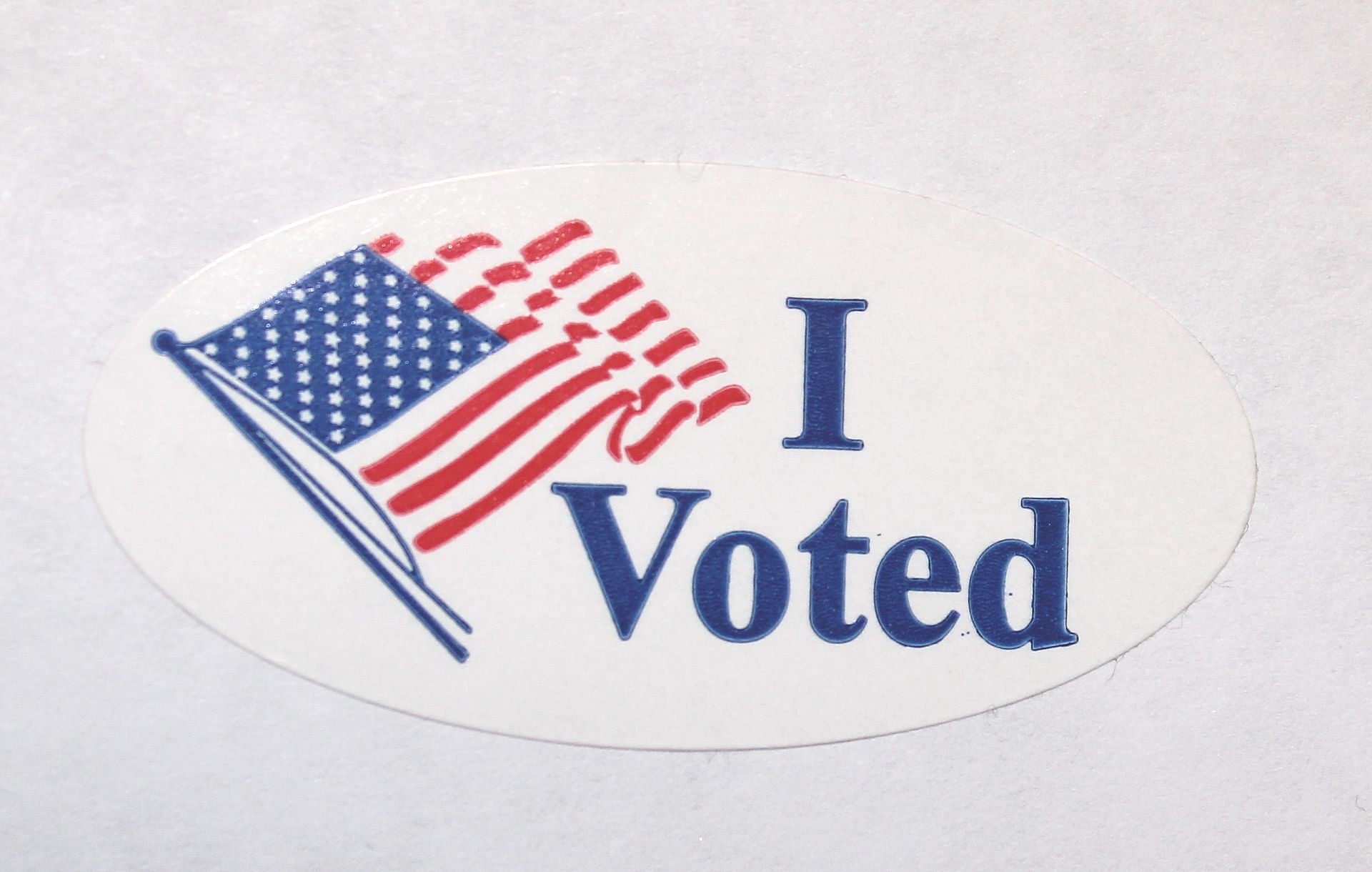 I voted today after lunch—absentee, if that wasn't clear. There's no particular reason I couldn't have voted on Election Day proper, but this was just more convenient. Indeed, I timed it, and it took 8 minutes, 34 seconds for me to vote (including walking to the nearest mailbox). That's several times faster than it would have taken me to vote in person. When I did that for this year's primary, it took about 45 minutes round-trip.
Still, I was willing to vote in both instances. This five-fold reduction in the time cost of voting wasn't decisive. Nor would we expect it to be, given how low the chances were of my vote altering the elections' outcomes in either case. I chalk it up to a taste for voting, because I always had a good time accompanying my parents to the polls when I was a wee lad. I carry that habit/taste with me into adulthood, and I value it plenty higher than even several hours of my time. It seems that most other voters do so based on a pretty strong taste, expression, or civic duty as well; after all, 2020's massive expansion of mail-in voting seems not to have had much of a causal impact on voter turnout. Those who already planned to vote voted; those who didn't, didn't.
Would Harold Hotelling go to Dunkin' or Starbucks?
Dunkin' Donuts and Starbucks have supplied America with caffeine for over half a century. Both offer a variety of specialty coffee drinks on their respective menus. I am indifferent about the two. Starbucks provides slightly better quality at a more premium price; however, with this difference, the two still provide remarkably similar products. In a study done in 2021, looking at the location of Dunkin stores, only one of the six explanatory variables studied was found to explain these locations. The number of Starbucks in each zipcode was the only statistically significant factor out of the population, number of households, income per capita, household median income, and family median income that could help predict a Dunkin' location. Harold Hotelling's model, which is related to spatial competition, could explain this observation better. In his model, with two competitors set in their respective locations, it is optimal for each store to move and operate in the exact same area. Under the assumption that people are indifferent between their products and buy from the closest location (for the purpose of the model), these moves happen because the two will play relocation cat and mouse until they end up in the exact location. This would create an equilibrium where people are indifferent about traveling to either Dunkin' or Starbucks, and it is now Pareto efficient because nobody can move without making one person worse off. When I ponder this study, what surfaced in my head are the Dunkin' and Starbucks stores that sit directly next to each other as you pull into the gates of my hometown high school, and Harold Hotelling helped me understand why. His model can be applied vastly to two-party political systems, fast-food chains, or even the bars on the Corner at UVA.
FOFR (Fear of Future Regret)
ECON 4300 - Public Choice
ARCH 1010 - Lessons of the Lawn
ECON 3720 - Econometrics
COMM 3010 - Intermediate Accounting
RELC 1220 - Early Christianity and The New Testament
This is my current schedule for the 2024 Fall semester, and as my accounting professor pointed out, it’s quite diverse. This lineup is a direct result of my aversion to future regret that drives many decisions in my life. Mueller would describe me as a minimax-regret strategist as the fear of future regret incentivizes my behavior as a rational agent.
I became conscious of this strategy at the end of first year when I finally entertained the idea of pursuing a degree in Architecture. I’ve always admired architecture and the passion that is palpable within the field, but never considered it for myself as I can barely draw a straight line. However, I recognized my opportunity to discover this field was fleeting and dreaded the idea of being discontent at a future job where I would dwell on what could have been if I’d only taken action. UVA is conducive to this strategy to an extent: each degree requires a diversity of subjects but there’s only a certain amount of credits taken outside the College that one can use towards their 120 credit-hour requirement. So while the classes in the A-School (and the many I took in the Comm School) set me back on Arts & Science credits needed for graduation, I weighed the E[MB] with the MC and found that the possibility of finding a passion, appeasing any future regret I may have, and broadening my education here at UVA would have a greater payoff than the costs of taking these classes, which include imposter syndrome, the extra work and effort to learn a brand new subject, and the opportunity cost of taking Econ classes. This doesn’t mean that the choice was easy - high opportunity costs including the possibility of graduating early or taking fewer credits each semester linger over my head, but I was and am ultimately pushed by future uncertainty that could contain regret of my inaction.
With that being said, I find the case of the minimax-regret strategist to be very underestimated as it’s intuitive for a rational individual to consider the outcome of their choices, which is a forward-looking approach that can naturally lead to considerations of future regret. Therefore, it’s rational and common for an individual to be motivated by the possibility of regret, and this incentive for behavior allows us to understand consumer preferences, as Mueller depicted in his attempt to rationalize the act of voting.