Sunday, November 5

Thank lobbyists for that extra hour of sleep

Have you ever wished there were more hours in the day? 

You aren’t alone—gas stations also wish the sun was up for longer.  Studies show Americans are more likely to leave their homes when it’s lighter outside, regardless of the time, and (for most, college towns may be an exception to this) leaving means driving and driving means more gas sales.  Very aware of this fact and eager to maximize profits, the Association for Convenience and Fuel Retailing lobbied hard to extend Daylight Savings Time by a month in 1986.  And it paid off: since adding a month to DST, the industry has estimated a $1 billion increase in annual sales. 

They aren’t the only ones who have a stake in the game either.  Lobbyists from the Chamber of Congress, gardening, sports equipment, and home improvement retailers, the golf industry, and even the barbecue industry are all in support of longer Daylight Savings Time because it allows their consumers more time to, well, consume.  How far are they willing to go? In 1985, the candy industry lobbyists, wanting to stretch Daylight Savings to cover Halloween in hopes of allowing trick-or-treaters more time to collect more candy, supposedly put candy pumpkins on the seat of every senator as a sweet little incentive.


Friday, November 3

MVT and political polarization

The median voter theorem predicts that a democracy will elect the candidate closest to the median and that, over time, rational politicians’ positions will converge to the median. Can this explain the outcome of the 2016 presidential election and the continuing trend of political polarization? Most would agree that Clinton was closer to the median than was Trump. Further, polarization, the opposite of convergence, seems inconsistent with the theory’s prediction. 

As we observed in class, the MVT holds even when crucial assumptions are relaxed. A polarized population (picture an inverted normal distribution) would still elect the median candidate, though perhaps begrudgingly. However, two key assumption—without which the MVT cannot hold—are violated in our political reality: there are extremely high barriers to entry in the political market and candidates have restricted political mobility. Suppose a polarized distribution, as envisioned before, and two political parties, one around the 25th percentile and one around the 75th percentile. The election will ultimately still be decided by the median voter, and each party could have performed better if it moved closer to the median. However, we are unlikely to see this happen. Candidates are chosen in primary elections by the median party member. They are not fully bound to the positions taken in primary elections, but they cannot move from these positions costlessly. Voters may “punish” a “flip-flopper” to such a great extent that the MVT’s predicted winner will in fact lose. Why doesn’t a third party enter the game, exactly at the political median, and immediately become dominant faction? Because of the incredibly high barriers to entry in the political market.

As such, we should expect to see less polarization in elections where candidates are more mobile and there are fewer barriers to entry. Take, for example, local school board elections. Unbeholden to parties or primary voters, school board candidates can tend towards the median without significant cost. New entries are feasible due to the local scale. As theory would predict, we see lower polarization in these elections. Under this theory, this lower polarization of candidates is not due to a lower polarization of the constituency, but rather due to lower barriers to entry and greater freedom of movement. 

Sunday, October 29

What rings a bell - epinephrine autoinjectors or EpiPen?

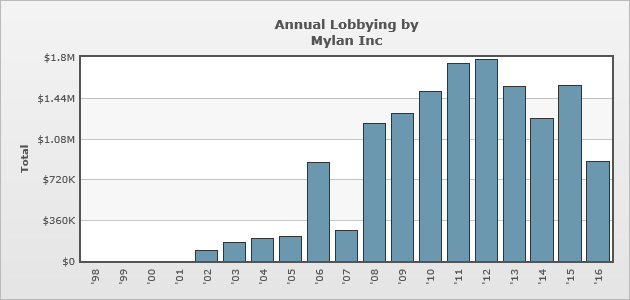
Pharmaceutical manufacturer, Mylan, has quite notably generated a monopoly around epinephrine autoinjectors, which releases epinephrine to stop a severe allergic reaction. Mylan's product, the EpiPen, has risen from less than $100 in 2007 to over $600 in 2017 (an over 400% price hike!) How is the company able to continue increasing its price without losing customers and market share? It's because of Mylan's lobbying efforts and close relationship with government mandates, fueling extremely high entry barriers, price and dosage changes, and restrictions on generic/brand name products. 
Picture

Source: https://www.opensecrets.org/lobby

Among many other several successful lobbying efforts, Mylan lobbied lawmakers to make epinephrine autoinjectors a necessity in schools. These efforts were supposedly to provide quick solutions to allergic reactions in general, agnostic of what the solution may be. However, further lobbying by Mylan included seeking federal legislation that provided subsidies to schools for the purchase of EpiPens, given that these schools do not buy epinephrine autoinjectors from any other vendors. Due to Mylan's years of lobbying and lavish PR/marketing, they had established themselves as the only player in the market, inevitably making them the only vendor in schools. 


With the help of the FDA, Mylan also lobbied to recommend the best treatment as 2 dosages instead of one, so now EpiPens are only sold in twin-packs. The monopolization of the epinephrine autoinjectors would not have been possible without the alliance between Mylan and governmental agencies. Also, can we examine the millions of dollars wasted to attain this rent? 


Monday, October 23

Amazon HQ 2

Amazon has begun plans on establishing a second headquarters equal to their Seattle Headquarters, in some city, in the US. Amazon says it will invest $5 billion in the construction of their HQ 2 and house 50,000 Amazon employees in the future. They have already received 238proposals, including bids from 7 cities in Canada and 3 in Mexico. Amazon has created a desirable prize for cities across the country and internationally that are looking to benefit from the influx in economic growth that this will certainly bring.   

All of these cities are rent seeking this prize, using resources to incentivize Amazon to pick their city and in turn diverting those resources that could be used to provide for their respective communities. The company has even stated “Incentives offered by the state/province and local communities to offset initial capital outlay and ongoing operational costs will be significant factors in the decision-making process.” The problem arises when the cities that don’t get the prize will have lost all of the resources expended on the incentives for Amazon. 

Sunday, October 22

Uber's Attempts to Ride the Gravy Train

The taxi market has always been engaged in the practice of rent-seeking, as groups lobby city commission boards for a medallion - which equates to access to the rent in the monopolistic market created due to these government licensing restrictions. Not only does lack of competition hurt consumers, who would pay higher than competitive market fares, but the expenditure on attempting to obtain a license - the bribes - are an allocatively inefficient use of resources. They are the costs associated with rent-seeking. When Uber arrived on the scene, it seemed to be to the benefit of the consumer. It provided a welcome alternative to taxis, undercutting the monopoly. Of course its entry brought about an increase in rent-seeking or "rent-protecting" behavior by taxi cabs who were threatened by the competition. But Uber, was spending its opposing lobbying money in ways that would seem to be socially positive: helping consumers by increasing competition. (One might argue that lobbying is in itself an inefficient use of resources, but the blame would be on the government for providing the barriers that Uber is being forced to lobby against.) It was decreasing the rent available, and increasing consumer surplus.

In the first half of 2017 Uber is the top lobbying spender in New York, attempting to decrease market regulations in upstate New York. Open markets seem to be a socially positive outcome such that it would be hard to call Uber's actions rent-seeking.  However, reports also state that once Uber has planted itself into a locality, it has tried lobbying for regulations that hurt present & future competitors (Lyft etc.). While the money spent here would be considered rent-seeking, what about previous lobbying efforts? If Uber were to establish the monopoly they seek, this would be at a detriment to consumers. If the loss of consumer surplus was equal/higher than when taxis ruled, would all of the lobbying done by Uber up to this point be considered rent-seeking? In the short-term, early lobbying would seem to have led to socially positive outcomes, but what happens if in the long-run the outcome becomes negative? If Uber's goal was always to open up competition only to decrease it and establish their own monopoly, effectively all of their actions would be for the purposes of securing a transfer of rent from taxis. Most seem to think that Uber will fail to secure a monopoly, meaning this question is moot. But in a hypothetical world with a more socially negative outcome, how much of Uber's lobbying efforts would constitute rent-seeking?


D factor

We know for a fact that it is irrational for people to vote on any kind of election since the expected benefit from voting is really small compared to the cost that will be incurred. Yet, there are still people who decide to vote instead. The more people who abstain from elections, the greater the effect an individual vote can have and hence the greater the incentive to vote. But this decrease cannot possibly account for a significant increase in the expected benefit that will exceed the cost. So, the D factor is put into play where D represents social pressure people are getting for not voting. The new equation is now E[B]+D>MC in order for people to vote.

We can see from this equation that there is an optimal amount of social pressure that needs to be incurred in order for people to vote. Let D* be the amount of social pressure for which the person is indifferent between voting and not voting (E[B]+D*=MC). For any D>D* we can see that the result will be the same. For any D>D*, people will vote no matter how much larger D is compared to D*. That means any additional social pressure incurred greater than D* will just make people more eager to vote but the ending result, voting, is the same. Is there a way to interpret any additional units of social pressure greater than D* ? In order to answer this, we must also consider that social pressure doesn’t always revolve around voting only but also around the candidates on the elections. People may ask others “did you vote for this candidate” instead of just “did you vote”. As a result, possible candidates might take advantage of this fact. If a candidate is losing, he should aim to increase the participation rate as this is the only way he might be able to win. If a way of measuring social pressure can be found, the candidate can aim to expose himself on social media, aiming towards achieving D* or greater around his name. By causing D*+A, where A is a positive amount of social pressure, he will cause the participation rate to rise and for the people whose optimal D is equal or less than the average D*, he will cause them to incur social pressure to others as they are now more eager to vote, increasing further the participation rate. To sum up, the additional D units can be interpreted as the amount of extra social pressure a candidate needs to achieve for his name in order to be lead to victory. If it was possible to measure D, candidates would be able to spend the right amount of resources on campaigns without overdoing it and wasting factors that could have been potentially used otherwise. On the other hand though, candidates’ dominant strategy is to incur as much D as possible in order to increase the chances of winning, causing the people to be split on the extremes when it comes to the policies and ideas each candidate represents.

College Football: Hoos ranked? Not us.

“In any ranking system, perfection or consensus is not possible”

However, there are a host of polls that try their best to get as close to “perfect” as possible.  The AP (Associated Press) Poll, which is released weekly during football season, names the Top 25 teams in the nation and is a good indicator of potential post-season matchups.  It is created by a panel of 60 sports reporters who cast votes using a Borda Count method.  They vote on which teams they believe are the best in the nation and rank them accordingly.  For every first place vote a team receives, the earn 25 points.  For every second place vote, 24 points, and so on—a classic Borda count voting procedure in action.  The Coaches’ Poll works in the same way, except the panel is made up of head football coaches from FBS schools.  These polls are taken as fairly accurate evaluations, and given the Borda Count is relatively Condorcet Efficient (especially when compared with simple pluralities or elimination/run-offs), this might not be too far off from naming the best team in the nation (or the Condorcet winner, should there be one).


Before Saturday’s game against Boston College gave all of us a reality check, there was this tiny grain of hope in me that maybe this year we could break into the Top 25 of the College Football AP Poll.  Last week, UVA received 10 points in the AP Poll (29th in the nation) and 42 points in the Coaches’ Poll (28th in the nation).  But, following our 41-10 loss on Saturday, we would have been lucky to see even one this week.

This picture was under the headline "BC Hands UVA a Beatdown" #ouch #hoosrising