Sunday, October 9

Option 1, Option 2? Does anyone really care?

One of my residents recently asked me why I decided to attend the University of Virginia. My answer was simple: Student Self-Governance. Many consider our Honor and Judiciary systems the epitome of this ideal. I know I do. I am also impressed with how these systems mimic our nation’s Constitutional system in that changes to the rules of these organizations require a voting student electorate. (UJC, for example, requires a two-thirds majority to ratify an amendment to its constitution while Honor requires a three-fifths majority. The different thresholds likely reflect the nature of the topics handled by each organization and the impacts these topics would have on the external costs to the University community. However, this is a subject for another blog post.)
I must admit I was thrilled the first time I cast a ballot in a University wide election, and I have never missed an opportunity to do so since. However, I have noticed during my time here the that my peers have become seemingly less interested with voting in student elections. According to the University Board of Elections, 40.25% of the student body voted in the 2013 spring cycle. This number dropped to 25% the next year, and only rose to 30.8% one year later. Regrettably, the participation rate for the election of Student Council President for this year was only 24.77%. This disturbing trend suggests an apathy towards voting at UVA. I know the University prides itself on the admission of students who outstanding academic results, and I firmly believe it presumes a student population that manifests a tremendous enthusiasm for university activity. Therefore, this is a surprising trend. Last year’s Honor Referendum highlighted this dilemma. One of the referendums in particular called for a university wide vote on whether we should amend our single sanction Honor system to a multi-sanction system that gives opportunities to educate rather than punish. Only 34.26% of the student body voted on this referendum. Nonetheless, our study of rational abstention demonstrates that this is completely normal and predictable.
In our class discussion of Johnson’s paper, Voting, Rational Abstention, and Rational Ignorance, we compared the cost of voting to the expected benefit of voting or the net benefit of casting a deciding vote multiplied by the probability of a voter deciding the election. We concluded that if the cost of voting was greater than the expected marginal benefit a rational voter would not vote. Additionally, we realized that this probability is almost negligible given the number of people participating in the electoral system. If we extend this rationale to discussing the voting practices of UVA students on an Honor Referendum we can clearly see why so few students decided to vote. Allow me to illustrate this. I assume that most UVA students believe that the Honor system will at some point misinterpret an action on their part for an Honor code violation. For an individual student voter who believes that a change from the status quo of a single sanction system in Option 1 to a multi sanction system in Option 2 would reduce the likelihood that they are expelled from the University of Virginia, I argue that the expected benefit that a student would receive would be equal to the probability of the student’s vote swinging the decision on the Referendum multiplied by the benefit of not being expelled from the University or the value of a bachelor’s degree for a millennial over and above the value of a high school graduate’s degree (The Pew Center estimated the benefit to be about $17,000: $45,000 – $28,000). The number of eligible voters in this election was 22,047, so the probability of one student’s vote deciding this issue was essentially 0% at 1/22,047.  When we multiply this probability by the expected benefit of a single student’s vote determining the outcome we find that this student could expect a marginal expected benefit of approximately 77 cents. (A note: I made an assumption about how students value the Honor System earlier in my analysis. Even if we changed those values, the probability of one student’s vote deciding this issue is so small that this would still be a negligible amount of expected benefit.) Now, let’s consider: the University uses an online ballot system powered by the University’s Wi-Fi that is free to all students. Nevertheless, it takes time to fill out the ballot and/or decide how to cast your vote. Undoubtedly, this time could have been spent studying for midterms or finals or engaging in utility maximizing activities with friends. We could say that at an incredibly low approximation, this opportunity cost might be somewhere between $10 and $20. The difference,therefore, between the cost to students voting and the expected benefit they would receive from having cast the decisive vote yields at minimum an approximate $9.33 net loss to a rational voter. Consequently, a more apt deliberation would be on why 34.26% did actually vote.

We discussed many theories in class with regard to voting, including civic duty/social responsibility, utility derived from the act of voting, expressive voting and minimax regret. However, given UVA’s admissions criteria and the composition of the student body I believe that most students who vote do so, as do I, motivated by a sense of civic duty. As student leaders, we are driven by a desire not to be free riders in our community.

http://m.memepile.com/photo?id=9460

How to Help Fight Rational Thinking and Increase Voter Turnout

Several weeks ago, we discussed the voter turnout in political elections and Professor Coppock showed us that in most instances, taking the time to vote is not even a rational use of your time. Downs makes a convincing argument that the marginal costs outweigh the marginal benefit of voting more often than not, as the likelihood that a given individual's vote will make a difference in determining the outcome of the election is incredibly low - so the rational, self-interested voter will not vote.

This hypothesis seems to hold up well in the U.S. compared to other countries around the world. See here and below - the U.S. ranks dismally low in regards to voter turnout.
Of course, between 50%-55% voter turnout, while comparably low, isn't zero - hence, the paradox of voting Downs observed. All hope is not lost for avid political enthusiasts such as myself. So what are the reasons many people are in fact fighting rationality and casting a vote? And how can people (such as myself) who want to stick it to Downs and increase turnout build on those reasons? We discussed a number of them in class, but two experiments done in New Jersey and California with two different 2005 and 2006 elections would suggest the "following the crowd" approach. Researchers found that people were a lot more likely to participate in an election if they thought relatively more people were going to vote as opposed to when they thought fewer would be participating, despite the fact that basic logic tells us your vote would count for more if less people turned out. Incredibly, a similar study conducted in Iowa yielded an 8.1% increase in voter turnout when homeowners received a letter saying that they and their neighbors would be notified after the current election regarding who voted and who didn't. So it seems that civic duty is important, but mostly when your friends find out you didn't carry out yours.
Finland

Burkini vs. Bikini; Regulating People's Choice


Life in a country like Iran, which is run by a totalitarian religious government, is very different from what we experience here in the US. Some issues that a young American has never even thought about can be an ordinary problem for an Iranian college student who lives in Tehran. One of these problems is the right to choose what to wear. As simple as that may sound, everyday many Iranians have to face the fact that what if “the Guidance Patrol” (aka Morality Police) stops them and gives them ticket for wearing “inappropriate” clothes. If you can remember on our second class this semester we discussed Friedman’s Capitalism and Freedom and what he thinks the role of a government should be in a free society. Professor Coppock showed us a picture regarding French police forcing a woman wearing burkini to remove her clothes on a beach in Nice (read the full article here!). This is exactly opposite to what Iranian police does in that country. And they are both examples of forced conformity. Recently in Iran a new app called Gershad was made for android smart phones. This app lets users report the locations at which the Morality Police have been located so that people can skip these cops by driving or walking though other routes (How it works?!). In this way you can decrease the chance of getting pulled over by the Morality Police.
I believe this app perfectly demonstrates how market finds its way to get around some extreme governmental policies, even under a dictatorial system like the one in Iran, to achieve its goal of "unanimity without conformity."


Inspire Change...Register to Vote!!!


Last weekend I was peer pressured by Facebook and 3,749,638 of my closest friends to register to vote "to make sure [I] have a voice in the election" and share this Life Event on my page. This new initiative on Facebook decreases the cost of voting by prompting users to simply click "register," taking them to the registration page for the state they live in. The average Facebook-er spends 50 minutes per day on the site, and now, registering to vote won't require much change in the daily routine.  As Public Choice students we know that just because the cost decreases doesn't necessarily make it rational for us to actually go and vote; however, letting everyone on Facebook know that I am registered to vote increases the utility I get from the act of voting, regardless of the outcome of the election and the effect of my individual vote. People may derive some expressive value from sharing with everyone they are "friends" with that they are fulfilling their civic duty. This utility can be added into "D" which, in combination with the decreased cost of voting, may make it rational for people to vote (PB + D > C).
Other apps, like Snapchat, are also attempting to decrease the cost of voting for millennials through a partnership with TurboVote, a site that allows users to quickly sign up to receive information about upcoming elections and how to register. Even Starbucks jumped on board promoting TurboVote on all their warm drinks this fall and encouraging customers to "inspire change." (I wish that when someone registered to vote, they received an "I Inspired Change" sticker!)

The decrease in the cost of registering and voting together with the increase in expressive utility people may get from easily sharing their participation in the upcoming election may result in more people rationally deciding to vote in November.


Saturday, October 8

Having a Median Temperament is a Winning Temperament

If you watched the first Presidential debate, you might remember Donald Trump commenting on his “winning temperament”. Given what we know about the median voter theory, why would any rational candidate running for president focus on their personality instead of their ideology? Anthony Downs essentially argues that all a candidate needs to win is to have the policy bundle that the median voter will vote for. However, given data from a 2004 Gallup poll, we can see that personality in conjunction with ideology appears to matter a whole lot.

Personal Traits of Candidates -- Importance in Predicting the Vote for President
Traits
Importance Score in Predicting How People Will Vote

%
Shares your values
100
Can manage the government effectively
49
Is honest and trustworthy
43
Party affiliation (of respondents)
35
Is a person you admire
30


Is knowledgeable about the issues
13
Is a strong and decisive leader
9
Does not change his positions on issues for political reasons
5
Cares about the needs of people like you
3
Has an optimistic vision for the country's future
3
Source: CNN/USA Today/Gallup Survey

Honesty, management abilities, and shared values all rank above belonging to the same party. So the question I now have is how do we reconcile the fact that personalities matters with the current median voter model? My proposal is that we have two models: a median voter model for ideology and then another for personality.

When you think about it, presidential candidates appear to try and be aiming for the personality that the most voters will like. Strong, but not stubborn. Honest, but not crass. Knowledgeable, but not bookish. Caring, but not naive, and so on and so forth. And while we individually might have different preferences for certain personality traits, our preferences aggregate across the electorate for a desired “presidential personality”. Under this expansion of the model, Donald Trump talking about his personality in a way to make it more appealing could be seen as a rational appeal to the median voter. And just like the assumption of spatial mobility in policy, many voters can see Donald Trump’s deceleration of having a “winning temperament” or Hillary Clinton’s countless attempts to re-craft her image as a sort of spatial mobility in personality. Thus, when the median voter is decisive, the median personality appears to matter equally or more than the median ideology.  

Tuesday, October 4

Can you tell these athletes apart? The median voter can

Last week when we were discussing the Median Voter Theorem in class, I could not help but think of an article I read over the summer about how Nike and Adidas have put their professional runners in almost identical kits the last two years (See picture below). In this situation, Nike and Adidas are both appealing to the “median viewer,” and thus end up with very similar products. The result that the companies are fighting over is future purchases by viewers (similar to votes) of the company’s products. The scale that the two companies are looking at could be considered conservative vs flamboyant, where the most conservative kits would be monotonous and dull colors without any patterns and the most flamboyant would be neon or bright colors.


Thus, the equilibrium for kit design is somewhere in the middle of that, assuming that the population is normally distributed on the scale. In the pictures, you can see that the designs have elements of a conservative design both years (2015- Black shorts with solid color top, 2016- Black shorts with gray top) and more “out there” elements (2015- Purple top, 2016- Neon logos, white stripes).

Just as in the hotdog stand example, this is not the optimal outcome for consumers. In the class example, people had to walk farther to get to the hot dog stand, and in this example, viewers have a difficult time telling the athletes apart when they are all dressed nearly identically, thus decreasing their utility for watching races. Viewers do have the option to abandon watching the sport, or other companies can come in on either extreme with their kit design to try to win over those viewers.

Monday, October 3

Find a Penny Pick It Up....

One of my favorite procrasti-pastimes is to watch John Oliver’s Last Week Tonight. If you haven’t watched it, click on his name now - you’re welcome. While he mocks just about every major societal topic, albeit in a stylized way, he does so in an extremely educational manner. I appreciate the information I gain from his show, but I don't usually dwell upon any one episode for too long. However, our past two lectures on voting prompted me to re-watch and re-think one of my more favored episodes titled quite simply: Pennies.


The main point Oliver makes in this webisode is that pennies are not only worthless, they actually hold NEGATIVE worth. That’s right, it costs 1.7¢ to make a currency valued at 1¢. Gives a whole new meaning to “spend money to make money”, doesn’t it? Oliver equated that America spends $136 million dollars a year to make $80 million dollars worth of pennies - this is absurd to me. However, what made me go back to this webisode was the argument of why people vote even when it is proven that the marginal benefit of voting a decisive vote is obviously less than the cost to cast it. We learned that there is some variable incorporating civic duty or responsibility, of voting “D”, accounting for other benefits we receive from the act of voting that is not dependent on the vote actually mattering. Similarly, it is proven that the benefit of a penny (1¢) definitely outweighs its cost (1.7¢). So I thought I would do a little research in to the “D” per say of the Mueller equation of the penny. Bear with me. 


Here is how I see the equation: The B of a penny is its value of 1¢. However, the probability of that value meaning something to the person whose pocket it is in is ~0, just like voting This is supported by news stories highlighting C-stores choosing to ban pennies, and even the 2% of people who admit to throwing away money.   Sure there are those few people who are still willing to pick up that lucky penny, but they are far and few between. So we are in this similar rational voter dilemma where P*B < C. We’re also aware with the penny that its cost (C) is very small, so it doesn’t take a huge change in B for the equation to flip. But that P of significance is so darn small that it can’t just happen with B. There must be some alternative benefit given to the penny that keeps it in circulation. Enter: Zinc Companies and Abraham Lincoln Lobbyists (isn’t the 5 dollar bill enough for you people?). These companies, who are like the people who still fight for floppy disks to matter, are the main reason why this currency has not been phased out. Their “D” comes from two different, but inevitably strong, feelings. First, the lobbyists of Common Cents fight every year for the continued production of the penny. But that is because their main sponsor, Jarden Zinc, is the sole manufacturer of the tiny copper circles that pennies are printed on. Of course they want the penny to exist, otherwise their company won’t. The second feeling incorporated by D is the love of good 'ole Abe, and the support from lobbyists who believe that getting rid of the penny is like peeing on the Abraham Lincoln Statue in D.C. Simply disrespectful. After thinking this whole concept through, I now understand a little better the other reasons why people feel the need to vote when the situation clearly tells them that it is economically irrational. But then again, what would humanity be without a little irrationality once in a while? Or in this case, every 4 years when we decide the fate of our country? I think it’s healthy. But that’s just me. 

Sunday, October 2

The Need for Speed?

While driving to Washington, D.C. before fall break, I found myself contemplating speeding as I exited the crowded, traffic-filled portions of US 29 and entered the portion of the highway with fewer cars. I began to consider the enforcement of the speed limit by the police and why we have our speed limits. Germany has the Autobahn (the federal controlled and provided highway system) where segments do not have a speed limit and their federal laws even promote this high-speed driving with punishment for failing to keep right if you are driving slower.

The federal system and the German police enforce the high-speed driving with punishments for reckless, “slow” driving or failure to signal a change of lanes as a means for providing this public good. However, in the United States, this same public good is regarded in a different perspective as it is considered reckless to speed and speed limits are enforced throughout U.S. highways. This reminded me of our discussions from class regarding the enforcement of the Pareto optimal equilibrium and strategy of a public good. Obeying the speed limit and the rules set by our local governments for use of the highway is not the dominant strategy, however.

Here is proof as to why speeding is the dominant strategy:
Car 1
Car 2
Do Not Speed
Speed
Do Not Speed
20, 20
10, 40
Speed
40, 10
30, 30

The dominant strategy in the U.S. is to speed, however the Pareto efficient and optimal allocation is for everyone to follow the speed limit and to not speed, which is enforced by the police. The numbers presented are in terms of the number of minutes the portion of the trip will take each driver (in the format Car 1 trip time, Car 2 trip time). It is assumed that when all cars are speeding it will take longer due to higher speed of traffic and congestion on U.S. highways.

Although, speeding in theory would be a dominant strategy for getting from point A to point B when in a hurry, the current infrastructure of U.S. roads and highways do not allow for high-speed travel. On US 29, for example, I experienced potholes and construction as well as many traffic lights and merging areas for oncoming traffic. Adding high-speed travel to these congested areas or bumpy and hilly roads could increase accidents or danger to ultimately increase travel time. To avoid this danger, the structure of the Autobahn actually allows for high speeds to create shorter travel time, as the highways are constantly maintained and include service stops alongside the freeway for less congestion exiting.

Although, in my travels the other day speeding could have accelerated my trip in certain areas, I believe the enforced speed limit is the Pareto optimal equilibrium in the United States due to American driving habit and mannerisms (i.e. changing lanes without always signaling), road infrastructure and traffic patterns. However, I may have to visit Germany soon to try out the Autobahn! 

Why Majoring in Economics is Irrational

According to both the notion of rational ignorance and this derisive drama major, I shouldn't have majored in economics. In order to explain why, I will use the number of classes I take in economics as a proxy for the quantity of economic knowledge I have. I realize this is hardly a perfect measure, as before I took a single economics class I had to know a thing or two about economics, and sadly even if I took 1,000 econ classes I still wouldn't have '100% knowledge of economics.' However, it's surely close enough to make reasonable use of.

The marginal benefit of the first two econ classes I took, 201 and 202, was very high as they, similarly to the first 300 words of a new language, provided me with a basic, highly useful understanding of the basic concepts that could allow me to have a worthwhile conversation in that new language, or about economics. Econ 301 and 302, allowed me to apply some of these concepts more rigorously, and thus move me along the knowledge x-axis we saw in class. Learning about monopoly power and being able to explain its characteristics and effects both qualitatively in discussion and quantitatively with a basic econ graph (as learned in 202), provides a much greater marginal benefit than the next step of knowledge (deriving mathematical effects of monopoly power in 301). The marginal benefit of each is positive as it permits greater understanding of economics which has at least some inherent value, however the value of each class as I progress within economics decreases because while adding a more nuanced understanding of something is beneficial, it isn't as beneficial as understanding the basics of it in the first place.

Knowing just the marginal benefit of each econ class isn't enough to decide how much knowledge of economics it is rational to have, or in this case how many econ classes I should take. We also must know the marginal cost. While the marginal benefit of each class is decreasing, the marginal cost of each is increasing because my ability to learn in each course is diminishing, and thus requires a greater tradeoff of my time and effort, which I could more beneficially apply to studying for classes for which my marginal cost is lower. My marginal benefit of taking 202 was equal to the marginal cost, and thus defined my rational level of knowledge (or # of econ classes) as 2: 201 and 202. Completing my major in economics required me to take a significant number of econ classes for which the cost exceeded the benefit, thus making my major in economics an irrational decision on my part.


Disclaimer: this doesn't explain why all Econ majors are irrational, just why mine is.


Political Geography of the 2016, 2012, and 2004 Presidential Elections

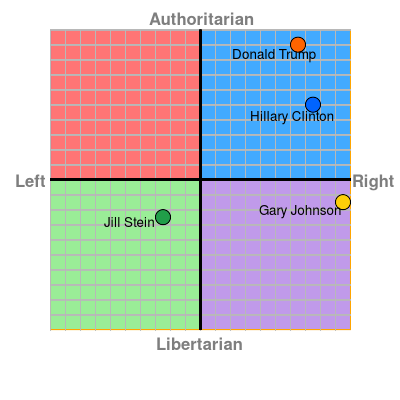
The Political Compass is a tool used by an organization of the same name to label and organize political thought on two dimensions. Instead of Downs' assumption of one political issue (more or less government), the compass uses a square that refers to four policy ideologies: left, right, authoritarian, and libertarian. It's a tool very similar to the concept proposed by Downs if we continue to assume the spherical political indifference curve. The Political Compass estimates that this election looks a little something like this:
      US Presidential Presidential candidates 2012 including Donald Trump, Jill Stein, Gary Johnson and Hillary Clinton
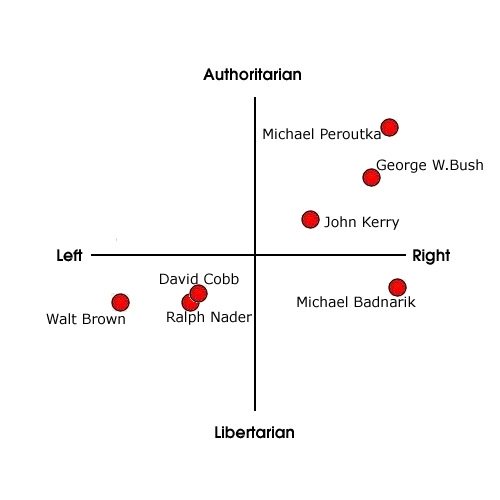
If we assume a two party system with Clinton and Trump, a uniform distribution of ideologies and complete adherence to rational voting would see Clinton with almost 75% of the popular vote. Much more likely, however, is a very different distribution of voters with relatively few people outside the top right corner. What I find interesting is the movement of leading democratic candidates more towards the upper right side of the upper right quadrant. For instance, this is the compass in 2004:
US presidential candidates 2004 including David Cobb, Walt Brown, Ralph Nader, Michael Badnarik, John Kerry, George W. Bush, Michael Peroutka
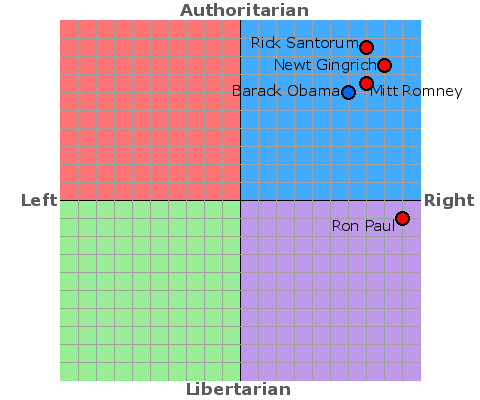
In 2004, John Kerry was much closer to the central point between left, right, authoritarian, and libertarian. Barack Obama's bid in 2012 saw a similar position on the chart but in 2012, Obama's policies stances were incredibly close to Romney's: 

US Presidential Presidential candidates 2012 including Rick Santorum, Newt Gingrich, Barack Obama, Mitt Romney, Ron Paul

According to Downs' theory, this movement makes complete sense since Obama is able to capture more voters by moving closer to Romney. This year looks like the hot dog stand equilibrium point because Obama and Romney are so close. These illustrations further support Downs' assumption of spatial mobility since the Democratic party has made substantial movements around the political spectrum. 

Overall Downs' theory has some predictive power for political movements but with a different candidates every four or eight years, consistent positions are rare unless candidates fully buy into a party platform. Further inquiry into the dynamics of voting in the United States might include a stab at creating a voter distribution on the maps shown above but this post is already way too long.