Saturday, October 8

Having a Median Temperament is a Winning Temperament

If you watched the first Presidential debate, you might remember Donald Trump commenting on his “winning temperament”. Given what we know about the median voter theory, why would any rational candidate running for president focus on their personality instead of their ideology? Anthony Downs essentially argues that all a candidate needs to win is to have the policy bundle that the median voter will vote for. However, given data from a 2004 Gallup poll, we can see that personality in conjunction with ideology appears to matter a whole lot.

Personal Traits of Candidates -- Importance in Predicting the Vote for President
Traits
Importance Score in Predicting How People Will Vote

%
Shares your values
100
Can manage the government effectively
49
Is honest and trustworthy
43
Party affiliation (of respondents)
35
Is a person you admire
30


Is knowledgeable about the issues
13
Is a strong and decisive leader
9
Does not change his positions on issues for political reasons
5
Cares about the needs of people like you
3
Has an optimistic vision for the country's future
3
Source: CNN/USA Today/Gallup Survey

Honesty, management abilities, and shared values all rank above belonging to the same party. So the question I now have is how do we reconcile the fact that personalities matters with the current median voter model? My proposal is that we have two models: a median voter model for ideology and then another for personality.

When you think about it, presidential candidates appear to try and be aiming for the personality that the most voters will like. Strong, but not stubborn. Honest, but not crass. Knowledgeable, but not bookish. Caring, but not naive, and so on and so forth. And while we individually might have different preferences for certain personality traits, our preferences aggregate across the electorate for a desired “presidential personality”. Under this expansion of the model, Donald Trump talking about his personality in a way to make it more appealing could be seen as a rational appeal to the median voter. And just like the assumption of spatial mobility in policy, many voters can see Donald Trump’s deceleration of having a “winning temperament” or Hillary Clinton’s countless attempts to re-craft her image as a sort of spatial mobility in personality. Thus, when the median voter is decisive, the median personality appears to matter equally or more than the median ideology.  

Tuesday, October 4

Can you tell these athletes apart? The median voter can

Last week when we were discussing the Median Voter Theorem in class, I could not help but think of an article I read over the summer about how Nike and Adidas have put their professional runners in almost identical kits the last two years (See picture below). In this situation, Nike and Adidas are both appealing to the “median viewer,” and thus end up with very similar products. The result that the companies are fighting over is future purchases by viewers (similar to votes) of the company’s products. The scale that the two companies are looking at could be considered conservative vs flamboyant, where the most conservative kits would be monotonous and dull colors without any patterns and the most flamboyant would be neon or bright colors.


Thus, the equilibrium for kit design is somewhere in the middle of that, assuming that the population is normally distributed on the scale. In the pictures, you can see that the designs have elements of a conservative design both years (2015- Black shorts with solid color top, 2016- Black shorts with gray top) and more “out there” elements (2015- Purple top, 2016- Neon logos, white stripes).

Just as in the hotdog stand example, this is not the optimal outcome for consumers. In the class example, people had to walk farther to get to the hot dog stand, and in this example, viewers have a difficult time telling the athletes apart when they are all dressed nearly identically, thus decreasing their utility for watching races. Viewers do have the option to abandon watching the sport, or other companies can come in on either extreme with their kit design to try to win over those viewers.

Monday, October 3

Find a Penny Pick It Up....

One of my favorite procrasti-pastimes is to watch John Oliver’s Last Week Tonight. If you haven’t watched it, click on his name now - you’re welcome. While he mocks just about every major societal topic, albeit in a stylized way, he does so in an extremely educational manner. I appreciate the information I gain from his show, but I don't usually dwell upon any one episode for too long. However, our past two lectures on voting prompted me to re-watch and re-think one of my more favored episodes titled quite simply: Pennies.


The main point Oliver makes in this webisode is that pennies are not only worthless, they actually hold NEGATIVE worth. That’s right, it costs 1.7¢ to make a currency valued at 1¢. Gives a whole new meaning to “spend money to make money”, doesn’t it? Oliver equated that America spends $136 million dollars a year to make $80 million dollars worth of pennies - this is absurd to me. However, what made me go back to this webisode was the argument of why people vote even when it is proven that the marginal benefit of voting a decisive vote is obviously less than the cost to cast it. We learned that there is some variable incorporating civic duty or responsibility, of voting “D”, accounting for other benefits we receive from the act of voting that is not dependent on the vote actually mattering. Similarly, it is proven that the benefit of a penny (1¢) definitely outweighs its cost (1.7¢). So I thought I would do a little research in to the “D” per say of the Mueller equation of the penny. Bear with me. 


Here is how I see the equation: The B of a penny is its value of 1¢. However, the probability of that value meaning something to the person whose pocket it is in is ~0, just like voting This is supported by news stories highlighting C-stores choosing to ban pennies, and even the 2% of people who admit to throwing away money.   Sure there are those few people who are still willing to pick up that lucky penny, but they are far and few between. So we are in this similar rational voter dilemma where P*B < C. We’re also aware with the penny that its cost (C) is very small, so it doesn’t take a huge change in B for the equation to flip. But that P of significance is so darn small that it can’t just happen with B. There must be some alternative benefit given to the penny that keeps it in circulation. Enter: Zinc Companies and Abraham Lincoln Lobbyists (isn’t the 5 dollar bill enough for you people?). These companies, who are like the people who still fight for floppy disks to matter, are the main reason why this currency has not been phased out. Their “D” comes from two different, but inevitably strong, feelings. First, the lobbyists of Common Cents fight every year for the continued production of the penny. But that is because their main sponsor, Jarden Zinc, is the sole manufacturer of the tiny copper circles that pennies are printed on. Of course they want the penny to exist, otherwise their company won’t. The second feeling incorporated by D is the love of good 'ole Abe, and the support from lobbyists who believe that getting rid of the penny is like peeing on the Abraham Lincoln Statue in D.C. Simply disrespectful. After thinking this whole concept through, I now understand a little better the other reasons why people feel the need to vote when the situation clearly tells them that it is economically irrational. But then again, what would humanity be without a little irrationality once in a while? Or in this case, every 4 years when we decide the fate of our country? I think it’s healthy. But that’s just me. 

Sunday, October 2

The Need for Speed?

While driving to Washington, D.C. before fall break, I found myself contemplating speeding as I exited the crowded, traffic-filled portions of US 29 and entered the portion of the highway with fewer cars. I began to consider the enforcement of the speed limit by the police and why we have our speed limits. Germany has the Autobahn (the federal controlled and provided highway system) where segments do not have a speed limit and their federal laws even promote this high-speed driving with punishment for failing to keep right if you are driving slower.

The federal system and the German police enforce the high-speed driving with punishments for reckless, “slow” driving or failure to signal a change of lanes as a means for providing this public good. However, in the United States, this same public good is regarded in a different perspective as it is considered reckless to speed and speed limits are enforced throughout U.S. highways. This reminded me of our discussions from class regarding the enforcement of the Pareto optimal equilibrium and strategy of a public good. Obeying the speed limit and the rules set by our local governments for use of the highway is not the dominant strategy, however.

Here is proof as to why speeding is the dominant strategy:
Car 1
Car 2
Do Not Speed
Speed
Do Not Speed
20, 20
10, 40
Speed
40, 10
30, 30

The dominant strategy in the U.S. is to speed, however the Pareto efficient and optimal allocation is for everyone to follow the speed limit and to not speed, which is enforced by the police. The numbers presented are in terms of the number of minutes the portion of the trip will take each driver (in the format Car 1 trip time, Car 2 trip time). It is assumed that when all cars are speeding it will take longer due to higher speed of traffic and congestion on U.S. highways.

Although, speeding in theory would be a dominant strategy for getting from point A to point B when in a hurry, the current infrastructure of U.S. roads and highways do not allow for high-speed travel. On US 29, for example, I experienced potholes and construction as well as many traffic lights and merging areas for oncoming traffic. Adding high-speed travel to these congested areas or bumpy and hilly roads could increase accidents or danger to ultimately increase travel time. To avoid this danger, the structure of the Autobahn actually allows for high speeds to create shorter travel time, as the highways are constantly maintained and include service stops alongside the freeway for less congestion exiting.

Although, in my travels the other day speeding could have accelerated my trip in certain areas, I believe the enforced speed limit is the Pareto optimal equilibrium in the United States due to American driving habit and mannerisms (i.e. changing lanes without always signaling), road infrastructure and traffic patterns. However, I may have to visit Germany soon to try out the Autobahn! 

Why Majoring in Economics is Irrational

According to both the notion of rational ignorance and this derisive drama major, I shouldn't have majored in economics. In order to explain why, I will use the number of classes I take in economics as a proxy for the quantity of economic knowledge I have. I realize this is hardly a perfect measure, as before I took a single economics class I had to know a thing or two about economics, and sadly even if I took 1,000 econ classes I still wouldn't have '100% knowledge of economics.' However, it's surely close enough to make reasonable use of.

The marginal benefit of the first two econ classes I took, 201 and 202, was very high as they, similarly to the first 300 words of a new language, provided me with a basic, highly useful understanding of the basic concepts that could allow me to have a worthwhile conversation in that new language, or about economics. Econ 301 and 302, allowed me to apply some of these concepts more rigorously, and thus move me along the knowledge x-axis we saw in class. Learning about monopoly power and being able to explain its characteristics and effects both qualitatively in discussion and quantitatively with a basic econ graph (as learned in 202), provides a much greater marginal benefit than the next step of knowledge (deriving mathematical effects of monopoly power in 301). The marginal benefit of each is positive as it permits greater understanding of economics which has at least some inherent value, however the value of each class as I progress within economics decreases because while adding a more nuanced understanding of something is beneficial, it isn't as beneficial as understanding the basics of it in the first place.

Knowing just the marginal benefit of each econ class isn't enough to decide how much knowledge of economics it is rational to have, or in this case how many econ classes I should take. We also must know the marginal cost. While the marginal benefit of each class is decreasing, the marginal cost of each is increasing because my ability to learn in each course is diminishing, and thus requires a greater tradeoff of my time and effort, which I could more beneficially apply to studying for classes for which my marginal cost is lower. My marginal benefit of taking 202 was equal to the marginal cost, and thus defined my rational level of knowledge (or # of econ classes) as 2: 201 and 202. Completing my major in economics required me to take a significant number of econ classes for which the cost exceeded the benefit, thus making my major in economics an irrational decision on my part.


Disclaimer: this doesn't explain why all Econ majors are irrational, just why mine is.


Political Geography of the 2016, 2012, and 2004 Presidential Elections

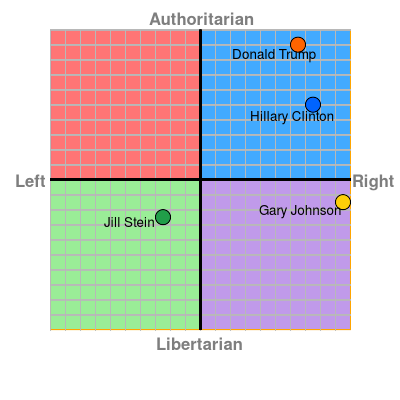
The Political Compass is a tool used by an organization of the same name to label and organize political thought on two dimensions. Instead of Downs' assumption of one political issue (more or less government), the compass uses a square that refers to four policy ideologies: left, right, authoritarian, and libertarian. It's a tool very similar to the concept proposed by Downs if we continue to assume the spherical political indifference curve. The Political Compass estimates that this election looks a little something like this:
      US Presidential Presidential candidates 2012 including Donald Trump, Jill Stein, Gary Johnson and Hillary Clinton
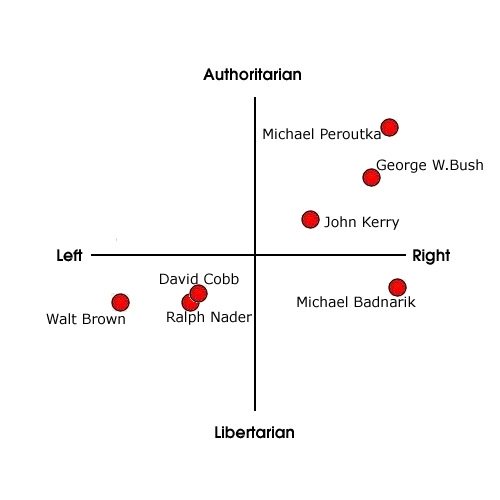
If we assume a two party system with Clinton and Trump, a uniform distribution of ideologies and complete adherence to rational voting would see Clinton with almost 75% of the popular vote. Much more likely, however, is a very different distribution of voters with relatively few people outside the top right corner. What I find interesting is the movement of leading democratic candidates more towards the upper right side of the upper right quadrant. For instance, this is the compass in 2004:
US presidential candidates 2004 including David Cobb, Walt Brown, Ralph Nader, Michael Badnarik, John Kerry, George W. Bush, Michael Peroutka
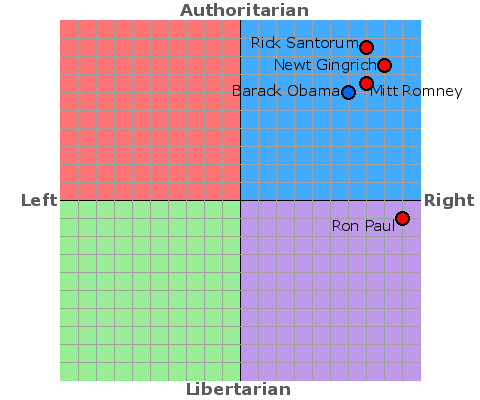
In 2004, John Kerry was much closer to the central point between left, right, authoritarian, and libertarian. Barack Obama's bid in 2012 saw a similar position on the chart but in 2012, Obama's policies stances were incredibly close to Romney's: 

US Presidential Presidential candidates 2012 including Rick Santorum, Newt Gingrich, Barack Obama, Mitt Romney, Ron Paul

According to Downs' theory, this movement makes complete sense since Obama is able to capture more voters by moving closer to Romney. This year looks like the hot dog stand equilibrium point because Obama and Romney are so close. These illustrations further support Downs' assumption of spatial mobility since the Democratic party has made substantial movements around the political spectrum. 

Overall Downs' theory has some predictive power for political movements but with a different candidates every four or eight years, consistent positions are rare unless candidates fully buy into a party platform. Further inquiry into the dynamics of voting in the United States might include a stab at creating a voter distribution on the maps shown above but this post is already way too long. 


Friday, September 30

If the Cold War Was a Prisoner’s Dilemma, We’d All Be Dead


The other day, I was reading for another class about the Cold War and the nuclear arms race. And it got me thinking – if the conditions were different, could we, the United States, and/or the USSR have been decimated by nuclear airstrikes 30 years ago? I investigated this possibility by first developing a set of relatively unrealistic starting assumptions (in classic Tiebout fashion):

1. Assume that the scenario is a “game” with two players, USA and USSR, who are faced with two choices, to launch a nuclear airstrike against the opposing player or to not.

2. Assume that these choices are made simultaneously and with no knowledge of the opposing player’s decision. (It might be helpful to think of a tense diplomatic situation in which communication lines have broken down.)

3. Assume that both players are made better off by the destruction of the opposing player. Through this assumption, we are ignoring geopolitical, economic, and other external factors that may influence the preferences of the two players.

4. Assume that a first strike from either the USA or the USSR would preclude the defending country from launching a second strike. In other words, if the USSR attacked the USA first, the USA would be unable (due to the destruction of its nuclear arsenal or otherwise) to retaliate with an attack of its own.


Following these assumptions, we would see something like the table above. If neither player chooses to strike, both players will have 50 utils; conversely, if both strike, they will be at 0 utils. If one player strikes while the other does not strike, the former will have 100 utils and the latter will have 0 utils.

In the above game, the dominant strategy of both players is to strike. Recall that a player’s dominant strategy is his optimal strategy no matter what the other player does. For both players, the outcomes for not striking are 50 and 0, while the outcomes for striking are 100 and 0. Because the expected payoff for striking is higher than for not striking, both players will choose to launch a nuclear airstrike against the opposing player and will end up at the Pareto-inefficient, dominant-strategy equilibrium at (0,0).

Thankfully, this Prisoner’s Dilemma was not the reality of the Cold War. First and foremost, the policy of mutual deterrence provided strong disincentives for the USA and USSR to attack each other. In Assumption 4, I assumed that a country that was attacked would not be able to retaliate; however, this was not the case in the Cold War. Mutual deterrence was based on the idea that any nuclear attack from one country against the other would provoke an equally forceful attack from the “defending” country. In other words, a country would be deterred from attacking due to the inevitable counterattack they would face.

“Relaxing” other assumptions also reveals mechanisms working against the powers attacking each other. Regarding Assumption 1, countries were able to avail themselves of non-nuclear or non-military strategies, such as economics sanctions. Regarding Assumption 2, diplomacy and communication between the two powers frequently defused tense situations. Regarding Assumption 3, a nuclear airstrike from one country against another would trigger a series of alliances that would almost certainly make the attacking country worse off.

Basically, mutual deterrence, along with other disincentives and alternative solutions, helped to stave off a nuclear war. Thank God the Cold War wasn’t a Prisoner’s Dilemma.

Thursday, September 29

Coppock's Miscalculation: Tim Tebow's Surprising Optimal Amount of Ignorance

A few weeks ago our discussion of rational ignorance led to us explaining Mr. Coppock's poor spelling and Floyd "Money" Mayweather's illiteracy. Our most esteemed professor remarked that Tim Tebow was not rational, as he gave up what could have been a prosperous career as a non-quarterback football player to pursue a career in baseball. I'm sure I'm not the only one whose conception of Tebow's rational ignorance saw serious shifting when they heard Tebow hit a home run on his first pitch ever as a professional baseball player.

Don't get too excited--Tebow is currently competing in the most minor of the minor leagues. Nonetheless, this home run sheds considerable light on Tebow's marginal cost and marginal benefit curves with respect to baseball-ignorance. The below graph is a refresher of what the model looks like when plotted. A voter faces a marginal cost and marginal benefit to educating his or herself about the issue of, say, healthcare. Wherever MB = MC, we find their optimal level of ignorance regarding the subject. Professor Coppock faces a plot with the same dynamics when choosing to educate himself about the subject of spelling, and Tebow about the "subject" of baseball. Each of them faces massive opportunity costs (the world's best economist can't waste his time ordering silly letters).
  
But somewhere we went wrong in analyzing Tim Tebow's Rational ignorance with respect to baseball. Let's assume for the sake of analysis that we originally assumed Tebow should've stayed on the football field. This would put his i* at or close to zero, as the chart below indicates (remember, this is plotting his rational ignorance with respect to baseball, not football): 

His momentary 1:1 pitch-to-home-run ratio would suggest that Tebow receives far more marginal benefit for becoming less ignorant about baseball. If this at-bat is any indication of the future, he should be way up near 100% knowledge!

My favorite part about this analysis is that you can completely flip the logic around with respect to football. The hype around Tebow when he graduated was immense. When he was selected as a first round draft pick, it was the NFL communicating to the world that they believed his charted ignorance with respect to the subject of football looked like the latter. This doesn't necessarily mean that his marginal cost and benefit curves actually look like the former chart, but they likely don't produce an i* as high as the latter. Enjoy fall break everyone!

Sunday, September 25

The Rational Voter Model and the Death Star

After a few lectures and readings, I would hazard a guess that we are reasonably acquainted with the rational voter model of C <P (B) + D. And while this model is frequently applied to voting, the question I have is how much further can we extend it? Voting, after all, is only a single component of civic engagement. While voting might be our most notable means of engaging in our civic responsibilities, The Pew Research Center may be able to offer us some additional perspectives below:
Civic and political involvement in America
None of these individual civic actions might rival the US voting rate of around 59% (as Johnson puts it between 1958-1976), but when combined, they demonstrate that a good 63% of Americans annually do some sort of civic or political task independent of voting. So, could we use the same logic of C < P (B) + D to justify our rate of engagement (or lack thereof) in other activities outside of voting? Well, let’s do a quick run through of the logic using the very real example of a US petition to have the government build a Death Star.

Say that I wanted to sign the petition to build a Death Star. To sign the petition, I would face some sort of cost, such as the time to fill out the form, to sign my name, to risk identity theft, or just sully my wise reputation with an outlandish petition. In order for me to override these costs given my rational nature, I must be receiving some form of benefit. Now the likelihood that my signing this petition would actually changing the government’s plan to construct a Death Star (which some estimate would cost $852,000,000,000,000,000) is extreeeeeeemely small, so let’s say that any benefit I would receive from its building (the P(B) part) essentially goes to zero. Just as in the voting case, we are left with D as the primary variable that would bring me to sign this petition. D could potentially be the obligation I feel to filling my social responsibility to support various petitions, my personal association with this petition and its humorous nature, the expressive value it has about me or my attachment to Star Wars, or just the utility I get from being an engaged citizen. Thus, it’s easy to see how all these potential benefits could outweigh the relatively minor costs of time or risk or exposure that we might face as nearly 35,000 people who signed the petition demonstrated. 

The US government is not building a Death Star, but the fact that our fellow citizens felt civically obligated to form a petition about a rather odd issue can still be seen through an extension of the rational voter model into other civic functions. Issues like protests against racial discrimination, letter writing campaigns to free an inmate, or voicing your opinion on zoning laws seem like they can all be interpreted through a similar framework as voting. Just like voting, we get to balance our perceived ability to change a public outcome, multiplied by the perceived benefits we get if the outcome happens, plus whatever personal feelings/utility we derive from the civic engagement, all in relation to the costs that we face for getting publicly involved. While each different form of engagement has its own unique costs and benefits, it seems like the rational voter model limits the full scope of use for analyzing the actions of citizens. Perhaps we need to move towards a more generic "rational civic engagement model", if for no other reason than so that the Death Star petition can get branded as the economically rational action that it really was.  

Low Turnouts for Such a High State


     Last spring I took a course on Mass Media and American Politics in which we learned about voter turnout.  We discussed and interesting election that occurred in CO in 2013.  What separated this election from others was the fact that it was a recall in which the minority defeated the majority in recalling Colorado Senate President John Morse and Senator Angela Giron, over gun-control issues.  What perplexed me at the time was why this was the case, and it wasn’t until we learned in Professor Coppock’s lecture about the rational voter's decision not to vote did I learn that this was actually a rational outcome for this election. 


     Using the terms we defined in class, it was clear to me that the MB of voting was greater than the MC for the minority, and the MC of voting was greater than the MB for the majority.  Low turnout rates for this vote implied that the proportion of constituents who cared enough to cast their votes in this election was small, yet made up the majority of those who turned out to election.  Therefore, the minority in this instance won, which begs the question—why didn’t the majority turn out to vote?

     As we learned in class, we know that the condition PB + D > C must be met in order for a rational person to vote.

     We discussed in class their MB (PB) is going to be less than MC because of the probability of being the decisive vote, and therefore D must be what makes MB increase. I believe that D for the majority of those against recall was not large enough to make MB>MC because the gun-control laws did not greatly affect them, being that most against the recall were gun-barren democrats.

     I believe that D in this equation for the minority is expressive voting; voters feel that their vote on this matter is representative of the entire platform of gun control advocacy, which gives it a much greater weight than for constituents who have no stake in this national matter.  

     They could also derive their D from a sense of social responsibility, which is largely inflicted by the NRA effectively framing this election in terms of absolutes: either you vote for the recall and are against gun control, or you don’t vote for the recall and are totally fine with your gun control rights being stripped from you.  This was clearly a targeted at a certain demographic, who saw it as a call to defend their values as rural American Republicans in Colorado and responded accordingly to “reinforce their rights to bear arms.”

Market Failure in the Premier League

For all of the American football fans who might be unaware, the English Premier League began its new season in August. The league, which began in 1992, is the highest revenue generating soccer league in the world. The EPL generates about 2.2 billion euros annually. In addition, it is the 4th highest revenue generating professional sports league in the world. The ever-increasing flow of revenue has been exponentially increasing due to massive TV Deals and the rising popularity of the Premier League including amongst American viewers.

This massive increase in revenue has led to huge spending by Premier League clubs especially within the past few years by the top English clubs. This has led to outrageous sums of money being paid for players within the transfer market. Over just this past summer, Premier League clubs spent over 1.1 Billion Euros on player transfers. Roughly 700 million of those purchases were made by only six of the 20 Premier League clubs. The most expensive singing of the bunch (and the world’s most expensive footballer) was Paul Pogba. The Italian club Juventus sold the French midfielder to Premier League juggernaut Manchester United (The soccer equivalent of the New York Yankees) for roughly 100 million euros ($112 million).

World's most expensive footballer and world's worst haircut.

This massive increase in spending has led to negative externalities within the Premier League player transfer market. There is a negative consumption externality associated with the expensive purchases by the elite English clubs.  The consumption of expensive footballers by the top clubs has reduced the well-being of the lower clubs that are unable to afford such players in high quantities. Thus, the social marginal benefit is lower than the private marginal benefit of some of the top clubs in the league such as Manchester City, Manchester United, Chelsea and Arsenal. There is an over-consumption of elite, highly expensive footballers by the top 5-6 clubs. This represents an inefficient allocation of resources because SMB does not equal PMB. This means that very little parity is left within the league as the top clubs continually dominate the table year after year. This will continue on until there is league intervention, such as a salary cap or more revenue sharing, which will push the social marginal benefit back to private marginal benefit and increase parity within the league.

American Idolatry

Unfortunately for me, my parents were big American Idol fans all through my high school years. The negative externalities of their viewing habits are a whole issue in themselves, but what I find fascinating in light of our recent class discussion is the voting habits associated with American Idol and other similar shows. We have established that choosing not to vote is rational because the expected utility derived from doing so is the benefit from your preferred candidate winning multiplied by the probability that you cast a decisive vote. This probability is extremely small, even compared to the likelihood that you die because you were "struck by a dog". For this reason, economists look at more than 45% of the population's decision not to vote in the 2012 presidential election and recognize the rationality of their behavior. No matter how passionate you are about an issue or a candidate, it is extremely unlikely that your vote will have any impact on the election outcome, and thus it is rational for you to choose not to incur the costs of casting a vote.


American Idol's voting system, on the other hand, has extremely low costs of voting and allows voters to express the strength of their preferences by voting multiple times. Individuals who feel strongly about a particular artist can use one or more of the many voting methods available to cast numerous votes. According to Nielson Mobile, the average Idol voter cast 38 text message votes in 2008, from the comfort of his or her living room chair. American Idol has taken further steps to facilitate voting, by doubling the time frame for casting votes, adding more phone lines, and developing a voting app. Admittedly, their system makes it difficult to determine voter turnout, and the data they choose to publicize and announce mentions only vote count, not turnout. While the staggering number of votes cast sounds impressive, the show experienced a consistent decline in viewers during its last decade. Despite the ambiguity surrounding the actual statistics, American Idol clearly recognized and capitalized on the cost-benefit analysis behind voter decisions. While I do not advocate an American voting system in which individuals can vote however many times they want, I know that allowing individuals who have a high stake in the outcome to express the intensity of their feelings in a way that increases their P also increases their incentive to vote. Taking advantage of technology to practically eliminate the costs of voting is effective toward the same end. I hate to admit it, but individuals who are angered by current US statistics and hope to increase voter turnout could definitely take tips from American Idol.

Thursday, September 22

Floyd Mayweather Jr. : Economist Extraordinaire

Whenever we think about economists, the usual names pop into our heads: Ronald Coase, Milton Friedman, John Maynard Keynes, etc. The heavy hitters. However, there is one elite economist that we tend to neglect because, well, he isn't actually an economist. He's a boxer. And his name is Floyd "Money" Mayweather Jr.
Image result for floyd mayweather espn cover

Even though Mayweather has most likely never taken an economics course, he thinks more like an economist than most professional economists (even Professor Coppock) do. That is because Mayweather is effectively illiterate. And it came as no surprise that once the media got a grasp of this information in the days and weeks leading up to the blockbuster Mayweather vs. Pacquiao fight in 2015, they went to town on the poor guy. The situation was only made worse when Mayweather, as shown in this hilarious clip, revealed that he seemingly didn't even know what the word magnitude meant.

But while the general public labeled him as an imbecile, economists probably would have used a much different term to describe him: rational genius. Because in all honesty, why would Floyd Mayweather Jr. bother with reading and writing when he can make $83,000 a second standing in a ring and punching another man in the face? The marginal cost of him improving his literacy involves actions such as training and self-promoting, which in his case, can be worth hundreds of thousands, if not millions of dollars. Like we said in class, it's actually rational to be ignorant to a certain extent. And in Mayweather's case, it's extremely rational to be ignorant.

Therefore, when Mayweather responded to criticism about his grasp on the English language by saying "I would be perfect at reading if that was how I made my living," the media shouldn't have crucified him. They should have given him an honorary degree in Rational Economics. Because while he may not know how to read or write, he sure is good at rationally maximizing his utility function.

So hats off to you Mr. Mayweather! You should be making your way into Mr. Coppock's deck of economist trading cards in no time!

You Don't Want to be an Adam


To an extent, Mueller's explanation of Ferejohn and Fiorina’s 1974 article on the minimax-regret strategist as an explanation for voter turnout rates resonates with me.  I without a doubt value the avoidance of what would be a monumental loss much more highly than any cost I have to pay in order to ensure myself of that security (i.e. walking to Alumni Hall between classes doesn’t seem like a lot of effort expenditure when put into this perspective). 

But what if it isn’t my decision not to vote that causes me regret…but my decision to vote? 

Many British citizens proved themselves poor minimax-regret strategists this past summer – 1.2 milllion of them, to be exact.  In coming to terms with the outcome of Brexit, research suggests that up to 7% of these “Leave” voters would have changed their vote had they known that, in doing so, they would actually interrupt the status quo.  A regretful voter, Adam, told BBC that “I didn’t think it was going to happen.  I didn’t think my vote would matter too much.”  Earlier this year, it was simply checking a box for the thrill of it – but come July and the following months, it was David Cameron’s resignation, the pound taking serious dives, foreboding economic implications, and Brexit champion Boris Johnson leaving the election race.  British voters were ignorant of what they were getting themselves into – and now, they are stuck with a lousy sense of Bregret over an outcome that they can no longer change.   

This leads me to conclude that perhaps my decision to exercise my civic duty could actually cause me to severely regret my decision in the future should my vote wind up actually mattering.  In the same way that I wouldn’t want to be responsible for not electing whomever would have conceivably turned out to be the best candidate, I likewise wouldn’t want to be responsible for electing someone who proved him or herself an awful candidate.  And, in the latter case, not only would I incur the huge cost of regret for causing the downfall of America, but I also would have incurred the cost of voting itself – maybe even skipping my precious lunch hour in the process.  I haven’t put actual valuations on any of these outcomes, but just from a quick theoretical glance-over, it seems to me that a rational voter who is a minimax-regret strategist aware of his or her own knowledge limitations would still choose not to vote – especially in an election as turbulent as 2016’s.  I wonder if Ferejohn and Fiorina would agree. 

Image result for brexit bloody joke
A disillusioned young British voter expresses feelings of Bregret (in a way that is effective but also  makes me wonder why Brits seem to have such an affinity for the word “bloody”). 

Tuesday, September 20

Bush is With Her!

Recently in class we have been discussing whether or not voting is a utility maximizing activity. Using the equation P * B = E[MB], where an individual would only decide to vote if E[MB] > C, it seems reasonable to conclude that the marginal benefit of voting would not exceed the marginal cost of taking time out of one's day to go to the polling station. Since P is the probability that an individual's vote would swing the election, multiplying P * B results in an E[MB] close to zero.

This is why I was surprised when I saw several news articles and posts on Facebook talking about how surprising it is that George H.W. Bush has declared that he plans to vote for Hilary Clinton. Clearly it is meaningful that a former Republican president is planning to vote for the Democratic candidate, however the question that popped into my head was, why would someone so successful waste his precious time going to vote?

For arguments sake, let me say that it takes him 45 minutes to an hour to get to the polling station, vote and return home. His opportunity cost for taking an hour out of his day is much higher than most Americans, since former presidents are often paid to speak, and George H.W. Bush has been known to charge up to $75,000 per speech. Clearly $75,000 is much more than his nearly negligible expected benefit from voting, however he still decides to vote. Obviously there is more going on in his expected benefit equation than just P * B.

The only explanation for why former President Bush would decide his marginal benefit of voting is higher than his marginal cost of voting, is that there is another value in the expected MB equation. We introduced this value in class as D and re-wrote the equation as P * B + D = E[MB]. This makes much more logical sense, because now we can see that his E[MB] actually has a chance to exceed his MC of voting. Whether this D value is representative of his civic duty, social responsibility, belief that he can influence other votes, or any number of reasons, it clearly results in an increase of his E[MB] so that it becomes great than his MC.

As a former president, it is understandable that he would have significant social and internal pressures to vote. He might personally regret his decision not to vote because of the negative example he believes he would have on other voters, or want to avoid the scorn he would receive from his peers for not casting a vote. Whatever D represents in this equation it clearly has a higher value than his MC, which results in him getting out of the house on election day and voting.

This D value influences many Americans to vote, whether it is your mother texting you until you register to vote or receiving an email from Teresa Sullivan talking about our responsibility to vote, I expect to see the majority of us at the polling station this November.

Sunday, September 18

Personality and Prisoner's Dilemma

This week, we learned and read about the Prisoner's Dilemma and interestingly enough, I ran across a Huffington Post article titled 'Envious' May Just Be The Most Common Personality Type. The article discusses a new study out of Spain published on Thursday analyzing volunteers in hypothetical situations in which they could either cooperate with their teammate or act in their own self-interest. The study found most players acted in their own self interest and prevented their teammates from receiving more payoff even if that required diminishing their own earning potential. The study categorized individuals into four basic personality types: optimistic, pessimistic, trustful and envious; 30 percent of people fell in the "envious" category. Based on what we learned in class and this video's great explanation of the Prisoner's Dilemma, the results of the study are not surprising. The defining characteristic of a prisoner's dilemma is that is has a dominant strategy, the optimal strategy for a player no matter what the other player does. Therefore, most of the volunteers in this study realized this dominant strategy and chose not to risk being left with a lower payoff than their counterpart. The study also found personality plays a huge role in what humans choose to do. Envious and pessimistic people chose not to cooperate while optimists and trustful people chose to cooperate and receive a greater payoff in the end.