When I was studying the section on voting rationality for our midterm I kept thinking about examples of the external factor that Johnson calls it "D" in my life. Back in 2009 we had a presidential election in Iran. There were 4 candidates running but the main race was between the famous crazy Mahmoud Ahmadinejad, who was running for the second term, and a reformist Mirhossein Mousavi. If I want to explain this election in a couple of sentences it would be as following. People were tired of Ahmadinejad and all his extreme policies during his first four years so they decided to give Mousavi a chance. In Johnson's paper there is no assumption for cheating on the election, but unfortunately in many countries like Iran this is something that happens in many of the elections. All the polls showed victory for Mousavi but when they announced the results of the election, Ahmadinejad won it by 63% (read an article on why this election was rigged here!). This all lead to protests by millions of Iranians on the streets of Tehran and many other cities in Iran which was a nightmare for the Iranian regime.
I could not vote at then but I was a member of Mousavi's campaign and I tried to persuade all the people who were eligible to vote around me to go and vote for Mousavi because abstention would not make any difference.
Couple of years later when I moved to San Diego I met a few Iranian Ph.D students in UCSD. We were discussing the election that one of them told me the story of the election day for them. As an Iranian citizen you are eligible to vote anywhere in the world if there is a polling location that has been set by the Iranian embassy in that foreign country. There is a 12 hour time difference between Tehran and California. So when these guys went to vote for Mousavi in the election side in San Diego the results of the election were already out in Tehran. So they already knew that their vote is not going to be decisive at all. But they still decided to vote. From Johnson's view this was an irrational move by them. But don't get me wrong, these student were people who won gold and silver medals in the international math olympiad. They sure knew what is the probability for their vote to be decisive. I think this is a great example to show the importance of the external factors "D". Iranians knew if they don't vote they cannot claim that election was rigged in case of any form of cheating. Although Ahmadinejad had the office for the next four years, this election and the protests after it resulted in series of reformations that made the Iranian regime to be more responsive to its citizens needs. This shows how important that "D" can be in Johnson's model. Many people in countries like Iran vote because they look at this action in the long run and not just as a vote that decides the president for the next 4 years.
Thursday, October 20
Citizens United: Tying Elections To Rent-Seeking
As I mentioned briefly toward the end of class, my immediate reaction to Tullock's The Welfare Costs of Tariffs, Monopolies, and Theft was that his analysis of rent-seeking must somehow be relevant to "Citizens United". What I was referring to was the 2010 Supreme Court decision in the case of Citizens United v. Federal Election Comission. The court ruled, in short, that corporations cannot be prohibited from making donations to political campaigns. Corporations are in effect 'persons' and the since the Constitution guarantees freedom of speech, restricting any person's right to make political donations would be stifling a form of free speech. Consequently, about 1/3 of campaign funding comes from PACs (political action comittees) which are typically the entities funneling corporate money into the system.
However, the link between the problems of rent-seeking and elections may not be as directly apparent as the problems found in tariffs, monopolies, and theft (note that political donations are nowhere in Tullock's title). Thus I will attempt to provide a simple example of wealth lost due to activity occurring as a direct result of Citizens United.
The election in 2012 featured President Obama defending his post against former Massachusetts Governor Mitt Romney. President Obama won with the help of massive corporate donors expressing their First Amendment right reaffirmed by Citizens United--that's money that was put to good use. But what about the money that went into Governor Romney's campaign? While his donors presumably weren't throwing money in the pot to get a particular monopoly or tariff, we can assume that firms donating to the campaign perceived there would be beneficial policies resulting from a Romney victory. In other words, these donations are quite similar to gifts and bids that a firm might throw towards securing for itself a monopoly.
The Romney campaign spent 992 million dollars. If we make a rough assumption that 1/3 of this money came from corporations, that means that about 331 million dollars came off of corporate balances sheets to fund a movement that amounted to nothing in terms of realizing policies.......
That's 331 million dollars that banks could have been lending to small businesses. Or 331 million dollars that tech firms could have been investing in research and development to boost productivity. Hell, it could have been 331 million dollars given to local soup kitchens! Without Citizens United, this money may well have been better spent and could have gone into valuable economic activity (dare I say twice that amount if you evened the odds with Obama!?). Thus we can see through this rudimentary example that campaign finance absolutely imposes losses on society, as the funds donated to the loser effectively amount to no return for donors. My instinct tells me that Tullock would want Citizens United repealed so that firms can deploy their resources in more valuable ways.
Labels:
Citizens United,
Obama,
rent-seeking,
Romney,
Tullock
Professor Coppock and Gordon Tullock Crushed My Childhood Dreams In About 30 Minutes
And it's a good thing that he did, because thanks to Public Choice, Professor Coppock, and Gordon Tullock, I now know that having a professional sports team in my small town probably would have wiped the small town of Cresskill, and many other small town across Bergen County, off of the map.
As we learned in class, Gordon Tullock defines rent as "when resources are spent in order to obtain rent which derives from some activity that has negative social value". If my tiny, no-name hometown wanted to become the new home of the Nets, my entire county would have to raise taxes by an exorbitant amount, probably disband countless police forces, get rid of multiple high schools, shut down community centers, and still probably secure a multi-million loan from a much larger city, just to build a stadium in an attempt to entice Mr. Prokhorov to bring his Brooklyn Nets to Bergen County.
Now you might be thinking "but the amount of revenue you generated from the Cresskill Nets would make up for the costs of rent seeking, no problem". WRONG! According to this article, sports teams have almost no economic effect on cities when they move in. Instead, the money that sports team generate is just being taken from other local businesses, so the net gain ends up being zero! As a matter of fact, some sports teams actually have negative effects on their city's economy.
So in the case of my small town in my small county in New Jersey, the money that would be spent trying to get the Nets to move would just end up being a complete loss (thanks to rent seeking), and would also turn countless towns into lawless and uneducated (pardon my language) hell-holes. Much to my disappointment, an NBA team in Bergen County, New Jersey makes absolutely no economic sense.
But should it ever be an option, you better believe I'll be first on line for Cresskill Nets season tickets.
Labels:
byebyeblogposts,
Netstape,
rentseeking
Can Mandatory Voting Preserve Our Democracy?
As Johnson says in Voting, Abstention, and Rational Ignorance, “rational abstention is very damaging to
the theory of democratic self rule.” Johnson mentions that a fine or penalty
could help to solve rational abstention. Democratic countries including Australia
and Belgium have adopted mandatory voting, and although it hasn’t gained much
traction in the US, the idea
has some support, including from President Obama.

Australia’s voting system imposes a $20 fine on
those who fail to show up to the polls and vote without a valid excuse. But, that means you can still show up to the
polling location to avoid the penalty and technically not vote.
This is what Aussies
call an informal ballot, which includes intentionally leaving it blank or
purposely filling it out incorrectly. In the U.S., these actions are free
speech rights and cannot be monitored since it is a secret ballot.
Thus, we previously assumed that voting and showing up at
the polls were one in the same, since no one would rationally endure the costs
of showing up at the polls and then not actually vote. However, with the
mandatory voting framework outlined above, citizens must make two separate
decisions: 1) if they will show up to the polls and 2) if they will cast a
valid ballot.
Let the fine for not showing up to the polls be denoted as F
(in Australia’s case, $20). Mueller
defines C as the personal costs of going to the polls. With mandatory voting,
if F > C, then a voter will simply show up to the poll, and may or may not cast
a valid ballot. Under Mueller’s model, for those who sit out in a voluntary
election, P(B) + D < C must be true, meaning the probability P your vote is the decisive
vote that would give you the benefit B of your candidate winning plus the
utility gained from voting independent from your candidate’s platform is greater
than C. In order for mandatory voting to increase turnout, F must also be
greater than the P(B) + D for those who would have sat out. Thus, a country
can determine the fine for not showing up to the polls to ensure close to 100%
participation.
Thus, if you are already at the polls because F > C, those
would become sunk costs when deciding whether or not to cast a valid ballot.
Presumably the costs of actually voting would then be close to zero. P(B) + D
< 0 would have to be true for a person to not cast a valid ballot. This
means the only way (given F > C) a person would not cast a ballot is if D is
negative (given P(B) is essentially zero).
This is plausible, as people may actually lose utility from voting, or
view casting an invalid ballot as a form of protest that gains them
utility. However, assuming C>0,
compulsory model would surely increase the number of valid votes compared to
the voluntary model.
Additionally, if mandatory voting is in place, it is likely to become ingrained in society that voting is a responsibility, leading to an
increase in the value of civic duty and a greater value of D for citizens once
the system has been implemented. This further ensures that the number of people
voting in a compulsory system would be greater than in a voluntary system.
In Australia, 94% turned out in the 2010 election, and of
those, 6% casted informal
ballots. In comparison with the 2012
U.S. election that had a 57% turnout rate, it shows that voting incentives
matter. A compulsory voting system will minimize rational abstention and can send a message that voting is critical
to ensuring that our democracy is participatory.
Tuesday, October 18
Nice Guys Finish.....First?
When rocky elections arise such as this year’s 2016 presidential election, or more honestly this absolutely preposterous election, you see voting behaviors that you may not see in a “normal” election, such as strategic voting - manipulating your vote preferences in order to affect the outcome, usually in your favor. I read an article from the Washington Post back in March that discussed how this was one of the few elections were we saw a large number of democrats actively voting for Rubio, at the time a potential Republican nominee. One Norfolk, VA strategic voter said "If Rubio is elected I'll gag and oppose just about everything he does, but that's standard democracy -- he'll adequately represent the views of a normal party.” Using the rationale that the Clinton v. Sanders race was safely favoring Hillary already, they chose to use their vote strategically towards Rubio as a way to dilute the potential votes towards the one candidate they absolutely loathed. However, seeing as the presidential election has boiled down to Trump v. Clinton, their actions, while noble, proved futile.
I thought back to this article when we were discussing the different options for voting methods that Mueller defined and and that we tease out in class. I thought back that maybe the reason the Rubio voters weren’t quite enough was because the plurality method was still being used just like it always has in American elections. It may have brought Trump below 50%+1 but he still had the most. The strongest third party candidate that we have now that could be similar to the Rubio/Trump v. Clinton time, is Trump/Johnson v. Clinton/Johnson. What is unique about Johnson’s voter pool is that voters see Johnson as the “least” of the three evils, like Rubio > Trump, and that since the two possible party candidates are so bad, maybe this other Libertarian middle guy is the best way to go. However, unlike Rubio who was a Republican, Johnson is a third party libertarian, so as a result of being a small mix of both ideals, he may be taking votes from both sides.
I decided to do some research and find out as of the time I am writing this, the current % of voters the polls say each candidate has captured. I chose to use the New York Time’s data as they use the culmination of ten different polls all with a variety of respondent types in order to update the current runnings; however I would not be an adequate analyst if I did not say take this with a grain of salt as Freakonomics claims that NYT as well as many other large scale papers lean towards the left . Their most recent poll report states that Hillary is ahead with 46% while Trump trails closely with 40%. Now we all passed 3rd grade math and realize that there is 12% missing. While there is an extensive lift of third parties, write ins, and poll responses of “I don’t know”, I am going to make an assumption like any good economist in order to simplify my argument. I am going to count the remaining 12% as one third party candidate’s support: Johnson. While that 12% seems minuscule next to the party’s percentages, it may be more important than our voting system reveals.
American voters have shown that they are using their votes strategically to secure the best outcome in this race, and therefore may choose to place this median candidate Johnson as a buffer between the two candidates they hold to the extreme, one loved and one loathed. However, most of the voters who choose Johnson as #1 have been shown to be taking the votes mostly from Hillary, closing her margin above Trump. Therefore these strategic placements of votes need to be taken into account when arranging voter preferences.
I am going to show that by our country’s choice to use strategic voting and relying on the Borda Count for the voting process, a third party candidate strategically placed in the middle of both extremes has the greater chance of winning the presidential election than either major party candidate. Here are my results. Johnson would be the Condorcet Winner, and win overall in the Borda count as seen in the excel depiction…just like we saw in the example in class with the convict, the KKK, and the current governor.
In class I questioned immediately why we wouldn’t rely on the “most Condorcet efficient” voting method of Borda count for every major American decision, but this somewhat cleared up my questions. While Johnson may come out with the best overall decision in Borda as well as in a pairwise vote , it also may be subjective to purposeful strategic voting methods, which can be an evil all on its own. Regardless, we can be 99.999% sure this Borda result will not play out in real life, but it seemed like an interesting calculation. Happy voting season everyone.
Labels:
#americaneedstobesingle,
Borda Count,
Clinton,
Johnson,
Trump
Sunday, October 16
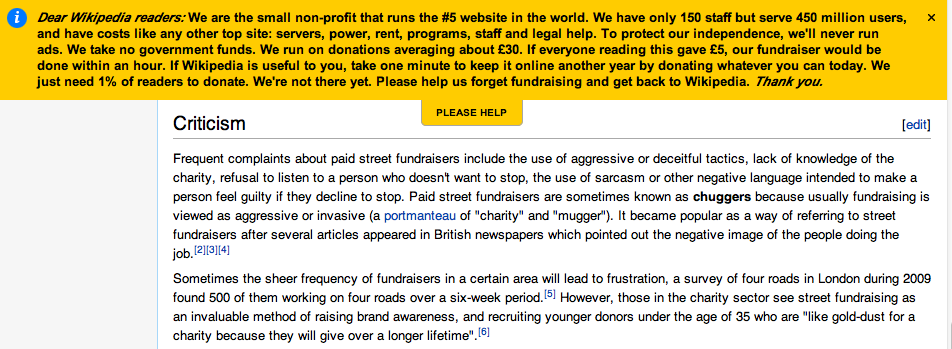
Wikipedia: Every Student's Free Friend
No one likes a free rider. We think of free riders as these
lazy people who will do anything to avoid contributing to group benefits, like
that one guy you had in a group project in high school that just happened to be
“sick” the night before it was due but promised he would contribute by looking
over the rest of the group’s work to make sure it looked good. Gruber says that if "an investment has a personal cost but a common benefit, individuals will underinvest", meaning there are too many free riders for these situations. But is it always the case there are too many?
I thought long
and hard if I would ever sink to that level, and then I realized, I do it every
week and most of us do too! How? We use Wikipedia. Every year, while we’re doing research for
papers for our classes or looking up a definition for a word, we see that big
yellow banner like caution tape cover the top half of our screen, asking for
donations in order to survive.
Without advertising for revenue, it makes sense
to plead with everyone that they will shut down if we don’t donate, right?
Wrong. As it turns out, last year Wikipedia was hoping for $25 million in
donations to survive, but ended up receiving $75 million, 1.5x the site’s
annual expenses. They are raking it in, more and more each year. The craziest
part about this is that Wikipedia page views have gone down by 5.4 billion (18.3 to 12.9 billion) from 2013-2015 and yet had an increase in the number of
donations by almost double (2.5 to 4.9 million donations). Clearly, as poor
college students, it is rational to take advantage of the kindness of others
and continue to not pay for great Wikipedia resources on our future projects
and papers. To me, this can be viewed as
one of the few times that there aren’t enough free riders for a good that gives
non-rivalrous group benefits, even if they only need 1% of readers to donate.
Labels:
free resources,
free rider problem,
Gruber,
Wikipedia
More Thoughts on Voting in America
2016 has confirmed once and for all for both me and probably much of the general population that our system of voting is flawed. Whatever your opinions of Donald Trump and Hillary Clinton are, it cannot be denied that both candidates have a low approval rating among much of the American public - see here for Hillary's ratings and here for Trump's. Both candidates current have an above 50% unfavorable rating, with Trump's sitting over 60% right now.
So how did we get to the point we are today? Many blame our primary system of voting, in that it's a winner take all method - many people don't vote their conscious, rather opting to choose a candidate who has a real shot at winning rather than "throw their vote away" (a concern some of my friends had when deciding whether or not to cast a vote for John Kasich). We discussed alternatives to the majority system of voting/winner take all approach in class at length, where we learned about voting systems that rely on ranking systems to choose the outcome of an election. For example, the Coombs method gets rid of a candidate who has the most votes ranking him last, and the system eliminates candidates in following rounds after, unless there is a candidate with an absolute majority of first place votes. Howard Dean generally advocates for a ranked system of voting in a piece for the NYT, praising Maine for actually implementing it and encouraging states to follow.
Dean's post drew both praise and criticism from many political scientists and economists in the days that followed. One such criticism came from Ilya Shlyakhter who asserted that Howard Dean was mistaking the ranking system for supporting majority rule, as the elimination system reduces candidates to two choices and those who supported the weaker candidates in the preceding rounds will not have their voice heard in runoff between the last two left standing.
So are there any other systems that we didn't discuss but may function even better than the Coombs and Borda count methods? There is a method preferred by some known as the "approval" system of voting, which essentially gives individuals the ability to vote for as many candidates as they want on the ballot. I personally prefer this method to all of the others discussed - as described in this article, a voter can both express their preference towards a third party candidate and at the same time not be concerned that their individual vote could eventually lead to selection of a candidate they would rank last in an elimination method of voting.
Alternative Voting Systems at the Oscars
In our class discussion on alternative voting methods to majority rule, Coppock made a poignant comment: “There are a lot of Republicans out there right now who wish we could have used a Coombs voting system in the primaries.” The Coombs system (as Mueller names it) eliminates candidates, starting with the candidate who has the most last-place votes (and reassigning votes from there), etc. until one candidate has received more than 50% of votes. By placing an emphasis on eliminating “most hated” candidates, the Coombs system seems like it would favor agreeable (perhaps bland?) consensus candidates over divisive ones. Now, in October of 2016, many Americans are in fact wishing that the hated, divisive Donald Trump could have been eliminated earlier to leave room for a more moderate Republican nominee. I am left with two questions: would alternate voting systems really bring this result? and is the more agreeable, moderate result the outcome we want in a political election?
A 2015 article from Vox describes how in 2009 the Academy Awards switched to a Hare (as Mueller names it) voting method for picking Best Picture out of the Best Picture nominees. The Hare method is similar to Coombs but eliminates based on fewest first-place votes. The Academy uses simple popular vote for other categories. The author, calling the Hare method a “messed-up voting process” in the headline, clearly doesn’t think the result is more desirable: "In essence, at every step of the Oscars process, the voting skews results toward bland consensus, rather than smaller, nervier choices.” In the author’s opinion, we’ve been left with a string of winners that are voters’ 2nd and 3rd choice films. For reference, here are recent winners:
2015: Spotlight
2014: Birdman or (The Unexpected Virtue of Ignorance)
2013: 12 Years a Slave
2012: Argo
2011: The Artist
2010: The King’s Speech
2009: The Hurt Locker
-change of voting system-
2008: Slumdog Millionaire
2007: No Country for Old Men
2006: The Departed
2005: Crash
2004: Million Dollar Baby
2003: The Lord of the Rings: The Return of the King
2002: Chicago
2001: A Beautiful Mind
2000: Gladiator
Looking at the list myself, I can see how some of the post-change winners feel like “safe” pics. Spotlight, Argo, The King’s Speech were all well-made, well-told stories without very experimental or controversial styles. However, the author offered another explanation for how the “blandness” could be manifesting itself in the winners. The Artist, Argo, and Birdman are all film about films and actors: "every single one of these films makes Hollywood types, especially actors, feel better about themselves and what they do. The films are all grand, stylish exercises in self-aggrandizement, exactly the sorts of things that will often end up in second or third place on a ranked ballot, and exactly the sorts of things that benefit from this voting system.” If Oscar voters secretly favor movies about movies, but there’s some shame about voting for them in 1st place, then these movies will end up 2nd or 3rd on everyone’s ballot and win 1st place with this voting method.
I can see that for an important political office, a candidate who is agreeable to all, who can unite disagreeing factions, and who doesn’t inspire vicious hate would be a good candidate, maybe even the ideal candidate. But if the psychology of the Vox piece holds up, could this voting system instead pick self-serving, "guilty pleasure" winners? Winners that our consciences tell us not to write in 1st place but who have some alluring quality that pulls us to indulgently vote them 2nd or 3rd? If so, that could be a catastrophic choice for public office.
Your Free Ride Just Tilted
![]() |
| A tilt for my IM Soccer team (Blood Bath & Beyond)
In class, we discussed the free rider problem as being a limitation to the Coase Theorem. People are reluctant to contribute to the payment for goods that bestow group benefits. I started thinking about this last week when my intramural soccer team (Blood Bath & Beyond) used Tilt to pay the registration fee for the fall season. Crowdfunding sites, such as Tilt, reduce the free rider problem by making it feasible to charge all of the members of a group no matter how large it is. The crowdfunding service acts as an umpire, requiring a critical mass to contribute before the good is provided and before any money changes hands.
Online crowdfunding platforms make it easier for the private market to lead to an allocatively efficient distribution of resources. For a group to eliminate the free rider problem altogether, just make the minimum number of payers equal to the size of the group- that way everybody shares the cost, and you minimize the cost per person.
The catch here is that it requires unanimity. If one person in the community doesn’t want to pay for the good, then the good will not be provided. This could potentially lead to high decision-making costs. The time it takes for everyone to make their contribution and for the event to Tilt will tend to increase with the size of the group, just as we saw in Buchanan & Tullock chapter 6, "A Generalized Theory of Constitutions."
|
Labels:
collective action,
free rider problem,
unanimity
Solving the political ignorance problem
As we have come to learn this election cycle, it doesn’t
take a public choice economist to recognize that America has a political ignorance problem. As we have discussed in
class and as the Cato Institute piece points out, incentives simply don’t exist
for many Americans to take the time or spend the resources necessary to educate
themselves on political issues. However, collectively, the social marginal
benefit of an informed electorate is higher than the personal marginal benefit
indicating a serious positive consumption externality in the market for
political information. Given that voters act rationally by remaining ignorant,
this becomes a complex externality to solve.
The Cato piece argues that decentralization of government
and greater delegation of policy to the state and local levels could mitigate
this problem. While such suggestions offer plausible solutions in theory, I
believe there may also exist more market-based solutions that could have
similar effects. Any solution to the problem must increase the personal
marginal benefit of becoming informed—this means either increasing the
probability of one’s level of political knowledge being meaningful or increasing the personal benefit
associated with consuming political information. I believe the latter is a more
realistic goal to pursue.
So what solutions may address this part of the equation? As economist Bryan Caplan of George Mason University also suggests, I believe instituting a voluntary political education
test that offers financial incentives for participating is one possible
creative solution that would increase personal marginal benefit of individual
voters. Along those lines, voters could also be financially incentivized to
take civics and political education classes. The incentives need not be
large—only a small financial reward could have an impact on political behavior,
but the point is that such solutions are the only ways to guarantee a rise in
personal marginal benefits associated with becoming educated. Of course, there
are issues with such solutions as well, but if the goal is to ensure a more
informed electorate, solving this particular positive consumption externality
requires creative solutions such as these that specifically attack the factors
that compose individual PMC curves of voters.
Applying the R.A.M. Voting Inequality to Other Decisions
When applied to voting, the rational agent model can help people decide whether it is worth it to vote. But making other life decisions can be very difficult, how do we make the rest of our decisions? Many people use a "pros and cons" chart, however, there are some problems with this method. Comparing a large list of unimportant "pros" with a small list of significant "cons" can be misleading, not to mention, some reasons are only theoretical possibilities. Examining a calculated cost and benefit can help compare decisions more effectively.
Consider you are a full-time student, deciding whether to pick up a job or internship on the side. Like the benefits, there are uncertain costs here, so we will compare
First we have the benefits:
Consider you are a full-time student, deciding whether to pick up a job or internship on the side. Like the benefits, there are uncertain costs here, so we will compare
Pb(B) + Db and Pc(C) + Dc.
First we have the benefits:
- B: Having a job is a good thing to put on a resume. Therefore, you gain a possible benefit from taking a job, which may be getting a job offer or receiving a higher pay for your experience: we call this B.
- Pb: Since B is uncertain, you will have to multiply this benefit by the probability of this job affecting your chances of getting hired or payed more: we call this Pb.
- Db: In addition, you may receive something else out of this job, for example a wage or self-gratification which you will receive regardless of whether this leads to another job or not: we call this Db.
- C: We will assume that the student's main concerns are academic. Jobs take time, time that could be used to study for classes. Because you are not certain whether you will require that time for studying or, if so, if you will use this time productively, we denote this as C (instead of Dc).
- Pc: We will have to multiply C by the probability that the study time lost by working will significantly affect your grades or desired knowledge gain: this probability is Pc.
- Dc: There will be some added costs you will inquire regardless of whether your studies are affected, including transportation costs, stress from coworkers and/or customers, etc.: this is Db.
How Awful Advice Will Save the Union
He is a man of the people, by the people, and for the people. One who inspires those who find it tougher and tougher to get excited about the world we live in today. Whether you're an overtly racist, hate-mongering wizard of old, or just a woefully misguided economist who finds feelings more compelling than facts, this man has got your back. It's time to come out of the woodwork friends.
A president's choice of his or her closest advisors is among the most crucial, telling decisions they make. Thankfully, Trump's own selections are going to save the U.S. from him. The original tax plan he released was described by Brookings as likely to land the U.S. $10 trillion deeper in debt. This comes as merely one of many derisive dissections of Trump's economic plans from think tanks, leading economists, and even some clever Econ 101 students. Trump's economic advisors, aside from getting a kick out of trade wars and fundamentally misunderstanding how a VAT works, are also uninformed on public choice - particularly the median voter theorem.
Our class learned that, given Down's assumptions, that the median voter will be decisive. As a result, one would expect that the winning candidate will be the one that can secure that voter's support. Prevalent understanding of this in politics can, at least in part, explain the run for the ideological middle one often sees after markedly more polarized primary elections. Trump needs to compete with Hillary for the moderate voters toward the middle in order to win, but either his advisors aren't telling him that or he isn't listening. Each week, Trump has turned up the conservative rhetoric and further solidified his Republican base while further distancing himself from the median voter. If this base were sufficiently large to get Trump past the pole, this strategy would hold more weight. Given that this isn't the case, it's shaky. Trump has even more reason to attempt to move toward the center if we relax the fifth assumption and allow for rational abstention. The delta of Trump voters seems to be extremely high because of a strong distaste for Hillary's platform. The incredible persistence of many of these supporters through scandal after scandal also points toward a higher measure of tolerance (only the one measured as the difference between the utility of the more and less preferred platforms). Altogether, the median voter theorem seems to imply that Trump would do well to run toward the middle and be as measured and moderate as he could in these next few weeks - as he would likely gain significantly more voters than he would lose. Thankfully, the lack of understanding of MVT among Trump advisors will prevent him doing so, and consequently from being able to implement any other economic policies of theirs in the White House.
At the end of the day though, fulfilling your responsibility to vote is the most important. So, don't forget to cast your votes for Barry Goldwater's great grandson on November 28th!
Thursday, October 13
Should Steve Kerr have won the 2015-16 NBA Coach of the Year?
Back in April, when Steve Kerr of the Golden State Warriors won the 2015-2016 NBA Coach of the Year, I was furious. How can a guy who sat out more than half of the NBA regular season (43 games) be the best coach in the league?! I mean, he wasn't even coaching the Warriors when they started off the season 24-0! Other coaches were so much more deserving! What was wrong with the basketball writers of America? WHAT'S WRONG WITH THE NBA'S VOTING-POINT (which I now know to be Borda) SYSTEM!
What a travesty!!!!!!
That's how I felt until last Thursday. I just couldn't buy into the fact that Steve Kerr really deserved the Coach of the Year. Then, at about 11:30 am last Thursday morning, we learned about Condorcet winners. After hearing this, I decided on the following: if Steve Kerr was (definitively) the Condorcet winner when it came to the 2015-2016 Coach of the Year award, I would bury the hatchet.
And after a little bit of research, a whole lot of typing, and a few calculations in Excel, I came to the following conclusion (much to my chagrin): Steve Kerr was the Condorcet winner.
This is how the head to head matchups played out:
(Note: any coach listed explicitly on this graph appeared on at least one ballot)
Any red numbers indicate the percentage of times we can guarantee, based on the limited data, that Steve Kerr beats the candidate to the right of the red number, and that happens... always.
Now, one note here: the voters for this award only pick their top three coaches out of a total of 31 (see Luke Walton). Therefore, if neither Kerr nor his opponent in a certain head-to-head matchup occur on a three-person ballot, it is impossible to tell whom would be ranked higher, if a certain voter ranked all coaches from 1-31. So, the roughly 68.4% that we see for "Anyone else" is the amount of times Kerr appeared on the ballots at any position (1 through 3). Given that Kerr appears on 68.4 % of the time and that any coach not explicitly listed above didn't show up at all on any ballots at any position, all we can say is that Kerr definitely wins the head to head against said "no-show" at least 68.4 % of the time.
And, I guess for now, that's good enough for me. And definitely good enough for Nicolas de Condorcet. But just know this Steve Kerr: the only thing that saved you from my everlasting hatred was cold, hard mathematics and economic theory.
So you're on thin ice.
Labels:
Bordacount,
five?,
Joerger4President
Tuesday, October 11
How a Dangerous Man Becomes President
Recently in class we have been discussing the many different systems of voting that often have different end results. Unfortunately, very few of these systems find the Condorcet Winner, otherwise known as the individual who would beat all other candidates in a pair-wise election. During our discussion today, we were using the example of the Louisiana gubernatorial election where one candidate was a convict, the other was the ex-leader of the KKK and the third was the current governor. To us the decision seemed clear, but surprisingly the Louisiana voters knocked out Roemer (the governor) in the first round of voting. Louisiana uses a majority rule system that turns into a run-off if there is no majority winner at first. Professor Coppock estimated the preferences of the voters and as we worked out, Roemer was the Condorcet Winner, even though he didn't have a shot in the actual election.
What struck me during our discussion was how close Louisiana came to electing a poor, if not dangerous choice for governor. As soon as this was brought up, I immediately thought of the presidential election in the Philippines that had taken place earlier this year. The winner, Rodrigo Duterte, claimed, “All of you who are into drugs, you sons of b***hes, I will really kill you. I have no patience, I have no middle ground, either you kill me or I will kill you idiots”, called Pope Francis "a son of a whore" and talked lightly about the 1989 gang rape of an Australian missionary. Clearly this man is unfit to be the president of any country, yet he somehow won by a large margin of 38.6% of votes to 23.4% for the runner up. The question circling in my head is, if the Philippines had been using something like the Borda System, would this madman have become president?
Currently, the Phillipines use a plurality voting system, where the individual who receives the most votes is the winner. Duterte received nearly 16 million votes, while the runner up only tallied 9.7 million. Although Duterte was the winner under this system, it is hard to imagine him winning under another voting system. With such radical views and statements, he certainly has alienated a large portion of the eligible voters.
For this example I used a Borda voting system, where the candidates get points based on their ranking. Clearly this shows a much different outcome for the election where Duterte (A) loses to Manuel Roxas (B) by a wide margin. In the long run, this might actually have been a better outcome for the Filipino people, but since they use a plurality system we must instead wait to see what terrifying policy Duterte has planned next.
Labels:
Borda System,
Duterte,
Phillipines,
Plurality
Monday, October 10
How Do You Like Our Doctrine?
Downs’
argument in "The Statics and Dynamics of Party Ideologies" that parties formulate policies in order to win elections rather than
win elections in order to formulate policies is an unsettling one to say the
least. Who wants to entertain the
possibility that our democratic system, the best in the world, allows for such
self-serving behavior? My patriotic heart
takes a hit to think of it. It got me
thinking, though, about another deeply emotional and divisive system which is
subject to the median voter: the Protestant Church in America.
Of course, Christian churches are meant to be led divinely; Ephesians 1:22, part of the New Testament Scripture, reads that “God placed all things under [Jesus’] feet and appointed Him to be head over everything for the church.” The Protestant Church is also a human-led, earthly organization, though – and when times and opinions change, its leaders must do what they think is best to survive in a new, dynamic culture. Increasingly, bearing a messy history of non-Biblical and wholly awful exclusion and discrimination, based in pride and a lack of understanding, Protestant Churches are now acting upon the belief that church is what you want it to be. Churches develop doctrine in order to attract members, rather than attract members in order to develop doctrine.
Recent trends have caused certain Protestant sects (not going to call anyone out here, we're all just doing our best) to feel as
though they must either make some sort of stance on hot-button social issues, the acceptance of which seem, at the surface level, to conflict with Biblical principles, or face legal
consequences like this case in Massachusetts.
Why is this the case, you ask? I think it has to do with the distribution of American people’s preferences, when faced with two (very simplified) “parties”: Biblical purism and secular subjectivism.
As
preferences tend to peak around a point closer towards the secular side of the
spectrum, churches alter their practices so as to ensure that their congregation
remains at a healthy size. You can’t
have a church without people – and Church leaders would much rather inch closer
to that magical “consensus” point on a few issues than lose members and stay
rooted where it has been located on the spectrum for centuries.
The trajectory Downs saw was that “this center area becomes smaller and smaller as both parties strive to capture the moderate votes; finally the two parties become nearly identical in platforms and actions.” Applying this end to our model, perhaps we should be aware of the ever-thinning line between “Churches” and “social groups with spiritual undertones” – and, because, unlike the government in its universality, we do have the freedom to choose where we go to gain spiritual or social fulfillment, we should honestly ask ourselves if the groups of which we are a part truthfully represent our personal preferences and beliefs or if their leaders are just in it for the numbers.
Subscribe to:
Posts (Atom)